Incendiary Acts Escalate Tensions in West Bank as Settlers Torch Mosques
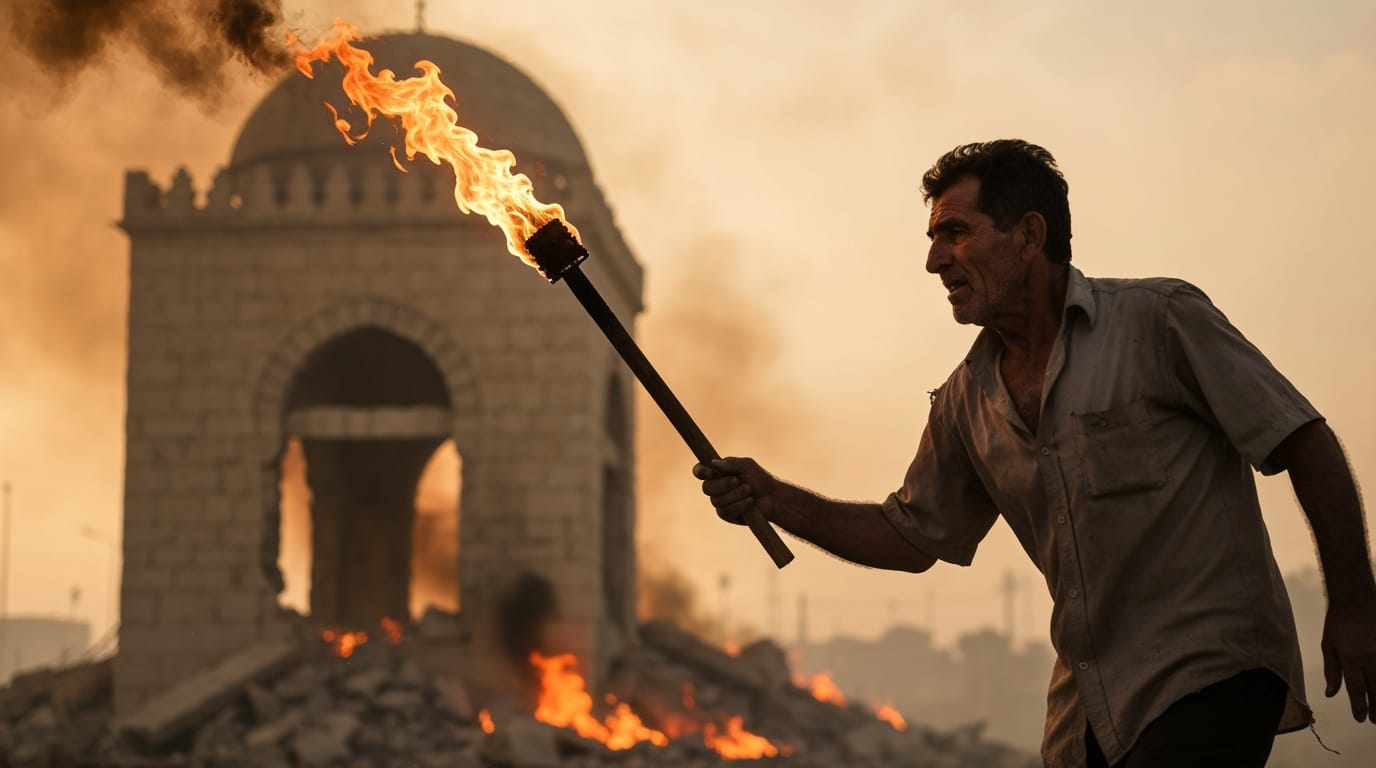
NABLUS, Occupied West Bank – In a grave escalation of regional tensions, Israeli settlers reportedly torched two mosques in the occupied West Bank overnight Sunday, spraying Hebrew graffiti with messages of revenge. The attacks, targeting religious sites in the villages of Qusra and Kur, followed a weekend of deadly clashes that left six people dead and further inflamed an already volatile situation across the Palestinian territories. The incendiary acts have drawn immediate condemnation from Palestinian authorities and reignited concerns over unchecked settler violence and its potential to plunge the region into deeper conflict.
Recent Incidents Fuel Cycle of Retaliation
The latest acts of arson unfolded in the pre-dawn hours of Sunday, July 26, 2026. In the village of Qusra, south of Nablus, settlers reportedly set fire to the Al-Rahma Mosque, which was nearing completion and slated to open in the coming days. The blaze extensively damaged the mosque's entrance, wooden materials, and construction equipment, causing partial collapse of some walls and blackening interior elements. Hebrew graffiti, including phrases such as "Revenge for Benayahu" (referring to an Israeli settler killed in recent clashes) and "Israel will be established with blood," alongside a Star of David, was found defacing the mosque's walls.
Hours later, a similar attack occurred in the village of Kur, near Tulkarem, where another mosque was set ablaze. Hebrew graffiti reading "Jewish blood is not free" was reportedly sprayed on its walls, indicating a similar retaliatory motive. While worshippers managed to extinguish the fire before it spread to the main prayer area, the attempt caused significant concern among residents.
These attacks transpired days after deadly confrontations erupted in the Palestinian village of Tell, southwest of Nablus. On Friday, a clash between armed Israeli settlers and Palestinians resulted in the deaths of four Palestinians and two Israelis, one of whom was identified as Benayahu Mellet, an armed settler from the illegal Havat Gilad settlement. The Israeli military stated that shots were fired by both sides, while Palestinian local authorities asserted that settlers provoked the violence. Following the incident, Israeli forces launched a sweeping crackdown across the West Bank, arresting dozens of Palestinians and sealing major roads, further exacerbating local tensions.
Escalating Settler Violence and the "Price Tag" Phenomenon
The mosque arsons are not isolated incidents but rather the latest manifestations of a growing wave of settler violence that has plagued the occupied West Bank for decades. This pattern of attacks often includes physical assaults, vandalism, arson targeting homes and vehicles, and damage to agricultural lands, frequently carried out with impunity. The motivation behind many of these acts is often attributed to the "price tag" policy, a tactic where extremist settlers retaliate against Palestinians or Israeli security forces in response to actions perceived as detrimental to the settlement movement.
According to Palestinian monitoring bodies, the first half of 2026 witnessed a sharp rise in settler attacks, with the Wall & Colonization Resistance Commission reporting 11,074 attacks by Israeli forces and settlers. The United Nations Office for the Coordination of Humanitarian Affairs (OCHA) has recorded the highest level of settler violence since it began tracking incidents in 2006, with an average of six attacks per day in 2026. This surge in violence has led to significant displacement, with OCHA reporting that 3,535 Palestinians have been displaced due to settler violence or access restrictions since 2023.
Religious sites, both Muslim and Christian, have increasingly become targets. In February 2026, parts of the Abu Bakr Al-Siddiq Mosque in Tell, near Nablus, were set ablaze, and racist slogans were spray-painted on its walls, including the name of the "Price Tag" group. The Palestinian Ministry of Endowments and Religious Affairs stated that 45 mosques were attacked by illegal settlers in 2025 alone. Historically, mosques have been targeted, such as an incident in December 2009 in Yasuf village where a mosque was attacked, holy books burned, and anti-Palestinian slogans scrawled.
Widespread Condemnation and Calls for Accountability
The international community, Palestinian officials, and even some Israeli leaders have condemned the ongoing settler violence. Palestinian officials, including the Ministry of Foreign Affairs and the Higher Fatwa Council, have denounced the mosque attacks as part of a "systematic campaign against places of worship" and a dangerous attempt to transform the political conflict into a religious one. They have urged the international community to take decisive action against what they describe as "settler terrorism," including designating armed settler groups as terrorist organizations and imposing sanctions.
The Israeli military issued a statement condemning the recent mosque attacks, asserting that "security forces strongly condemn incidents of this kind, including harm to religious sites, and will continue to act decisively to maintain security and public order." Investigations are reportedly underway, with the Israeli military stating that troops found graffiti and signs of arson at the Qusra mosque and police investigators would gather evidence. However, Palestinian officials and human rights organizations have repeatedly criticized Israeli authorities for their perceived failure to hold extremist settlers accountable, citing a long record of attacks that often go unpunished.
Concerns have also been raised by international figures. U.S. Secretary of State Marco Rubio, speaking in November 2025 following a separate settler attack, expressed "some concern about events in the West Bank spilling over and creating an effect that could undermine what we're doing in Gaza." Israeli President Isaac Herzog, in the same period, described settler attacks as "shocking and serious," crossing a "red line" and calling for decisive action from all state authorities. Pope Leo, responding to the latest incidents, voiced deep concern and called for a rejection of actions that violate the respect and status quo of holy sites.
Impunity and the Expanding Settlement Enterprise
Critics argue that the surge in settler violence is emboldened by Israel's far-right government and a broader climate of impunity. Human rights and international organizations describe the system of control in the occupied territories as amounting to Israeli apartheid, with systemic violence occurring in this context. Reports suggest that Israeli security forces have, in some instances, accompanied or supported attackers, further raising concerns about enforcement and accountability. A United Nations report found that out of 1,500 killings between 2017 and September 2025, Israeli authorities opened only 112 investigations, resulting in merely one conviction.
The expansion of Israeli settlements, considered illegal under international law, plays a significant role in the escalating tensions. Settlers have reportedly established new outposts beyond existing settlements, often leading to increased friction with Palestinian communities and further encroachments on Palestinian land. Prime Minister Benjamin Netanyahu's government, which opposes Palestinian statehood, has accelerated settlement expansion. Palestinians maintain that the ultimate goal of this violence and expansion is to dislodge them from their lands.
Conclusion: A Precarious Future
The recent torching of mosques in the West Bank underscores the dangerous trajectory of the Israeli-Palestinian conflict, particularly in the occupied territories. These attacks, driven by retaliatory motives and rooted in a broader pattern of settler violence, threaten to ignite further instability and deepen religious animosity. While Israeli officials condemn attacks on religious sites, the persistent criticism regarding the lack of accountability for settler crimes continues to fuel Palestinian despair and international concern. As the cycle of violence persists, the prospects for peace remain increasingly distant, with each act of aggression pushing the region closer to a precipice of unpredictable and devastating consequences.


