India Blazes New Trail with Historic Private Orbital Rocket Launch

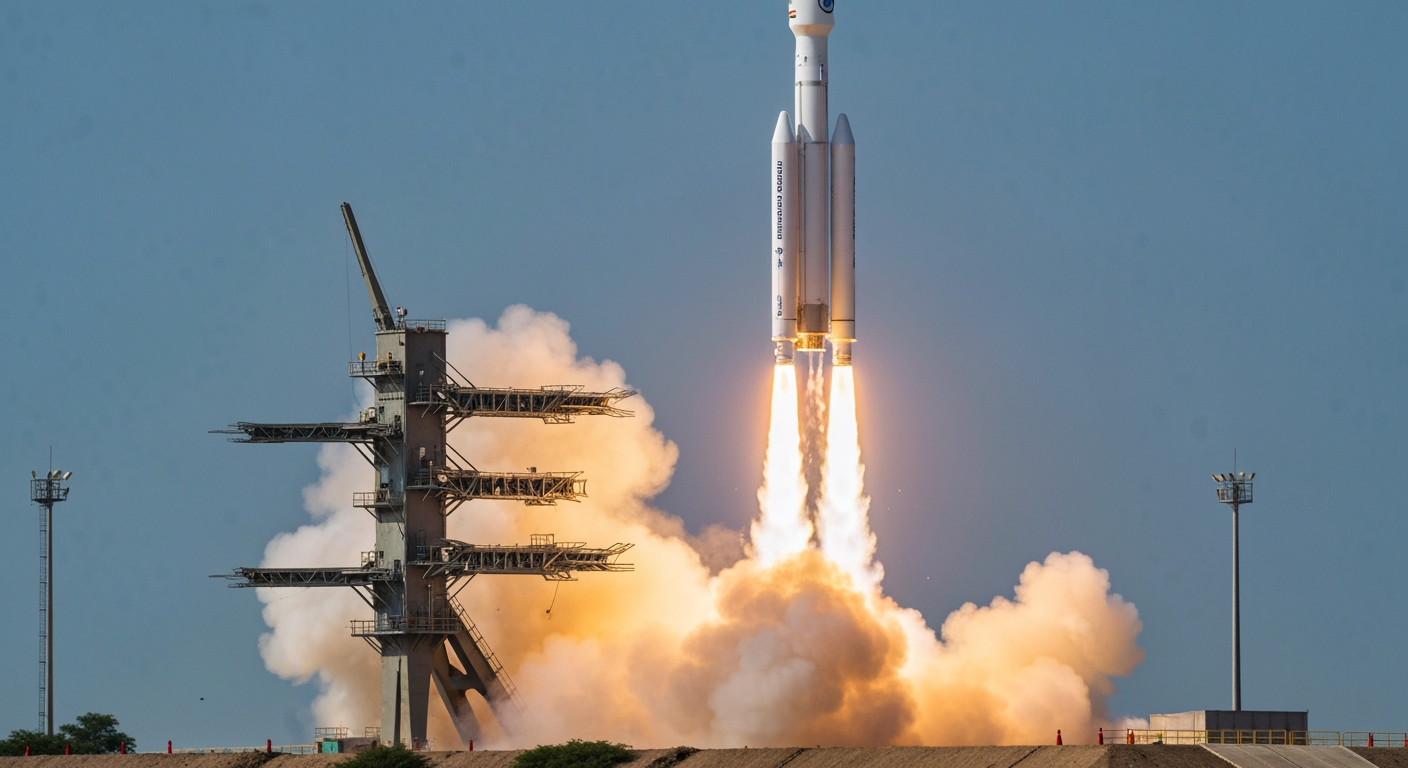
SRIHARIKOTA, India – India's burgeoning private space sector achieved a monumental milestone Saturday with the successful orbital launch of Vikram-1, the nation's first privately developed orbital-class rocket. Blasting off from the Satish Dhawan Space Centre, the mission, dubbed "Aagaman" (Sanskrit for "arrival"), ushers India into an elite club of just three nations boasting private orbital launch capabilities, alongside the United States and China. This triumph by Hyderabad-based Skyroot Aerospace signifies a profound shift in India's space strategy, moving beyond state-led endeavors to embrace a vibrant, commercially driven ecosystem poised for rapid expansion.
A New Dawn for Indian Space
At precisely 12:05 PM Indian Standard Time, the 23-meter-tall Vikram-1 soared skyward, marking a pivotal moment in India's journey to democratize access to space. Developed by Skyroot Aerospace, a company founded in 2018 by former scientists from the Indian Space Research Organisation (ISRO), the launch successfully deployed multiple technology demonstration payloads into a 450-kilometer Low Earth Orbit. Among the diverse cargo were Skyroot's own SCOPE satellite, a technology demonstration from German company DCubed, Grahaa Space's SOLARAS S3, and Cosmoserve Space's Embrace, a robotic arm designed for future space debris capture. The rocket also carried symbolic items, including an 18-karat gold miniature rocket and an artwork composed of lab-grown diamonds, underscoring both artistic and scientific aspirations. The mission, which was initially scheduled for 11:30 AM but experienced a brief, planned pause, concluded with resounding success, validating the rocket's systems and propelling India's private space ambitions into a new era.
From State Monopoly to Private Enterprise
The successful launch of Vikram-1 is the culmination of strategic policy shifts initiated by the Indian government in 2020. Historically, India's space program, spearheaded by the venerable ISRO, operated largely as a state monopoly. While ISRO has achieved remarkable feats, including missions to Mars and the Moon, the growing demand for satellite launches and space-based services necessitated broader participation. Recognizing this, the government enacted reforms to open the space sector to private players, fostering innovation and investment.
A key facilitator in this transition has been the Indian National Space Promotion and Authorisation Centre (IN-SPACe), established as a single-window, independent nodal agency. IN-SPACe's mandate includes authorizing, promoting, and supervising private space activities, as well as providing access to ISRO's extensive facilities and expertise. The Indian Space Policy 2023 further solidified this framework, encouraging private participation across the entire space value chain, from satellite manufacturing to launch services and downstream applications. This supportive ecosystem enabled Skyroot Aerospace, formed by former ISRO scientists, to leverage decades of national space heritage while pursuing agile, commercial development. Skyroot had previously made history in 2022 with its suborbital Vikram-S rocket, demonstrating its capability to reach space. The orbital flight of Vikram-1 represents a significant technological leap from that initial suborbital test.
Engineering Innovation and Global Ambition
Named in honor of Dr. Vikram Sarabhai, widely regarded as the father of India's space program, the Vikram-1 rocket embodies advanced engineering designed for efficiency and reliability. The rocket stands approximately 23 meters tall with a diameter of 1.7 meters and is capable of carrying payloads weighing up to 350 kilograms to Low Earth Orbit. A distinctive feature of Vikram-1 is its ultra-lightweight, high-strength carbon-composite structure, a design choice that significantly reduces the rocket's dead weight and enhances its payload capacity. The vehicle is powered by three solid-fuel stages and a liquid orbital adjustment module, showcasing indigenous advancements in propulsion and materials science.
Skyroot's ambition extends beyond this initial success. The company aims for a high launch cadence, with plans to scale production to one orbital rocket per month from its Hyderabad campuses. This focus on rapid and on-demand launch services positions India as a competitive player in the global small-satellite market, catering to the growing need for dedicated and rideshare launches for Earth observation, communication, scientific research, and technology demonstration missions. The successful orbital insertion of Vikram-1 validates India's capacity not only for state-led missions but also for agile, commercially viable space ventures.
Economic Thrust and Future Outlook
The success of Vikram-1 is a powerful indicator of the economic potential unleashed by India's liberalized space policy. Before 2020, India's space startup ecosystem was nascent, with just a handful of entities. Today, thanks to government reforms and increased private participation, over 400 space startups have emerged, reflecting a dynamic landscape of innovation.
India's space economy, currently valued at approximately $8.4 billion, is projected for exponential growth. Experts anticipate a fivefold expansion, reaching $40-45 billion by 2030, with an ambitious target of $100 billion by 2040. This growth is fueled by increased private capital, a supportive regulatory environment, and robust public-private partnerships. The burgeoning sector is expected to create numerous opportunities across manufacturing, launch services, satellite operations, and various space applications, further cementing India's position as a global hub for space technology and commercial activities. Prime Minister Narendra Modi lauded the achievement, highlighting it as a reflection of the "talent, determination and entrepreneurial spirit of our youth."
Conclusion
The successful orbital launch of Vikram-1 marks a watershed moment for India, signifying not just a technological triumph but a strategic recalibration of its space ambitions. By fostering private innovation and providing a supportive regulatory framework, India is rapidly transitioning from a predominantly state-centric space power to a diversified ecosystem. This historic flight by Skyroot Aerospace is a testament to the nation's engineering prowess and entrepreneurial drive, positioning India as an increasingly influential and competitive force in the global space economy. The "Mission Aagaman" truly heralds the arrival of a new era, promising a future where Indian private entities play a central role in exploring and utilizing the cosmos.
Related Articles


Ratko Mladić, "Butcher of Bosnia" and Convicted War Criminal, Dies at 84
THE HAGUE, Netherlands – Ratko Mladić, the former Bosnian Serb military commander known as the "Butcher of Bosnia" and convicted of genocide, war crimes, and crimes against humanity, has died at the age of 84. Serbian...


Long-Awaited 9/11 Mastermind Trial Set for 2028, Decades After Attacks
GUANTANAMO BAY, Cuba – Nearly a quarter-century after the devastating terror attacks of September 11, 2001, a military judge has finally set a trial date for Khalid Sheikh Mohammed, the alleged mastermind behind the...