India Extends Red Carpet to Putin, Affirming Deep Ties Amidst Heightened Western Scrutiny
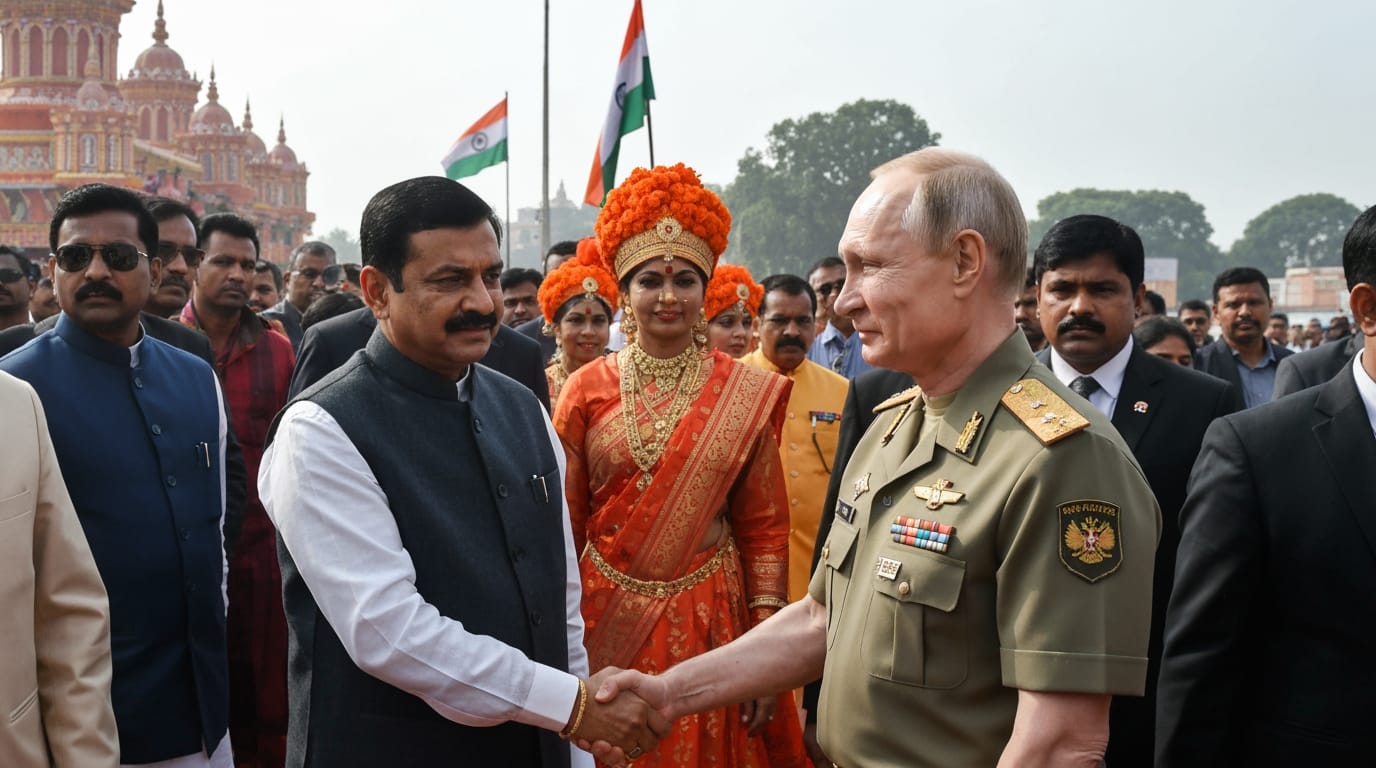
NEW DELHI, India – Russian President Vladimir Putin concluded a high-stakes visit to New Delhi on Friday, December 5, 2025, receiving an elaborate welcome that underscored India's unwavering commitment to its long-standing ally, even as the diplomatic embrace threatened to further strain relations with Western powers. The visit, marking the 23rd India-Russia Annual Summit, saw Prime Minister Narendra Modi break standard protocol to personally greet the Russian leader, a gesture interpreted globally as a powerful affirmation of a bond resilient to international pressures stemming from the ongoing conflict in Ukraine.
The two-day summit, held against a backdrop of intensifying Western calls for India to distance itself from Moscow, reaffirmed the "special and privileged strategic partnership" that has defined India-Russia relations for decades. Discussions spanned a wide array of cooperation, from energy security and ambitious trade targets to critical defense agreements, signaling New Delhi's determination to pursue its strategic autonomy despite mounting geopolitical complexities.
A Grand Welcome and Enduring Alliance
President Putin’s arrival on Thursday, December 4, 2025, was met with a distinctive display of camaraderie. Prime Minister Modi not only received him at the airport, bypassing usual diplomatic customs, but also shared a car ride and a "trademark embrace," setting an immediate tone of warmth and solidarity. The Russian President was later accorded a ceremonial welcome and Guard of Honour at the Rashtrapati Bhavan, India's presidential palace, further highlighting the significance India attaches to this relationship.
In public remarks, both leaders emphasized the steadfast nature of their partnership. Prime Minister Modi likened the India-Russia friendship to a "pole star," navigating through global ups and downs, while President Putin lauded India's resistance to "external pressure" in upholding their shared bond. This mutual praise served as a clear message to international observers that efforts to isolate Russia, particularly since its full-scale invasion of Ukraine in February 2022, have not swayed India from its traditional alignment. The annual bilateral summit, which had been paused following the Ukraine conflict, resumed in 2024 with Prime Minister Modi's visit to Russia, and this reciprocal visit by Putin reinforces the institutionalized nature of their high-level engagements.
Economic Imperatives and the Energy Lifeline
A cornerstone of the reaffirmed partnership centered on economic cooperation, with Russia pledging "uninterrupted shipments" of fuel to India, a crucial assurance for the rapidly growing Indian economy. Energy security has been consistently highlighted as a "strong and important pillar" of bilateral relations. India's reliance on Russian oil surged following the Ukraine conflict, with discounted crude becoming a significant component of its energy imports. In October 2025, India remained the second-largest buyer of Russian oil after China. While recent data indicated a 38% reduction in the value of India's oil imports from Russia in October 2025 compared to the previous year, Russia still accounts for approximately 32% of India's total oil imports by value and volume. This reduction was attributed to a high base effect and an overall decrease in India's oil imports, alongside the impact of U.S. sanctions.
Beyond oil, the two nations solidified an economic cooperation program stretching until 2030, aiming for an ambitious bilateral trade target of $100 billion. Discussions also advanced on a Free Trade Agreement with the Eurasian Economic Union, a Moscow-led economic bloc. India seeks to balance its trade, which is currently heavily skewed in Russia's favor, by boosting its exports of pharmaceuticals, agriculture, and textiles. New agreements also covered sectors such as health, food safety, maritime logistics, and labor mobility, with Russia keen to address its labor shortages by attracting skilled Indian workers.
Defense Pillars and Strategic Autonomy
Defense cooperation continues to be a critical bedrock of the India-Russia partnership. Despite India's ongoing efforts to diversify its arms imports and bolster domestic production, Russia remains its largest defense supplier. During the summit, India reportedly sought faster delivery of the remaining S-400 Triumf surface-to-air missile systems and initiated discussions on the potential purchase of advanced military hardware, including the fifth-generation Su-57 fighter aircraft and S-500 air defense systems. These discussions occurred even as India faced delays in the delivery of some Russian platforms due to Moscow prioritizing its own defense needs.
India's continued reliance on Russian military technology is central to its doctrine of "strategic autonomy," allowing it to maintain an independent foreign policy stance. Indian officials, including Defense Secretary Rajesh Kumar Singh, have openly stated that India's defense cooperation with Russia is long-standing and will not cease, affirming the nation's right to pursue its national interests. This approach is particularly salient given ongoing border tensions with China and the need for a robust defense posture.
The West's Mounting Concerns and India's Balancing Act
India's elaborate welcome for President Putin and the subsequent agreements have inevitably drawn sharp reactions from Western capitals. The United States, in particular, has consistently voiced concerns over India's continued energy and defense ties with Russia, arguing that purchases of Russian oil indirectly finance Moscow's war machine in Ukraine. The Trump administration intensified pressure by imposing an additional 25% tariff on Indian goods, bringing the total to 50%, specifically citing India's discounted Russian oil imports. In October 2025, the U.S. also sanctioned major Russian oil producers, leading some Indian refiners to temporarily halt imports.
European nations have also been critical, with some EU sanction packages even including Indian entities for the first time. This ongoing tension has complicated India's "tightrope walk" to balance its historical ties with Russia against its burgeoning strategic partnerships with the U.S. and Europe. President Putin, in turn, has directly challenged the Western position, questioning why the U.S. is permitted to purchase Russian nuclear fuel while India is chastised for buying oil. "If the U.S. has the right to buy our fuel, why shouldn't India have the same privilege?" Putin remarked.
Navigating Future Challenges and Global Realities
While the recent summit showcased the strength of India-Russia ties, the relationship is not without its challenges. India faces a significant trade deficit with Russia, with its exports lagging considerably behind imports. Delays in Russian defense deliveries and issues concerning the rupee payment mechanism have also been points of friction. Furthermore, India observes with growing concern Russia's deepening dependence on China, fearing that Moscow could become a "junior partner" to Beijing, potentially compromising its neutrality in a future Sino-Indian conflict. The economic benefit from discounted Russian oil, while substantial in previous years, is also reportedly shrinking as discounts narrow and Western sanctions on shipping tighten.
Despite these complexities and the vocal objections from the West, India's foreign policy establishment continues to champion a path of strategic autonomy, asserting its right to maintain diverse partnerships based on national interest rather than aligning with any single bloc. India has maintained a nuanced stance on the Ukraine war, calling for dialogue and a peaceful resolution while largely abstaining from UN resolutions condemning Russia. The recent summit reaffirms that New Delhi views its enduring relationship with Moscow as essential for its defense, energy security, and geopolitical standing, even as it navigates a rapidly evolving global landscape and seeks to cultivate closer ties with Western democracies. The ability of India to sustain this delicate diplomatic balance will profoundly shape its role on the international stage in the years to come.


