India-Indonesia Forge Landmark Missile Deal, Bolstering Strategic Ties in Indo-Pacific
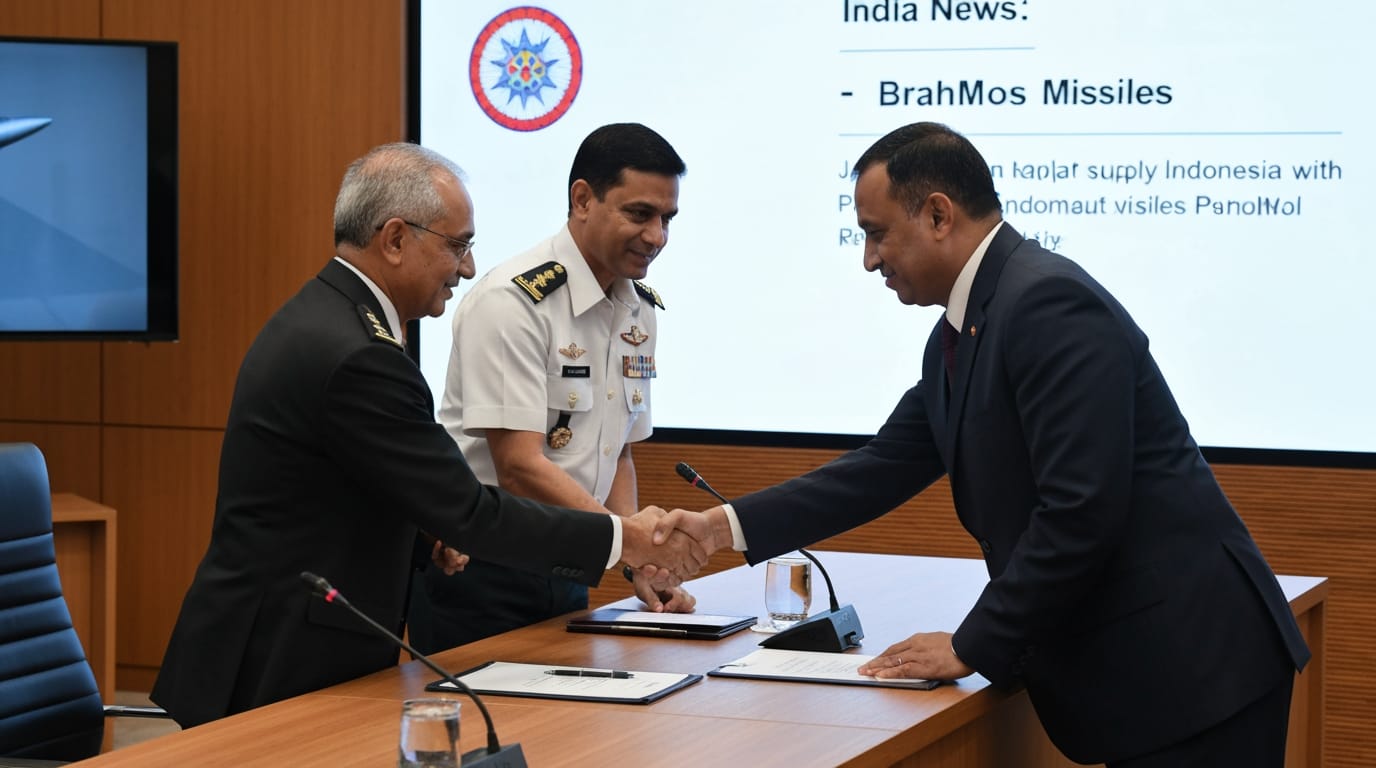
JAKARTA, INDONESIA – India and Indonesia have cemented a significant defense cooperation agreement, with Jakarta officially signing a contract on July 7, 2026, to procure the advanced BrahMos supersonic cruise missile system from India. The landmark deal, announced during Indian Prime Minister Narendra Modi's visit to the Indonesian capital, marks a pivotal moment for both nations, underscoring Indonesia's commitment to modernizing its maritime defense capabilities and highlighting India's emergence as a formidable global defense exporter.
The agreement also includes the supply of Astra air-to-air missiles, further diversifying Indonesia's arsenal. While specific details regarding the number of missiles and the delivery schedule were not immediately released, the contract is reportedly valued at approximately $630 million. This comprehensive package is set to significantly enhance Indonesia's strategic posture in the critical Indo-Pacific region.
A Strengthened Maritime Shield for the Archipelago
Indonesia's decision to acquire the BrahMos system stems from a strategic imperative to reinforce its coastal defense and anti-access/area denial (A2/AD) capabilities across its vast maritime territory. Comprising more than 17,000 islands and situated along some of the world's busiest sea lanes, Indonesia's archipelagic geography necessitates robust measures to safeguard its sovereignty and protect vital maritime chokepoints, including the Malacca, Makassar, Sunda, and Lombok Straits.
The BrahMos, a joint venture between India's Defence Research and Development Organisation (DRDO) and Russia's NPO Mashinostroyeniya, offers a qualitative leap in Indonesia's defense capabilities. The missile's supersonic speed of Mach 2.8 to 3.0 makes it exceedingly difficult to intercept by existing weapon systems, providing a potent deterrent against potential threats. Furthermore, its capability for low-altitude sea-skimming and complex terminal maneuvers enhances its survivability and precision against naval targets.
Discussions leading to the deal indicated interest in both shore-based and ship-mounted versions of the BrahMos, with initial procurements likely focusing on at least one shore-based battery, designed for scalability in future phases. This targeted acquisition is seen as a direct response to increasing tensions in areas such as the North Natuna Sea, where Indonesia has faced challenges to its territorial claims.
India's Ascent as a Global Defense Exporter
For India, this deal represents another significant milestone in its ambitious journey to transform from a major arms importer into a leading defense exporter. Indonesia is now the third nation, following the Philippines and Vietnam, to officially sign an agreement for the BrahMos system, solidifying its position as India's flagship defense export product. The Philippines signed a $375 million deal for shore-based BrahMos batteries in January 2022, with deliveries commencing in 2024, and Vietnam secured a roughly $620 million deal for naval variants in May 2026.
This burgeoning export success aligns with India's "Make in India" initiative, which aims to boost indigenous defense manufacturing and reduce reliance on foreign suppliers. India's defense exports reached a record high of approximately $2.76 billion in 2024-25, further climbing to ₹38,424 crore in the 2025-26 fiscal year. The BrahMos, a jointly developed Indo-Russian weapon system, has become a cornerstone of India's "defense diplomacy," strengthening strategic partnerships across Southeast Asia and the broader Indo-Pacific.
The interest in BrahMos extends beyond Southeast Asia, with countries like Thailand, Malaysia, and the United Arab Emirates also expressing interest, indicating a growing global recognition of India's advanced defense technologies. This strategic shift positions New Delhi as a credible alternative security partner, offering high-tech arms without what some analysts describe as "hegemonic baggage," in a region traditionally dominated by U.S. and Chinese influence.
The Lethality of the BrahMos System
The BrahMos missile is renowned for its exceptional capabilities, making it one of the world's fastest and most potent cruise missiles. It is a two-stage missile, using a solid propellant booster to achieve supersonic speed, followed by a liquid ramjet engine that propels it to speeds of Mach 2.8 to 3.0 during its cruise phase.
With an operational flight range of up to 290 kilometers in its export configuration (compliant with Missile Technology Control Regime limits), the BrahMos can carry a conventional warhead of 200 to 300 kilograms. Its "Fire and Forget" principle, coupled with advanced guidance systems including Inertial Navigation System (INS) and Global Positioning System (GPS/GLONASS), ensures pinpoint accuracy. The missile's stealth technology further reduces its visibility to radar, enhancing its effectiveness in combat scenarios.
The versatility of the BrahMos allows it to be launched from multiple platforms, including land-based launchers, ships, submarines, and even fighter aircraft, providing significant operational flexibility. The system has demonstrated its combat effectiveness during a four-day conflict with Pakistan, where it was reportedly used to strike terrorist bases and military airbases, showcasing its deep penetration capabilities against active air defense systems.
Broader Implications for Regional Security
The Indo-Indonesian BrahMos deal carries significant implications for regional security dynamics. It deepens strategic ties between two of the largest economies in Southeast Asia and reinforces their shared commitment to peace and prosperity in the Indo-Pacific. The enhanced defense cooperation is viewed as a crucial step in maintaining stability amidst intensifying geopolitical competition and concerns over regional instability.
During Prime Minister Modi's visit, both leaders also discussed broader aspects of their comprehensive strategic partnership, including trade, investment, maritime safety, and security cooperation. The focus on strengthening defense and maritime security highlights a concerted effort to foster a more secure and stable Indo-Pacific, where both nations can play a pivotal role. The acquisition of the BrahMos missiles by Indonesia signals a new era of defense collaboration, one that is poised to reshape strategic balances and foster greater self-reliance in the region.


