India-New Zealand Forge New Era: PM Modi's Historic Visit Cementing Decades of Evolving Ties
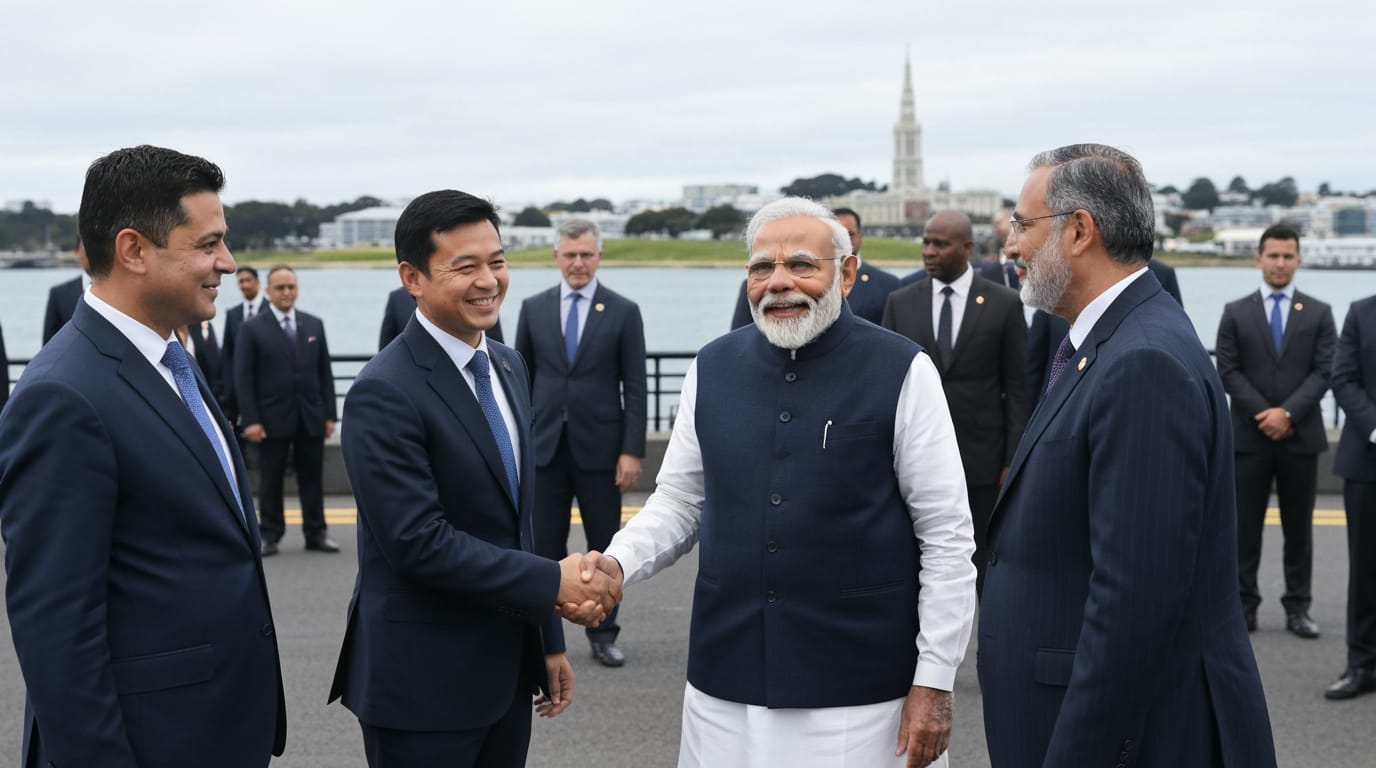
AUCKLAND, New Zealand – Indian Prime Minister Narendra Modi arrived in Auckland today, July 10, 2026, marking a historic and highly anticipated maiden official visit to New Zealand. This pivotal trip is the first by an Indian Prime Minister to the island nation in 40 years, signifying a crucial turning point in bilateral relations that seeks to elevate strategic, economic, and cultural cooperation between the two Commonwealth nations. The visit follows closely on the heels of the landmark Free Trade Agreement (FTA) signed between India and New Zealand in April 2026, setting a robust agenda for discussions aimed at deepening an already strengthening partnership.
Decades in the Making: A Renewed Partnership
The arrival of Prime Minister Modi in New Zealand concludes a four-decade hiatus since an Indian Prime Minister last set foot on New Zealand soil, a significant gap that underscores the magnitude of the current diplomatic engagement. The last such visit was by then-Prime Minister Rajiv Gandhi in 1986. Diplomatic relations between India and New Zealand were formally established in 1952, building on a shared legacy as former British Empire territories, common law practices, and democratic traditions. Despite geographical distances, the two countries have maintained cordial ties, rooted in mutual respect and shared aspirations for economic development and prosperity.
New Zealand has consistently prioritized enhancing its engagement with India, recognizing India's burgeoning economy and growing geopolitical influence. Initiatives such as New Zealand's "Opening Doors to India" policy in 2011 and the "NZ Inc. India Strategy" aimed to position India as a core trade, economic, and political partner. This concerted effort culminated in recent high-level exchanges, notably New Zealand Prime Minister Christopher Luxon's visit to India in March 2025. During that trip, both leaders officially launched negotiations for a Comprehensive Free Trade Agreement and signed a bilateral defense agreement, laying crucial groundwork for the present visit. This proactive diplomacy from both sides has set the stage for what is anticipated to be a transformative phase in their relationship.
The Economic Nexus: Fueling Growth Through Free Trade
At the heart of Prime Minister Modi's visit is the recently inked India-New Zealand Free Trade Agreement, a testament to both nations' commitment to significantly boosting economic ties. Signed in April 2026, the FTA is projected to unlock substantial economic opportunities, driving exports, fostering job creation, and stimulating stronger economic growth. The agreement is particularly advantageous for New Zealand, as it aims to eliminate tariffs on 95% of its exports to India, with 57% becoming tariff-free immediately upon implementation. Concurrently, the FTA provides duty-free access for all Indian exports to New Zealand, strengthening India's foothold in a high-income Pacific market.
Beyond tariff reductions, the FTA includes a significant commitment of USD 20 billion in investment from New Zealand into India over the next 15 years, signaling long-term economic confidence and cooperation. Bilateral merchandise trade between the two nations stood at approximately USD 1.3 billion in 2024-25, with total trade in goods and services reaching around USD 2.4 billion. India primarily imports wool, iron and steel, fruits, and nuts from New Zealand, while New Zealand receives Indian pharmaceuticals, machinery, and textiles. This economic partnership is crucial for New Zealand's ambition to diversify its trade relationships and tap into India's market of 1.4 billion people, one of the world's largest and fastest-growing economies. However, the FTA has not been without scrutiny; an ongoing political debate in New Zealand, including criticism from New Zealand First leader Winston Peters, has highlighted concerns over immigration-related provisions linked to the agreement. Despite these discussions, officials from both sides remain optimistic about the FTA's potential to foster a robust and mutually beneficial economic relationship.
Strategic Horizon: Indo-Pacific Vision and Regional Security
Prime Minister Modi's visit to New Zealand is not an isolated event but the final leg of a crucial three-nation tour that included Indonesia and Australia. This itinerary underscores India's deepened commitment to its "Act East" Policy and the "MAHASAGAR" Vision, an institutional blueprint for fostering security, stability, and inclusive growth across the maritime domain. Through these engagements, India aims to reinforce its commitment to a free, open, and inclusive Indo-Pacific region, a strategic objective shared by New Zealand.
The discussions between Prime Minister Modi and his New Zealand counterpart, Christopher Luxon, are expected to cover enhanced strategic cooperation and maritime security. Both nations emphasize adherence to a rules-based international order and collaborate within various international organizations, including the United Nations and the Commonwealth. In an increasingly complex global environment, New Zealand views a close partnership with India as vital for regional stability and for diversifying its strategic alliances. The previously signed bilateral defense agreement during Prime Minister Luxon's 2025 visit further solidifies the foundation for increased collaboration in this critical area. India's growing geopolitical influence and its focus on the Indo-Pacific strategy resonate with New Zealand's own interests in the region, creating a strong alignment for future cooperation.
Bridges of Culture and Community: Deepening People-to-People Ties
Beyond high-level diplomacy and economic agreements, the visit also celebrates the profound people-to-people connections that bind India and New Zealand. New Zealand is home to a vibrant and rapidly growing Indian diaspora, comprising approximately 300,000 individuals, who account for around 6% of the country's population. This community is deeply integrated into New Zealand society, contributing significantly across various sectors including business, technology, health, and education.
Prime Minister Modi is scheduled to interact with business and sports personalities in Auckland and address a large gathering of the Indian community, acknowledging their vital role in strengthening bilateral ties. Education links are particularly strong, with approximately 8,000 Indian students currently pursuing higher education in New Zealand in diverse fields such as information technology, hospitality, and engineering. Tourism and sports, especially cricket and hockey, also serve as significant avenues for cultural exchange and fostering goodwill. The strengthening relationship is anticipated to create more long-term opportunities for both nations and their people, further building on existing cooperation in areas like technology, horticulture, and forestry.
Conclusion
Prime Minister Narendra Modi's maiden official visit to New Zealand marks a truly historic moment, signaling a robust re-engagement after a four-decade hiatus. The visit, anchored by the recently signed Free Trade Agreement, promises to inject fresh momentum into bilateral relations, propelling cooperation across economic, strategic, and cultural spheres. As both nations seek to navigate a dynamic global landscape, this high-profile engagement underscores a mutual desire to foster prosperity, enhance regional security, and deepen the enduring bonds between their peoples. The outcomes of this visit are poised to significantly strengthen the India-New Zealand partnership, laying a collaborative foundation for decades to come.