India’s Youth-Led 'Cockroach' Movement Sets Sights on Election Chief Amid Voter Roll Turmoil
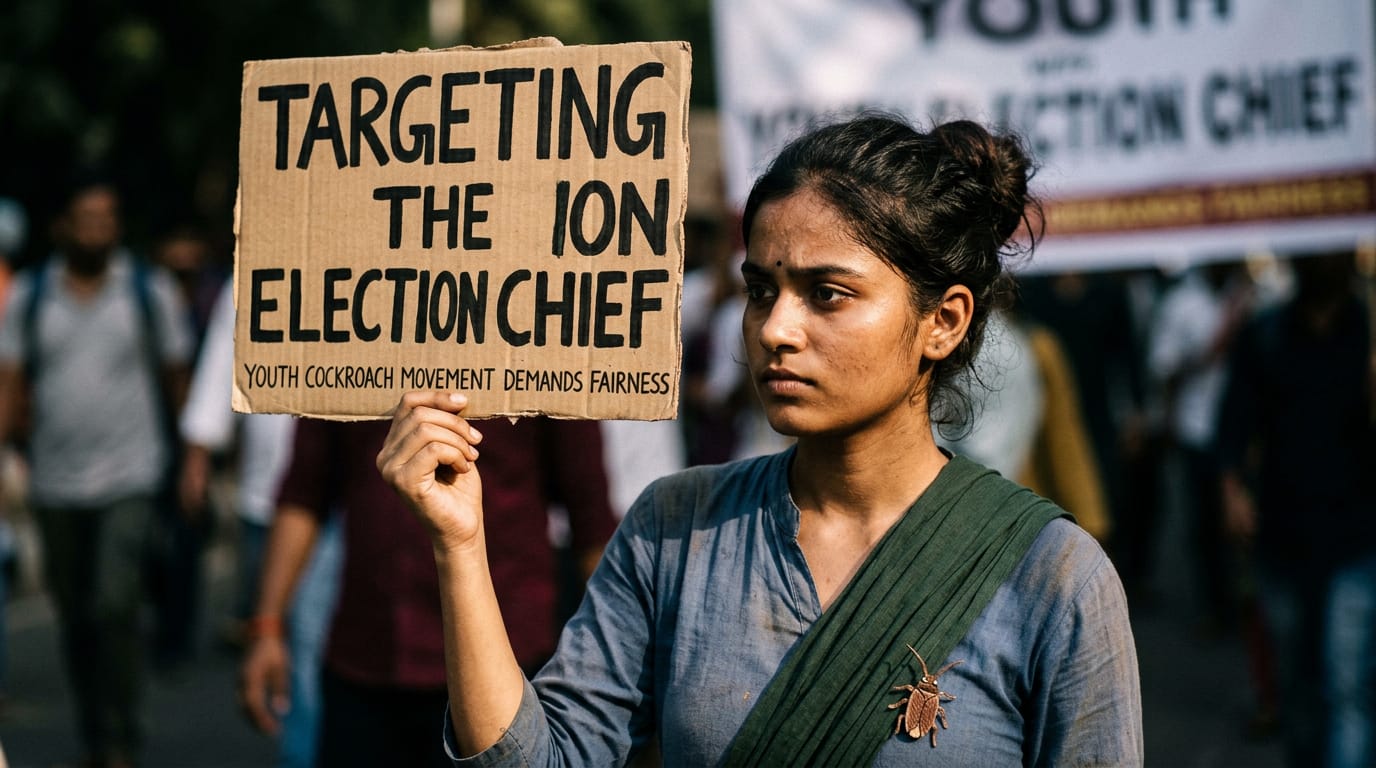
A fast-growing youth movement that previously rattled the government by forcing a cabinet minister from office has turned its attention to a new target: India’s chief election commissioner. Leaders of the Cockroach Janta Party, known informally as the cockroach movement, are demanding the immediate resignation of Chief Election Commissioner Gyanesh Kumar, accusing the country’s election watchdog of disenfranchising voters through opaque revisions to electoral lists.
The ultimatum, accompanied by warnings of nationwide sit-ins and rallies beginning in major metropolitan hubs, follows a media investigation revealing internal rifts within the three-member Election Commission of India. For India’s Generation Z activists, the confrontation marks an ambitious pivot from campus grievances and examination scandals toward the foundational mechanics of Indian democracy.
Internal Friction at the Poll Body
The immediate trigger for the movement’s mobilization was an investigative report disclosing deep division inside the country’s top polling authority. According to records reported by domestic media, two of the three commissioners, Sukhbir Singh Sandhu and Vivek Joshi, repeatedly challenged procedural maneuvers concerning the Special Intensive Revision of voter rolls. The commissioners reportedly logged at least 14 formal objections over a 10-month period, raising alarms that significant decisions—ranging from voter registrations and deletions to data handling—were being executed without their knowledge or formal consent. In one written objection, actions were described as unauthorized and outside institutional norms.
The report fueled longstanding grievances raised by opposition figures, who allege that millions of legitimate voters have seen their names quietly removed while new entries have been incorporated without proper on-the-ground verification. Critics contend that these revisions disproportionately undermine marginal communities and provide an unfair advantage to the governing Bharatiya Janata Party. Both the governing party and election authorities have pushed back against these assertions, stating that vigorous debates are standard practice in any collective governing body and that all electoral measures comply fully with the law.
From Satirical Meme to Street Power
The confrontation represents the latest chapter in the rapid evolution of the Cockroach Janta Party. The group originated in May after controversial judicial remarks surfaced in which critics and unemployed young people were referred to as parasites and cockroaches. Embracing the pejorative label as a badge of resilience and satire, young people transformed the moniker into an online campaign that quickly spread across social networks.
The internet campaign soon shifted into tangible street agitation. Over the summer, the group orchestrated massive student rallies across several cities over irregularities and leaks in nationwide entrance examinations. The prolonged pressure culminated in July with the resignation of the country’s education minister, delivering a rare political concession driven entirely by youth mobilizers. Following that victory, members conducted citizen audits of government school infrastructure, highlighting staff shortages and deficient amenities to keep authorities accountable.
Expanding Demands for Electoral Reform
The group's leadership is seeking much more than a symbolic exit. Beyond calling for the commissioner’s immediate removal and potential legal proceedings, the movement is pressing for an immediate halt to ongoing voter roll revisions, the suspension of upcoming polls until the rolls can be independently audited, and the repeal of a controversial 2023 law that altered how election commissioners are selected.
That 2023 legislation, which removed the chief justice from the selection panel and gave the executive branch greater leverage over appointments, has long drawn fire from civil liberties groups and legal scholars who view it as an erosion of the commission’s autonomy. By adopting this institutional issue, the youth group has aligned itself with broader democratic concerns, seeking to protect the fundamental right of ordinary citizens to cast a ballot.
Balancing Perspectives Amid Rising Tensions
The clash over the election machinery highlights growing friction between state institutions and young citizens demanding transparency. Ruling party representatives maintain that the electoral apparatus remains neutral, robust, and beyond reproach, accusing opposition factions of using street groups to discredit an institution simply because they struggle to win at the ballot box. Election officials continue to emphasize that disagreements between commissioners represent normal internal dialogue, not constitutional wrongdoing.
For the youth organizers, however, the dispute over voter rolls touches the core of their political future. Activists argue that young job seekers and university students are often the first to face practical disenfranchisement when migration for work or study complicates residency requirements, making voter roll integrity a matter of personal relevance.
The Path Forward
With local authorities in key cities already moving to impose restrictions on assembly, the movement faces a test of whether it can maintain its momentum beyond digital networks and campus concerns. Previous waves of student activism demonstrated an ability to command national attention and force executive accountability. By challenging the custodian of the country’s electoral process, India’s cockroach movement has escalated its campaign from specific socio-economic grievances to a high-stakes test of the nation's institutional transparency and democratic trust.