Indian Families Demand Justice and Compensation After US Strike Kills Sailors
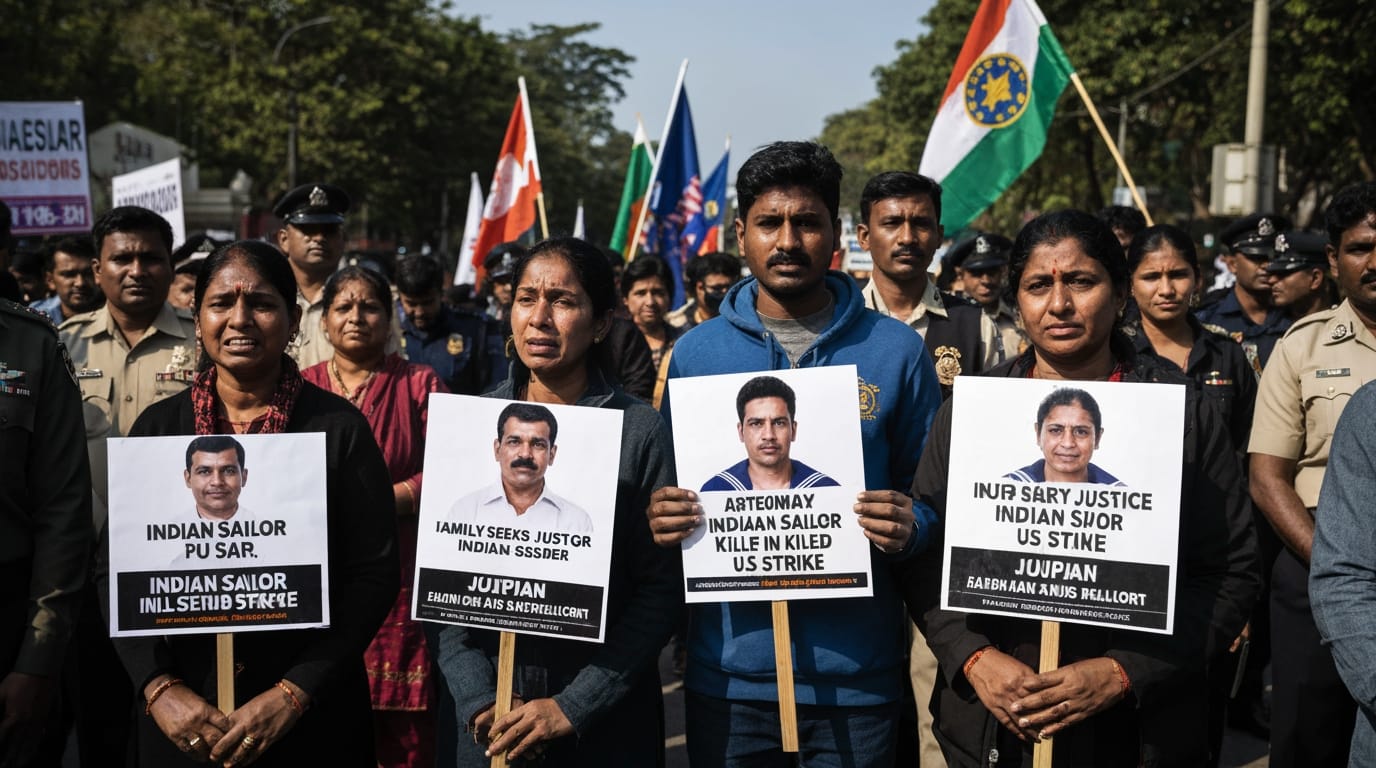
Deoria, India – Families of three Indian seafarers killed in a U.S. military strike on a commercial vessel near the Gulf of Oman are demanding accountability and substantial compensation, thrusting the grim realities of maritime conflict into the global spotlight. The incident, which occurred on June 10, 2026, saw the Palau-flagged oil tanker MT Settebello hit by U.S. forces, resulting in the deaths of Shivanand Chaurasiya, Patnala Suresh, and Aditya Sharma. Their grieving relatives, many of whom relied on the sailors as primary breadwinners, are calling on both the U.S. and Indian governments to ensure justice and provide long-term support.
The tragedy has sparked outrage and a fervent plea for investigation into the precise circumstances that led to the deadly strike, particularly as the U.S. military claims the vessel disregarded numerous warnings, a contention strongly rejected by an Indian seafarers' union.
Deadly Encounter in the Gulf of Oman
The incident unfolded on June 10, 2026, when the MT Settebello, an oil tanker flying the Palau flag, was struck by U.S. military forces near the Oman coast. The U.S. military stated its forces targeted the ship's engine room to disable it, alleging that the vessel had ignored approximately 60 warnings prior to the strike. However, this claim has been met with skepticism and outright rejection by a major Indian seafarers' union, which argued that the crew would have had no rational reason to deliberately ignore or challenge American forces. The powerful explosion and subsequent fire in the engine room were so intense that survivors described the event as terrifying, making rescue efforts difficult. Of the 24 Indian crew members aboard, 21 were rescued, but three — Shivanand Chaurasiya, Patnala Suresh, and Aditya Sharma — perished in the attack. Another Indian seafarer, Nishanth Uirthanathan, also reportedly died from medical complications in the Persian Gulf following alleged delays in his medical evacuation, though this death is distinct from the immediate strike fatalities.
A Family's Grief and Demand for Answers
The loss of Shivanand Chaurasiya, Patnala Suresh, and Aditya Sharma has left an irreplaceable void in their families, many of whom regarded the deceased as their sole source of income. Shivanand Chaurasiya, an engine fitter, was cremated in his native Surauli village in Uttar Pradesh after his body was repatriated from Muscat. His family, including his parents, wife, and brother, initially refused to perform the last rites, demanding justice and substantial aid from the government. They called for an ex gratia payment of Rs 1 crore each from both the central and state governments, a government job for a dependent, and "martyr status" for Chaurasiya. The family eventually agreed to proceed with the funeral after local officials received their memorandum and assured them of necessary action.
Rampravesh Chaurasiya, Shivanand's father, directly appealed to the U.S. government to take responsibility for the incident and urged the Indian government to press for compensation for all three mariners killed. Similarly, Rajesh Sharma, the father of cadet Aditya Sharma, demanded a thorough investigation not only into the U.S. attack but also into the ship's management, alleging that the vessel continued sailing towards the Strait of Hormuz despite warnings. He stressed the profound personal loss, stating, "I had only one son. I have no other son, no daughter now. My aim is to provide justice to Aditya Sharma." The families collectively called for "not less than $5 million" in compensation for each of the three seafarers killed in the attack, as well as for Nishanth Uirthanathan.
Diplomatic Pressure and Maritime Risks
The incident has swiftly escalated into a matter of diplomatic concern, with India reportedly lodging a strong protest following the deaths of its citizens. The families and seafarers' unions are urging the international community not to forget the victims and to hold the United States accountable for actions that resulted in the loss of innocent lives, emphasizing that the seafarers had no involvement in regional conflicts. The demand for a comprehensive investigation extends beyond the military strike itself, seeking scrutiny of the ship's operational decisions.
This tragedy underscores the severe risks faced by Indian seafarers who work in volatile international waters. India boasts one of the world's largest maritime workforces, with thousands of sailors employed on commercial vessels globally. Their invaluable contributions to global trade are often overlooked until such catastrophic events occur. The Ministry of External Affairs and maritime authorities in India have been coordinating efforts regarding the repatriation process and support for the affected families, highlighting the complex logistical and humanitarian challenges involved.
Calls for Accountability and a Safer Future
As the families grapple with their immense loss, their unified voice calls for both immediate compensation and systemic changes to protect those who navigate the world's oceans. The quest for justice for Shivanand Chaurasiya, Patnala Suresh, and Aditya Sharma represents a broader appeal for the safety and recognition of all seafarers. The incident has magnified the vulnerability of neutral commercial shipping amidst geopolitical tensions and naval operations.
The pursuit of accountability for the US strike, coupled with demands for investigations into the ship's management, underscores the complex layers of responsibility in such an incident. The families' insistence on compensation and government support reflects not only their personal devastation but also a collective hope for a future where the lives of seafarers are safeguarded and acknowledged, even in the most perilous global hotspots. The ultimate resolution of this case will likely set a precedent for how international law and humanitarian considerations intersect in the increasingly dangerous waters of maritime trade.


