India's 'Cockroach' Uprising: Can a Satirical Movement Redefine National Protest?
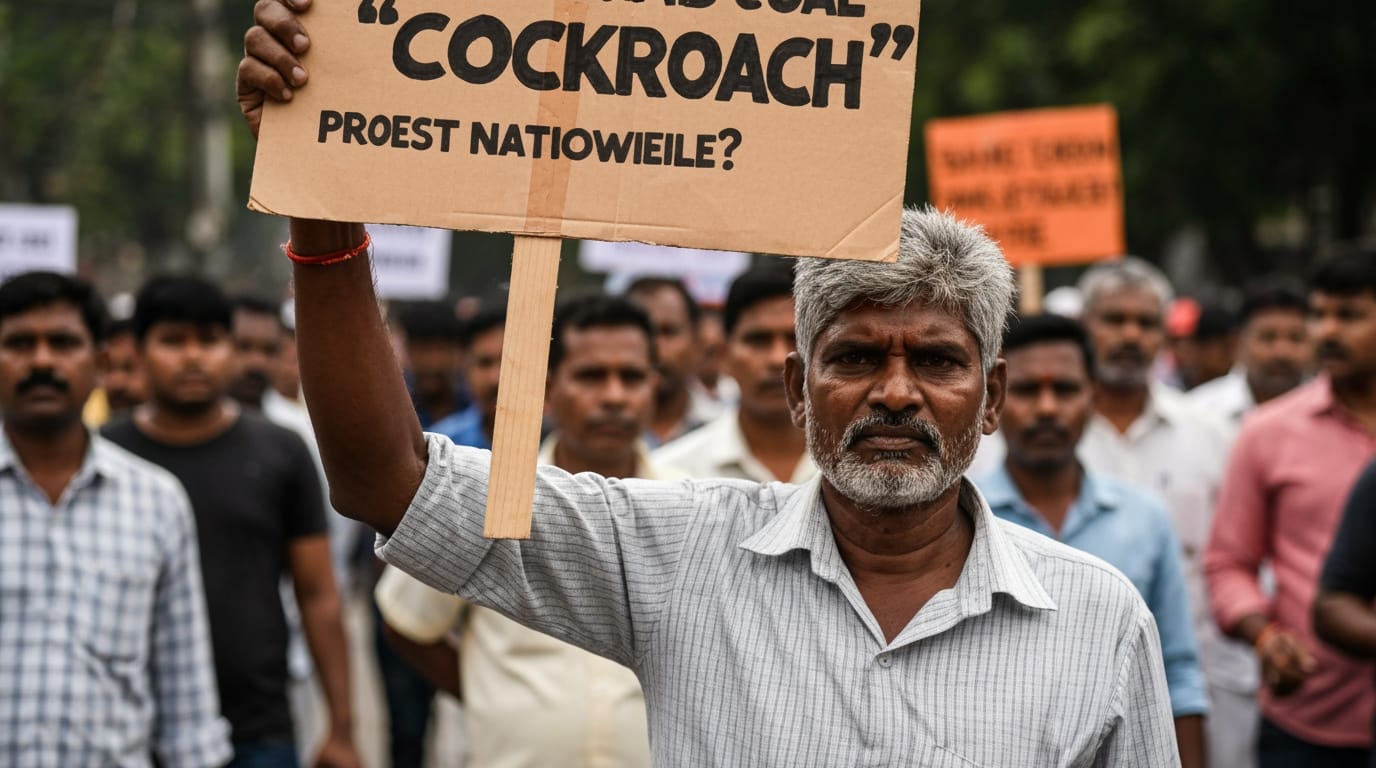
NEW DELHI – What began as a satirical online jibe has rapidly metamorphosed into one of India's most significant youth-led protest movements, posing an unexpected and persistent challenge to the established political order. Dubbed the "Cockroach Janta Party" (CJP), this movement, fueled by widespread youth disillusionment, has moved from internet memes to mass street protests, demanding accountability and sweeping reforms to the nation's beleaguered education system. As thousands rally across cities and defy police crackdowns, observers are closely watching whether this unconventional, youth-driven force has the staying power to extend its reach nationwide and fundamentally alter India's protest landscape.
From Insult to Icon: The Birth of the Cockroach Identity
The genesis of the "Cockroach" movement lies in a contentious remark made on May 15, 2026, by Chief Justice of India Surya Kant. During an unrelated Supreme Court hearing, Kant controversially compared some unemployed youth and activists to "cockroaches" and "parasites of society," comments that ignited a swift and furious backlash across social media. Seizing upon this insult, political communications strategist Abhijeet Dipke, a former Aam Aadmi Party (AAP) volunteer, launched the "Cockroach Janta Party" (CJP) online just a day later, on May 16, 2026.
The CJP quickly became an online sensation, a satirical parody of the ruling Bharatiya Janata Party (BJP), with its name translating roughly to "Cockroach People's Party." Its website adopted the tagline "Voice of the Lazy & Unemployed," and its mock eligibility criteria humorously listed being "unemployed, lazy, chronically online, and able to rant professionally." The movement's social media presence exploded, garnering over 20 million followers on Instagram within days, a figure that eclipsed those of India's most prominent political entities, including the BJP and the Indian National Congress. This rapid digital ascent underscored a deep vein of frustration among young Indians who felt overlooked and disrespected by the country's institutions.
From Digital Stir to Street Confrontation: Demands and Escalation
While born in the digital realm, the CJP swiftly transitioned to real-world activism. By June 2026, Dipke began organizing protests across various states, culminating in significant demonstrations in the national capital. The immediate catalyst for these street actions was widespread anger over alleged leaks of highly competitive national examinations, including the National Eligibility cum Entrance Test (NEET) for medical admissions and the CBSE board exams. These exams are crucial gateways to stable employment and upward mobility for millions of young Indians, and repeated irregularities have led to cancellations and retakes, causing immense stress and uncertainty.
The CJP's core demands include the immediate resignation of Union Education Minister Dharmendra Pradhan, comprehensive reforms to prevent future paper leaks, and financial compensation of 1 crore rupees for the families of students who have died by suicide, allegedly due to exam-related pressures. Beyond these specific educational grievances, the movement has broadened into a campaign for greater government accountability and a restoration of trust in institutions that many young people believe have failed them.
In July 2026, the protests escalated dramatically when thousands of CJP supporters attempted to march to India's Parliament in New Delhi. Police responded with tear gas and batons, leading to injuries and numerous detentions in what marked one of the most serious confrontations between youth activists and the government in years. The movement gained further momentum with the involvement of prominent activist Sonam Wangchuk, whose three-week hunger strike became a powerful symbol of the protests, drawing national attention and sympathy. Despite the police crackdown, protesters vowed to continue their sit-in at Jantar Mantar, a designated protest site, signaling a sustained commitment to their cause.
The Tides of Discontent: Factors Propelling Nationwide Reach
The Cockroach Janta Party's rapid rise and its ability to mobilize thousands underscore a pervasive sense of discontent among India's youth. The movement's appeal extends beyond the student community, drawing support from professionals and families who share frustrations over economic pressures, unemployment, and perceived institutional decay. This broad resonance suggests a deeper societal malaise that the CJP has effectively tapped into. With hundreds of millions of voters under the age of 35, India's youth represent a critical demographic, and their growing frustration holds significant political implications for future elections.
The CJP's decentralized nature and its emergence outside traditional political party structures have been key to its widespread appeal, allowing it to bypass the limitations often faced by established opposition groups. Its success in leveraging social media for mobilization and communication has also been pivotal, creating a viral dynamic that traditional movements often struggle to replicate. Furthermore, the movement mirrors a broader trend of youth-led uprisings seen across South Asia, indicating a regional context of similar grievances and aspirations among younger generations. Opposition parties and human rights activists have also lent their support, framing the CJP's efforts as a broader struggle for democratic accountability and the right to peaceful protest, further amplifying its reach and legitimacy.
Obstacles and the Government's Response
Initially, the government largely dismissed the CJP, with the education minister accusing its members of acting against national interests. There were also attempts to block the movement's social media accounts on national security grounds, though these were largely unsuccessful. The government's response to the protests has been marked by strong police action, including the use of tear gas and batons, leading to accusations of heavy-handedness.
Facing mounting pressure, Prime Minister Narendra Modi publicly addressed the issue for the first time, announcing the creation of fast-track courts to handle cases related to exam paper leaks. However, the CJP swiftly rejected this as insufficient, with a spokesperson stating, "It's a Band-aid. That's not giving us accountability." Protesters maintain that the government has yet to address their fundamental demands for accountability and comprehensive reform.
Historically, social movements in India face challenges such as a lack of unity among diverse regional and ideological groups, an episodic nature that makes sustained momentum difficult, and resistance from powerful vested interests. The government's reluctance to engage in direct negotiations with the CJP leadership remains a significant hurdle.
Conclusion: A New Chapter in Indian Dissent
The Cockroach Janta Party, born from an insult and nurtured by satire, has rapidly evolved into a formidable voice for India's disillusioned youth. Its transition from a viral online campaign to sustained street protests marks a pivotal moment in Indian political discourse, challenging the traditional mechanisms of dissent and accountability. The movement's ability to unite diverse segments of the youth on issues ranging from educational integrity to broader governmental transparency suggests a deep-seated desire for change.
While obstacles remain, including potential governmental resistance and the inherent challenges of sustaining a decentralized movement, the CJP has demonstrated a remarkable capacity for mobilization and resilience. Its ongoing impact will hinge on its ability to maintain public engagement, consolidate its demands, and navigate the complex political landscape. Regardless of its ultimate trajectory, the "Cockroach" movement has undeniably cast a spotlight on the frustrations of a generation and irrevocably etched its unique identity into the narrative of Indian protest, signifying a potentially new chapter in how dissent is articulated and confronted in the world's largest democracy.


