India's Youth Stage Historic Win Against Government With Wit and Relentless Resolve
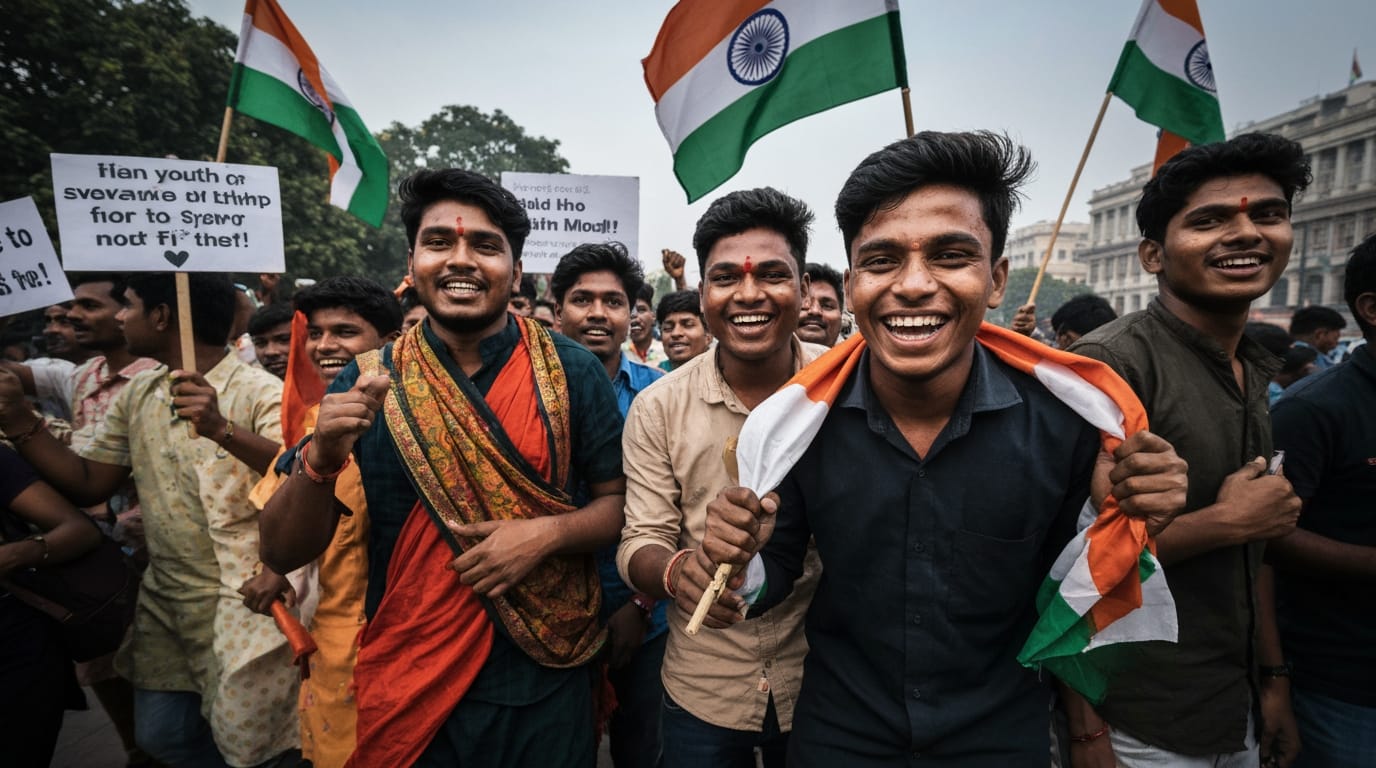
New Delhi, India – In a significant display of youthful agency and digital-era activism, a movement spearheaded by India's Gen Z has achieved a landmark victory against Prime Minister Narendra Modi's government, forcing the resignation of Education Minister Dharmendra Pradhan and securing critical concessions. What began as a groundswell of frustration over systemic educational failures and unemployment morphed into a powerful, satirical force, deftly leveraging humor, memes, and an unyielding spirit to challenge the nation's political establishment. This unprecedented triumph marks a pivotal moment, showcasing the political effectiveness of India's youth and signaling a new dynamic in the country's public discourse.
The recent youth-led protests, culminating in the education minister's departure, represent one of the most substantial public challenges to Prime Minister Modi's administration since he took office in 2014. Fueled by widespread discontent over repeated exam paper leaks, recruitment irregularities, and soaring youth unemployment, the movement demonstrated a profound loss of faith in the government among younger generations. This simmering anger reached a boiling point following a series of national medical entrance exam scandals, which affected millions of students and reportedly led to several suicides.
From Insult to Icon: The Birth of the Cockroach Janta Party
The catalyst that transformed widespread frustration into an organized movement was an insult leveled by Supreme Court Chief Justice Surya Kant. In May, Kant controversially described unemployed youth and activists as "cockroaches" and "parasites." Rather than being deterred, young Indians defiantly reclaimed the slur, giving birth to the satirical "Cockroach Janta Party" (CJP). The CJP, a playful spin on the ruling Bharatiya Janata Party (BJP), rapidly gained traction online, amassing over 22 million Instagram followers within a week of its formation. This ironic embrace of the "cockroach" as a symbol of endurance resonated deeply, providing a potent emblem for their struggle.
The Arsenal of Wit: Memes, Parody, and Pop Culture
The CJP's strategy was characterized by its innovative and irreverent use of humor and digital media. Recognizing that Modi had built his political brand through social media, protesters decided to fight him at his own game. They flooded platforms like Instagram with memes, parody videos, and self-deprecating jokes, effectively turning political critique into viral content. Protesters marched in Spider-Man masks and Batman costumes, carrying placards that blended pop culture references with pointed political messages. One notable poster featuring the education minister asked, "When will AI take his job?", while another declared, "Every joke is a tiny revolution."
Online, this creativity translated into spoof videos mocking pro-government television anchors and their dramatic, often biased, reporting. Protesters transformed confrontations with police into viral clips, sometimes joking about fitness apps while fleeing or creating "get ready with me" videos in protest settings, mirroring influencer culture. These tactics not only injected humor into the movement but also countered mainstream media narratives that often sought to label them as "anti-national." The youth, often referred to as the "summary generation," found speeches boring and instead communicated in the fast, visual language of their era.
Sustained Pressure and Government Response
The movement was not confined to the digital realm. Thousands of young people took to the streets in New Delhi and other major cities, participating in marches and demonstrations demanding accountability and education reforms. A march to the Indian parliament on July 20 brought the capital to a standstill, with tens of thousands occupying central roads. Police responded with baton charges, tear gas, and mass security deployments, leading to more than 100 student injuries.
Initially, Prime Minister Modi's government resisted calls for Pradhan's resignation, proposing instead measures like fast-track courts for paper leak cases and stronger anti-cheating legislation. However, protest leaders rejected these proposals, insisting that accountability had to begin with the education minister himself. The sheer scale and persistence of the youth movement, amplified by its savvy use of social media, ensured that the pressure mounted continuously. Jokes about Modi, once rare, became commonplace, with protesters mocking his gestures, pauses, and mannerisms, transforming his own words into political humor. The movement successfully broke a long-standing taboo, making mocking the powerful and image-conscious Prime Minister less taboo.
A Concrete Victory and Broader Implications
After weeks of sustained pressure, the government relented. Education Minister Dharmendra Pradhan resigned on Saturday, July 26, marking a significant victory for the youth movement. In addition to the minister's resignation, the government agreed to drop police cases against protesters and provide compensation to families of students who died by suicide following the exam leaks. These concessions were met with jubilation at the main protest sites, signaling a rare instance of the Modi administration yielding to public pressure.
Analysts view this outcome as far more than just a single ministerial resignation. It highlights the cracks in the government's ability to connect with younger generations and dents the aura of invincibility that Prime Minister Modi has cultivated. The movement demonstrated that modern political activism does not necessarily require traditional party structures to influence governments, relying instead on social media, shared identity, and sustained public mobilization. With nearly half of India's population under 25, young voters represent a powerful and influential electoral group, and their collective voice has now proven its capacity for tangible change. The success of the "Cockroach Janta Party" underscores a growing demand for government accountability and suggests that India's youth are unwilling to silently endure systemic failures.
This episode serves as a powerful testament to the ingenuity and tenacity of India's youth. Through a blend of sharp humor, digital prowess, and unwavering determination, they have not only secured specific demands but have also redefined the landscape of political protest in the world's largest democracy. The "win" goes beyond a single minister's resignation; it marks a moment where a generation, often dismissed, asserted its collective power and forced a government to listen, proving that sometimes, the sharpest critiques come with a laugh, and the most impactful change is wrought with grit.


