Indonesia's Neutrality Under Scrutiny Following Joint Naval Drill with China Near Taiwan
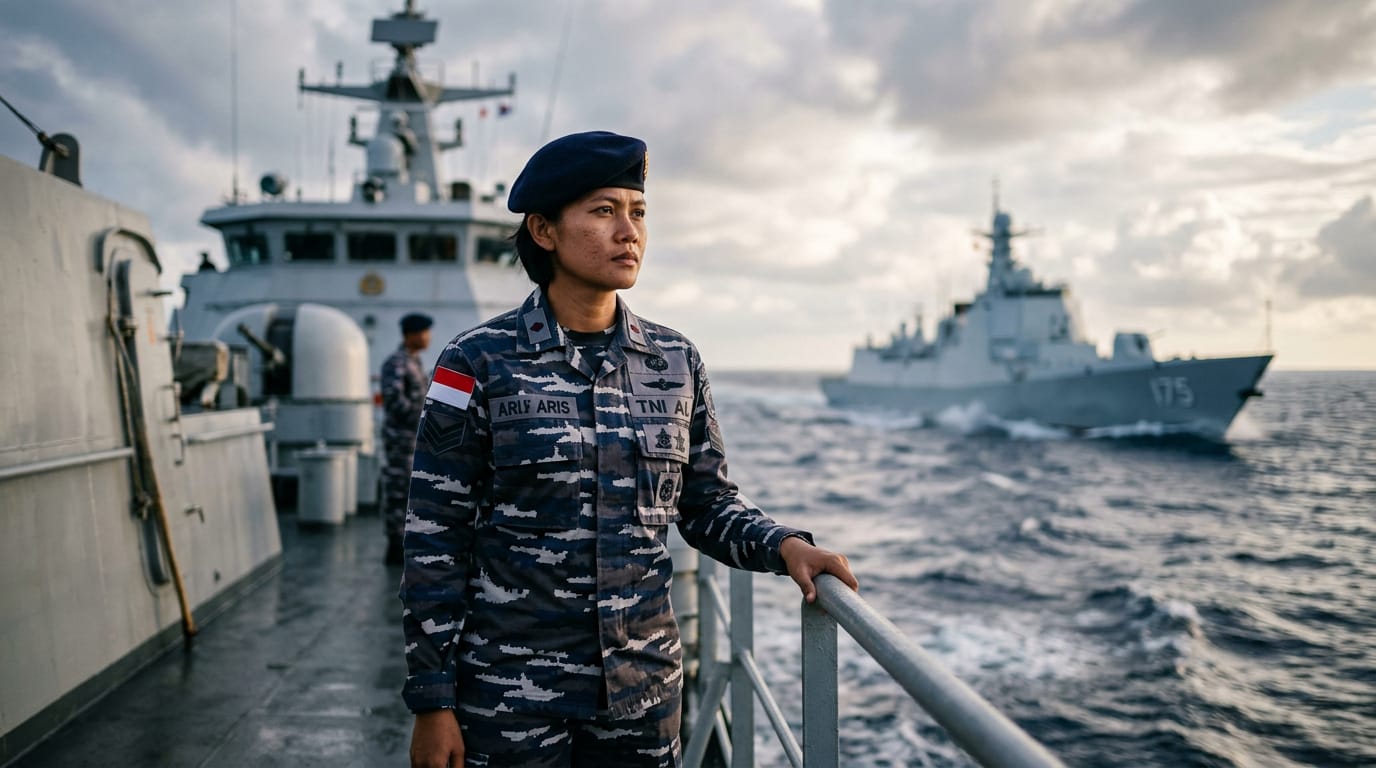
JAKARTA – A recent joint naval exercise between Indonesia and China in waters east of Taiwan has ignited debate, placing Indonesia’s long-standing "free and active" foreign policy under an intense geopolitical spotlight. While Jakarta maintains the drill was a routine "passing exercise" consistent with its non-aligned stance, Beijing's assertive framing of the event, coupled with Taiwan's strong condemnation, underscores the delicate balance Indonesia seeks to strike amid escalating regional tensions.
The exercise, which occurred in mid-August 2026, involved China's Type 054A frigate Honghe and the Indonesian Navy's KRI I Gusti Ngurah Rai. Official statements from both nations confirmed the drill focused on communication drills, at-sea replenishment, and formation maneuvers. China's Ministry of National Defense characterized the exercise as a means to enhance joint operational capabilities and contribute to regional peace and stability. However, the location—in waters east of Taiwan, an area of significant geopolitical sensitivity—and the differing interpretations from the participants and regional actors have raised questions about Jakarta's foreign policy integrity.
The Nuance of "Free and Active" Diplomacy
Indonesia has historically adhered to a "free and active" (Bebas Aktif) foreign policy, a doctrine enshrined in its 1945 Constitution. This policy dictates that Indonesia avoids alignment with any major power bloc, instead maintaining open and friendly relations with all nations while actively contributing to global peace and justice. Indonesian officials, including First Admiral Tunggul, spokesperson for the Indonesian Navy, emphasized that the recent engagement was merely a "passing exercise" (Passex), a common naval tradition for vessels transiting international waters, rather than a "warfighting" drill. The Indonesian Foreign Affairs Ministry further affirmed the exercise as part of its maritime diplomacy and bilateral defense cooperation, aligned with its non-aligned principles. This stance highlights Indonesia's efforts to project strategic autonomy, engaging with various global powers without committing exclusively to any single one. Indonesia has a history of conducting similar exercises with other navies, including those of Russia, Japan, and multinational drills like Garuda Shield which involve the United States, Australia, and Singapore.
Geopolitical Chessboard: Taiwan and the South China Sea
The location of the joint drill—in the contentious waters east of Taiwan—injected a significant layer of complexity. Taiwan’s Mainland Affairs Council swiftly condemned the exercise, labeling it a "military provocation" designed by Beijing to create a "false impression" of jurisdiction over these waters and to infringe upon Taiwan's sovereignty. Chinese military experts, however, asserted that the exercise underscored China's sovereign rights and jurisdiction over the exclusive economic zone (EEZ) east of Taiwan, presenting it as a normal and reasonable action within China's claimed sphere. This stark divergence in narrative placed Indonesia in a precarious position, as Beijing's characterization implicitly drew Jakarta into supporting China's broader territorial claims, an assertion Indonesia has actively refuted.
Beyond the immediate vicinity of Taiwan, the broader geopolitical landscape of the Indo-Pacific, particularly the South China Sea, looms large. While Indonesia does not have overlapping territorial claims with China in the traditional sense, Beijing's expansive "nine-dash line" claim extends into Indonesia's exclusive economic zone around the Natuna Islands. This has led to repeated infringements by Chinese fishing vessels and coast guard patrols, prompting Jakarta to reinforce its maritime defenses and assert its sovereignty based on the UN Convention on the Law of the Sea (UNCLOS). Indonesia's commitment to diplomatic resolution while maintaining a firm stance on its maritime rights has been a hallmark of its approach to these issues.
Economic Ties Versus Strategic Autonomy
Indonesia's decision to engage in military exercises with China, despite the potential diplomatic fallout, reflects a complex interplay of strategic and economic considerations. China stands as Indonesia's largest trade partner and its second-largest source of foreign investment. This substantial economic interdependence provides a powerful incentive for Jakarta to maintain robust ties with Beijing. Balancing these economic benefits with the imperative of strategic autonomy and regional stability poses a constant challenge for Indonesian foreign policy.
Analysts suggest that Indonesia's participation, even if framed as routine, might have either underestimated or accepted the political risks involved. The drill, particularly in its specific location and the conflicting narratives surrounding it, risks complicating Indonesia’s relationships with other regional powers such as Japan, the Philippines, and the United States, who view China's growing military footprint with concern. This event could also be seen as illustrative of China's evolving strategy regarding Taiwan, aiming to assert de facto jurisdiction through various means, including joint exercises with regional partners.
Looking Ahead: Navigating a Contested Future
The joint naval drill with China serves as a critical test for Indonesia's "free and active" foreign policy in an increasingly polarized Indo-Pacific. While Jakarta emphasizes its non-aligned approach and the routine nature of the exercise, the differing interpretations from Beijing and Taipei highlight the inherent difficulties of maintaining strict neutrality when engaging with great powers in contested zones.
Indonesia faces the ongoing challenge of balancing its significant economic interests with China against its commitment to international law and regional stability. The incident underscores the necessity for Indonesia to clearly articulate the parameters of its engagement with all external powers to avoid unintended signals or strategic misinterpretations. As great power competition intensifies, Indonesia's ability to navigate these complex waters with clarity and consistency will be paramount to preserving its national interests and contributing to a peaceful regional order. The events of mid-August 2026 will undoubtedly feature prominently in future discussions about Jakarta's role in the evolving dynamics of the Indo-Pacific.