IOC Bars Ukrainian Racer's Memorial Helmet, Citing Political Neutrality Rule
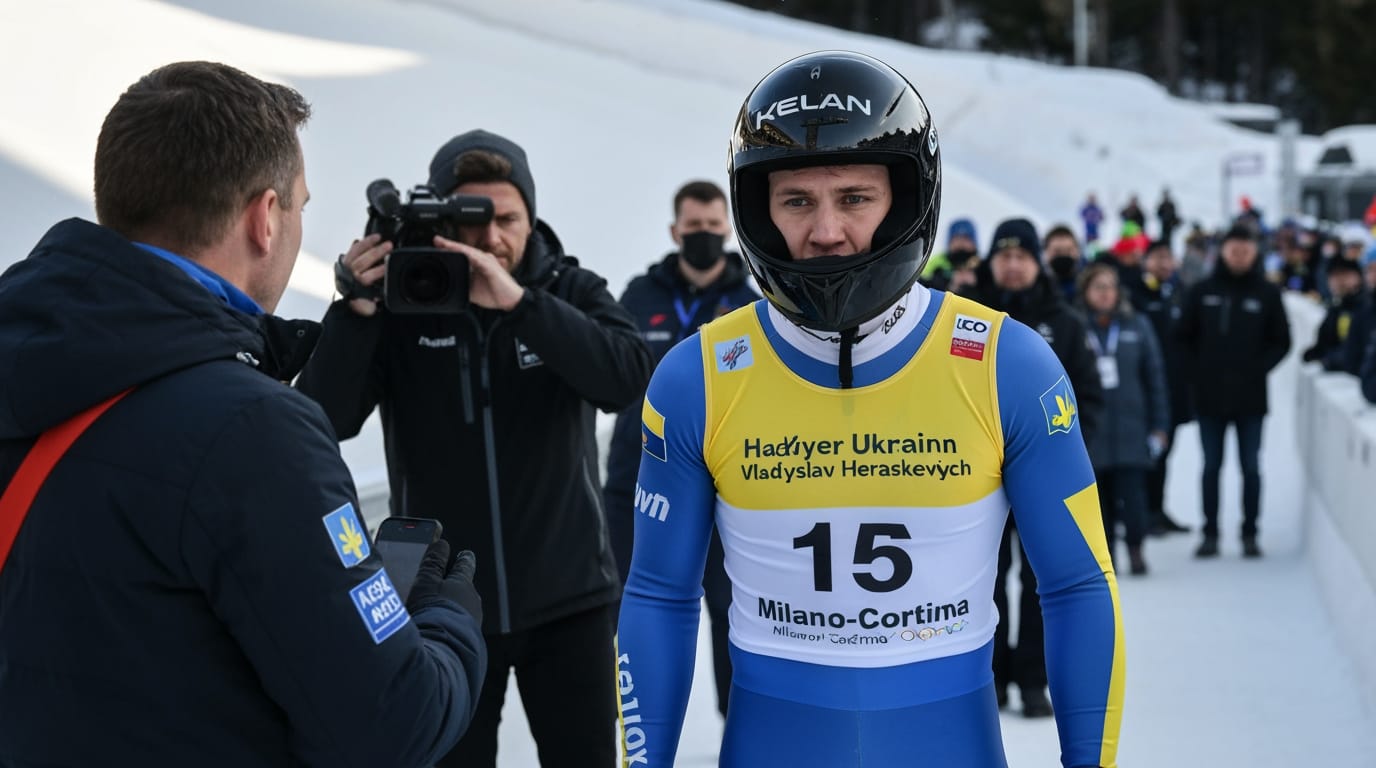
Cortina d'Ampezzo, Italy — Ukrainian skeleton racer Vladyslav Heraskevych will not be permitted to wear a helmet featuring images of compatriots killed in the ongoing war in Ukraine during competition at the Milano-Cortina Olympics. The International Olympic Committee (IOC) informed Heraskevych that the helmet, which he had used in training, violates its long-standing rule prohibiting political demonstrations at the Games, sparking a renewed debate over athlete expression and the perceived neutrality of the Olympic movement.
A Tribute Deemed Political
The custom-designed helmet, worn by Heraskevych during practice runs at the Cortina d'Ampezzo sliding center, served as a poignant tribute to Ukrainian athletes whose lives were tragically cut short by the conflict. The helmet featured portraits of several individuals, including figure skater Dmytro Sharpar, boxer Pavlo Ishchenko, ice hockey player Oleksiy Loginov, actor and athlete Ivan Kononenko, diver and coach Mykyta Kozubenko, shooter Oleksiy Habarov, and dancer Daria Kurdel. Among those honored was also biathlete Yevhen Malyshev. Heraskevych stated that some of the fallen were his personal friends, emphasizing his desire to honor their memory and ensure the world remembers the immense human cost of the war. He expressed that these individuals were integral to the "Olympic family" and deserved to be recognized.
This is not the first time Heraskevych has used his platform to draw attention to the conflict. At the Beijing 2022 Olympics, just days before Russia’s full-scale invasion of Ukraine, he displayed a "No War in Ukraine" sign after a race. At that time, the IOC opted not to sanction him, interpreting his message as a general call for peace. However, the committee's stance on the memorial helmet for the Milano-Cortina Games appears to be a stricter application of its regulations.
Rule 50: Upholding Olympic Neutrality
The International Olympic Committee's decision hinges on Rule 50.2 of the Olympic Charter. This rule explicitly states that "no kind of demonstration or political, religious or racial propaganda is permitted in any Olympic sites, venues or other areas." An IOC representative, Toshio Tsurunaga, reportedly informed Heraskevych of the violation, directly referencing Rule 50.
The IOC maintains that Rule 50 is crucial for preserving the neutrality of sports and ensuring that the focus of the Olympic Games remains squarely on athletic performance, unity, and universality. While recognizing the importance of freedom of expression, the IOC has refined its guidelines in recent years. Following the 2020 Tokyo Games, amendments were introduced to allow athletes to voice personal convictions in designated "safe spaces," such as press conferences, mixed zones, and on their personal social media accounts. However, these concessions do not extend to the field of play, the opening and closing ceremonies, or the medal podium, which remain strictly off-limits for any form of protest or advocacy. The rationale behind these restrictions is to protect the "sanctity of the sporting moment" and prevent individual political agendas from overshadowing the collective athletic achievements.
The Ukrainian Olympic Committee, however, submitted a formal request to the IOC on February 10, arguing that the helmet was a "helmet of remembrance" and did not contain political slogans or discriminatory elements. They asserted that the helmet was created solely to honor fallen Ukrainian athletes and fully complied with safety requirements and IOC rules.
Zelenskyy's Support and the Broader Context
Ukrainian President Volodymyr Zelenskyy publicly lauded Heraskevych's initiative, expressing gratitude for his effort to "remind the world of the price of our struggle." In a Telegram post, President Zelenskyy articulated that "this truth cannot be inconvenient, inappropriate, or called a 'political act at a sporting event.' It is a reminder to the whole world of what modern Russia is." He emphasized that such actions underscore the global role of sports and the Olympic movement's historic mission for peace and life.
The incident highlights the persistent tension between the Olympic ideal of political neutrality and the reality of athletes' desires to use their global platform for humanitarian or political statements, particularly in times of conflict. The debate is further complicated by the IOC's controversial decision to allow Russian and Belarusian athletes to compete as "Individual Neutral Athletes" (AINs) under strict conditions, despite the ongoing war. This allowance has drawn criticism from Ukraine and other nations, who argue that it undermines the principle of neutrality when the aggressor nation's athletes are still permitted to participate.
Conclusion: A Difficult Balancing Act
The IOC's decision to bar Vladyslav Heraskevych's memorial helmet at the Milano-Cortina Olympics underscores the complex and often contentious nature of balancing Olympic neutrality with athlete expression. While Heraskevych sought to offer a profound tribute to fallen comrades and draw attention to the human tragedy of war, the IOC invoked its mandate to prevent political demonstrations within competitive venues. This ruling places the athlete in a difficult position, forcing him to choose between adherence to Olympic regulations and a deeply personal act of remembrance. The ongoing debate reflects the global challenge facing sports organizations: how to uphold traditional principles of non-partisanship while acknowledging the increasingly interconnected world and the moral imperatives felt by individual athletes.


