Jharkhand Student Leader Hospitalized After Police Clash During Massive Protest Over Exam Irregularities
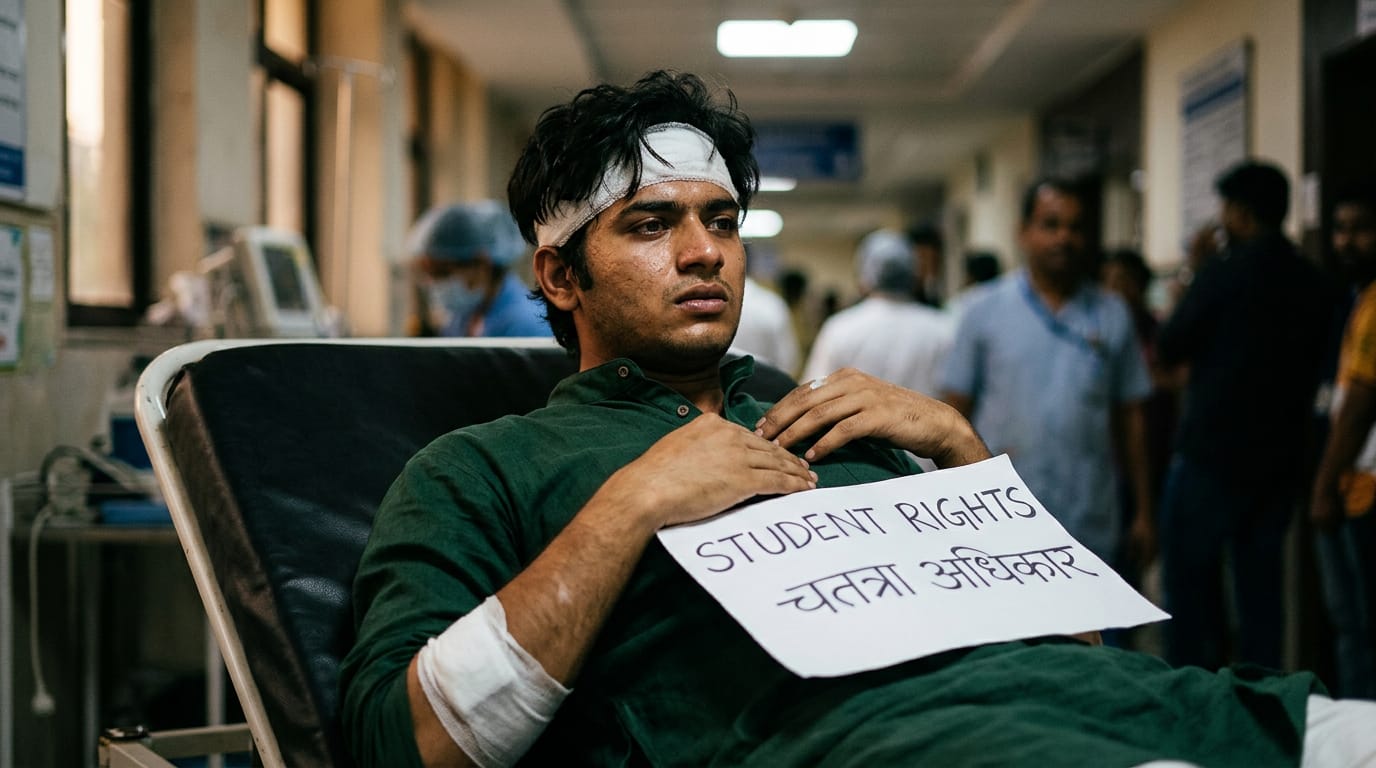
RANCHI – A major student protest in Jharkhand escalated into widespread confrontations with police on Monday, August 10, 2026, culminating in the hospitalization of prominent student leader Devendra Nath Mahto. Thousands of job aspirants, demonstrating against alleged irregularities in state recruitment examinations, marched towards the State Assembly in Ranchi, where police deployed water cannons, tear gas, and batons to disperse the crowd. Mahto, already weakened by a nine-day hunger strike, reportedly sustained further injuries during the police action, deepening the crisis and drawing sharp political condemnation across the state and nationally.
Escalation and Confrontation at the State Assembly
The Monday demonstration marked the 17th consecutive day of protests by students and job aspirants, who have been demanding accountability and reforms in Jharkhand's public service recruitment process. The march, which began from outside the old Assembly building, saw thousands of determined young men and women attempting to breach multiple police barricades along the four-kilometer route towards the new Vidhan Sabha complex. Visuals from the scene depicted protesters, many carrying national flags and placards, pushing against security personnel as they tried to advance.
As the protesters neared the final barricade near Jagannathpur Temple, approximately 200 meters from the Assembly, police intensified their efforts to contain the gathering. Security forces deployed water cannons, followed by rounds of tear gas. When these measures failed to disperse the determined crowd, police resorted to a lathi-charge, using batons against the demonstrators. Protesters alleged that many, including women students, sustained injuries to their heads, arms, and faces during the baton charge, describing the police action as "barbaric." Ranchi City SP Paras Rana, however, stated that four policemen were also injured during stone pelting by some demonstrators, and police maintained they used "mild force" that was "reactionary" to the protesters' attempts to breach barricades.
Devendra Nath Mahto, a leader of the Jharkhand Loktantrik Krantikari Morcha (JLKM), played a central role in the protest despite his severely compromised health. Mahto, who had been on a hunger strike for nine days protesting the exam irregularities, joined the march in an ambulance. His health had already deteriorated significantly, with doctors noting a drastic drop in his blood sugar level. Following the clashes, Mahto was admitted to Ranchi Sadar Hospital, where his condition was described as critical.
Roots of Discontent: The Exam Irregularities
The widespread student agitation stems from allegations of corruption and mismanagement in various competitive examinations conducted by the Jharkhand Public Service Commission (JPSC) and the Jharkhand Staff Selection Commission (JSSC). The primary demands of the protesting students include the cancellation of the JSSC-Combined Graduate Level (CGL) examination, comprehensive reforms within both commissions, and a thorough investigation into the alleged irregularities by the Central Bureau of Investigation (CBI).
Students claim that despite several rounds of discussions with the state government, their core demands remain unmet. While the government asserted that it had accepted 98% of the students' demands, protesters countered that only three out of their 13 requested exam cancellations had been agreed upon. They expressed dissatisfaction with the government's proposal for a CID probe, advocating instead for a CBI investigation, which they believe would be more impartial given the scale of the alleged corruption. Adding to the complexity, the government stated it lacked the unilateral power to cancel examinations conducted under the supervision of the High Court and Supreme Court or to automatically transfer cases to the CBI. However, an Enforcement Directorate (ED) money-laundering probe into the "anomalies" has been launched, and former JPSC chairperson L. Khiangte was arrested in connection with the alleged irregularities.
Mahto's Ordeal and Allegations of Brutality
The hospitalization of Devendra Nath Mahto has become a focal point of the ongoing controversy. Mahto's aide, Pankaj Kumar, alleged that the student leader was "lathi-charged" by the police near the Assembly and suffered injuries, in addition to his already critical state from the hunger strike. Abhijeet Dipke, founder of the Cockroach Janata Party (CJP), spoke with Mahto from the hospital and publicly condemned the police action, describing it as "cruel and inhuman." Dipke stated that Mahto reported being hit by police and experiencing chest pain.
Doctors at Ranchi Sadar Hospital confirmed Mahto's critical condition, primarily due to a severe drop in his blood sugar levels resulting from his prolonged hunger strike. While medical staff focused on stabilizing his health, the allegations of police brutality against an already frail protestor have intensified public scrutiny and political debate regarding the handling of the demonstration. Police officials reiterated that force was used to manage a situation where protesters were attempting to breach security cordons, but denied indiscriminate lathi-charging.
Political Fallout and Public Reaction
The police action and Mahto's hospitalization have sparked significant political backlash. Jharkhand Health Minister Dr. Irfan Ansari visited Mahto and other injured students at the hospital, indicating official concern. However, opposition parties were quick to criticize the state government. The Bharatiya Janata Party (BJP) accused the ruling Jharkhand Mukti Morcha (JMM)-Congress alliance of using excessive force against peaceful student protestors. The BJP subsequently called for a statewide "bandh" (shutdown) on Tuesday, August 11, 2026, to protest what it termed "police atrocities" and the lathi-charge.
National political figures also weighed in, with Congress leader Rahul Gandhi condemning the use of force against student protesters in Jharkhand. Gandhi emphasized the right to peaceful protest and called for dialogue to resolve the students' issues. His statement, however, led to criticism from BJP MPs who accused him of a selective stance, contrasting his condemnation in Jharkhand with his party's alleged silence on similar issues in other states. This political back-and-forth highlights the sensitive nature of student protests and police conduct in India, often becoming a battleground for broader political narratives.
An Unresolved Impasse
The hospitalization of Devendra Nath Mahto and the ongoing student protests in Jharkhand underscore a deep-seated frustration among job aspirants regarding transparency and fairness in government recruitment processes. While Mahto receives medical attention, his condition serves as a stark symbol of the sacrifices made by students in their pursuit of justice. The state government faces continued pressure to address the students' demands comprehensively, particularly concerning the CBI probe into alleged irregularities and the cancellation of specific examinations.
The incident on August 10 has not only amplified the students' voices but also deepened political divisions within Jharkhand. The ruling dispensation must navigate the dual challenges of public discontent and opposition criticism, while ensuring that future protests are handled with sensitivity to avoid further escalation. The path forward appears to require more than just piecemeal solutions; it demands a clear, accountable, and transparent mechanism to rebuild trust among the state's youth. The coming days will reveal whether the current impasse can be resolved through constructive dialogue or if the cycle of protest and confrontation will continue to define the landscape of student activism in Jharkhand.


