Kim Jong Un Re-elected General Secretary, Consolidating Power at Historic Party Congress
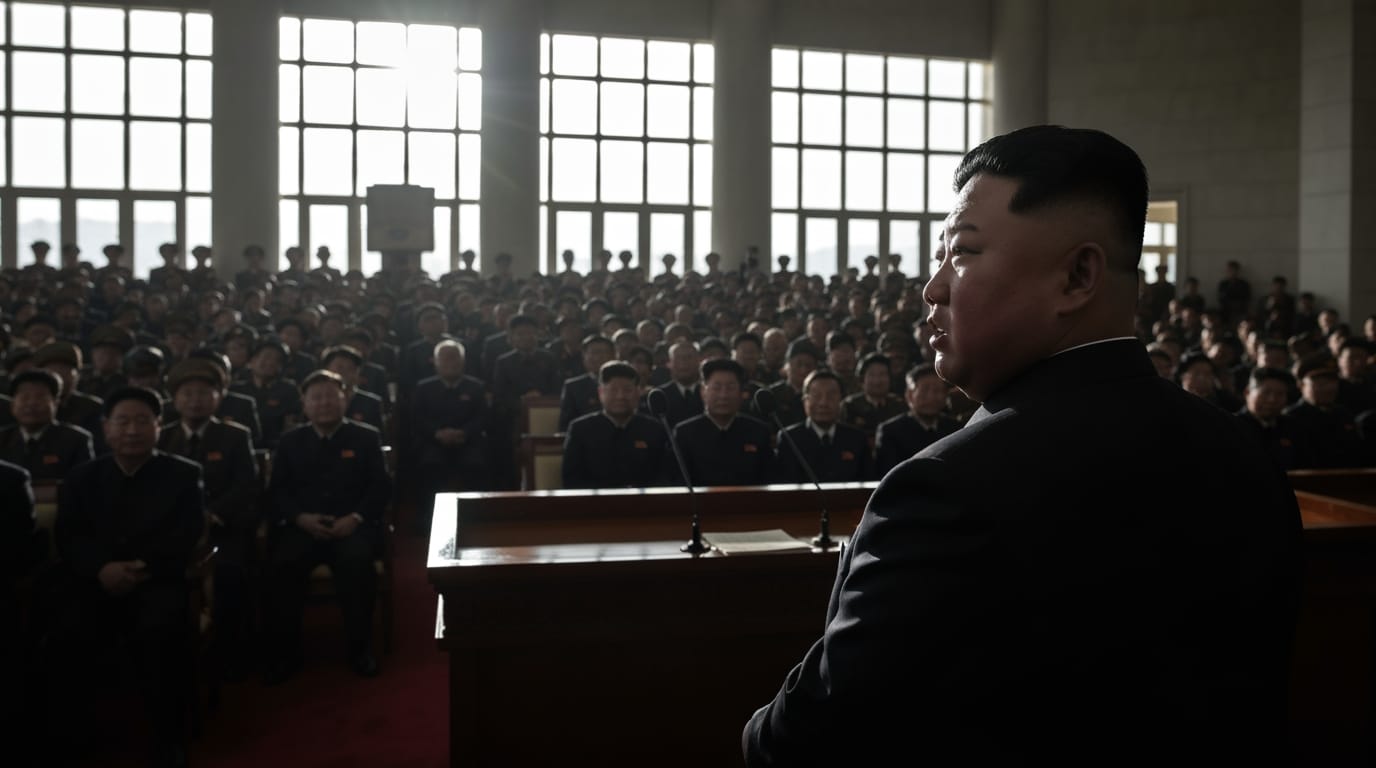
PYONGYANG – Kim Jong Un has been re-elected as the General Secretary of the Workers' Party of Korea (WPK), North Korea's ruling party, solidifying his command over the reclusive state's political and military apparatus. The decision, announced by state media on Monday, February 23, 2026, came on the fourth day of the Ninth Party Congress, held in Pyongyang. This latest affirmation of leadership signals a renewed mandate for Kim's strategic vision for North Korea's economy, military, and international standing, as the nation navigates complex geopolitical dynamics and persistent domestic challenges.
The Formal Affirmation of Unrivaled Authority
The re-election of Kim Jong Un to the party's highest post was described by the official Korean Central News Agency (KCNA) as a "momentous decision" made "in accordance with the unshakable will and unanimous desire of all the delegates." Delegates at the Ninth Party Congress, which commenced on February 19, convened to review past achievements, outline future policies, and make key personnel decisions, including the re-endorsement of Kim's leadership. The WPK's charter mandates the election of the General Secretary, who "represents the party and organizes and leads the entire party," at a congress held every five years, underscoring the regularity and institutional weight of this event.
This latest re-election follows Kim's initial assumption of the General Secretary title at the Eighth Party Congress in January 2021. Prior to 2021, Kim had held the title of Party Chairman since 2016, and before that, First Secretary since his ascent to power in late 2011. The restoration of the General Secretary title in 2021, a position previously held by his father Kim Jong Il and grandfather Kim Il Sung, was a significant symbolic move, placing him in direct lineage with the nation's "eternal" leaders and cementing his dynastic claim to absolute power. The KCNA report accompanying his most recent re-election lauded Kim for elevating the country to "the pinnacle of self-respect and self-reliance" through the strengthening of its nuclear capabilities. It further credited him with "radically improv[ing]" the country's "war deterrence" with nuclear forces and building "revolutionary armed forces fully prepared to proactively respond to any invasion threat."
Economic Direction: Self-Reliance Amidst Global Pressures
The Ninth Party Congress serves as a critical platform for outlining North Korea's economic development strategy for the next five years. Kim Jong Un, now in his 15th year in power, has adopted a more confident tone regarding the nation's economy compared to the previous congress in 2021. At the Eighth Congress, Kim made a rare admission of "catastrophic failure" in meeting the goals of the 2016-2020 five-year economic development plan, attributing shortcomings to international sanctions, natural disasters, and the COVID-19 pandemic.
The 2021 congress subsequently unveiled a new five-year plan (2021-2025) with a strong emphasis on "self-dependence and self-sufficiency" and tightening state control over the economy. This plan included ambitious targets for expanding various industries, from metal and chemical production to coal mining, and called for significant investment in infrastructure projects, such as the construction of at least 50,000 apartments in Pyongyang and 25,000 dwellings in the Komdok mining area, alongside increasing cement production capacity to support these efforts.
As the Ninth Party Congress unfolds, observers expect a continued focus on these internal strengths, with state-led management of the economy reinforced. While Kim has acknowledged that external economic relations and capital investment are crucial for long-term sustainability, the prevailing strategy remains rooted in mobilizing internal resources and reinforcing the party's control. Recent reports suggest an improving agricultural harvest and progress in housing construction, contributing to Kim's more optimistic assessment of the economic situation at the close of 2023. The current congress is anticipated to maintain this trajectory, stressing internal unity and self-reliance.
Geopolitical Stance: Bolstering Nuclear Prowess and Shifting Alliances
A core element of Kim Jong Un's leadership has been the relentless pursuit of military development, particularly the expansion and modernization of North Korea's nuclear arsenal. The KCNA's commendation of Kim for bolstering the country's "war deterrence with the nuclear forces as its pivot" highlights the centrality of this program to his regime's legitimacy and security doctrine. At the 2021 congress, Kim openly vowed to enlarge his nuclear arsenal and develop more sophisticated weapons systems, a pledge that has seen considerable fulfillment, including the development and testing of solid-fuel intercontinental ballistic missiles and tactical nuclear systems.
The current congress is expected to further emphasize the parallel development of both nuclear and conventional military capabilities, potentially under a separate five-year plan for military development. This reflects North Korea's ambition to maintain a credible deterrent while also strengthening its conventional forces. The nation's perceived regional standing has also seen a boost, notably through strengthening ties with Russia and China, which has deepened its standoffs with the United States and South Korea. These alliances provide a crucial buffer against international sanctions and facilitate advancements in both military and economic spheres. While the 2021 congress had a less positive tone regarding relations with the U.S. and South Korea, defining the U.S. as the "principal enemy," the current geopolitical climate sees North Korea leveraging its enhanced nuclear capabilities and strategic partnerships to project a more forceful presence on the international stage.
Conclusion: Solidifying a Decade of Power
Kim Jong Un's re-election as General Secretary of the Workers' Party of Korea at the Ninth Party Congress marks a pivotal moment, reaffirming his unassailable leadership and setting the course for North Korea for the foreseeable future. The congress, a rare window into the opaque nation's strategic priorities, has underscored Kim's commitment to self-reliance in economic development and the continued strengthening of its nuclear-armed military. Amidst a complex global landscape, his re-endorsement signals a consistent trajectory of prioritizing national defense, consolidating internal political control, and pursuing an economic agenda aimed at increasing self-sufficiency. The world will closely watch as North Korea endeavors to implement the directives emerging from this congress, shaping its internal dynamics and its engagement, or defiance, of the international community.


