Lithuania Uncovers Migrant Tunnels, Points Finger at Minsk in Escalating Border Tensions
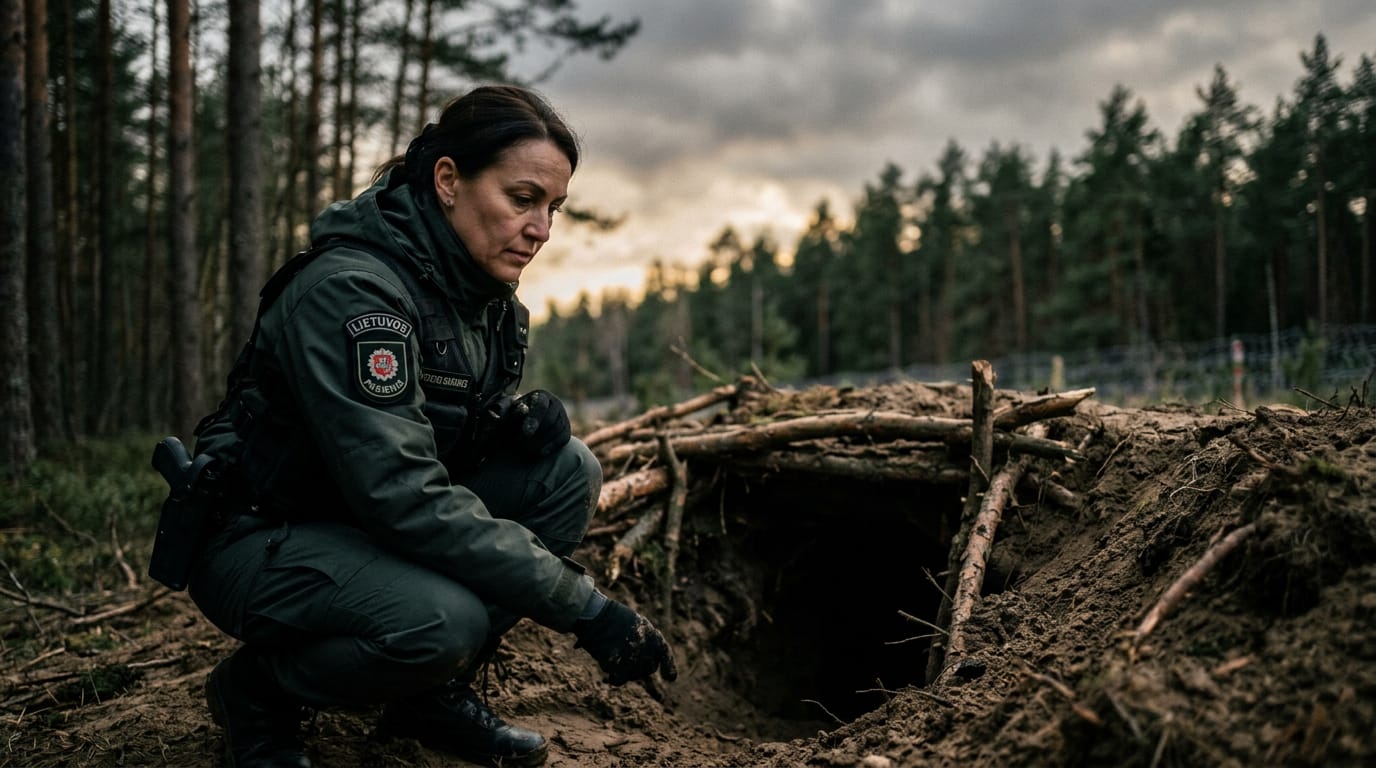
VILNIUS, LITHUANIA – Lithuanian authorities have recently uncovered a series of sophisticated underground tunnels along the border with Belarus, raising alarms and intensifying accusations that the Belarusian regime in Minsk is orchestrating a new phase in its hybrid warfare tactics against the European Union. These subterranean passages, seemingly designed for the illegal movement of migrants, underscore an evolving and persistent threat to the EU's eastern flank, demanding heightened vigilance and robust countermeasures.
The Emerging Underground Frontier
In recent weeks, Lithuanian border guards have discovered at least three unfinished underground tunnels suspected of being constructed for migrant smuggling from Belarus into Lithuanian territory. The most recent find, announced in early August 2026, was located near the village of Latežeris in the Druskininkai Municipality. This passage was dug approximately 1.5 meters deep beneath the border barrier, reinforced with logs and planks, and extended about four meters into Lithuania from the Belarusian side, with its entrance concealed by camouflage fabric. This followed earlier discoveries in July 2026: a five-meter tunnel near Pesčiai on July 23, and an 11-meter passage near Pertakas on July 26, which notably contained construction materials and buckets.
While none of these recently discovered tunnels were fully completed or had an exit point on the Lithuanian side, preventing immediate illegal crossings, their professional construction indicates a deliberate and organized effort. Lithuanian State Border Guard Service (VSAT) officials report that these recent incidents are part of a broader pattern, with a total of 12 attempts to construct such tunnels recorded since the beginning of 2026. One tunnel discovered earlier this year reportedly extended approximately 25 meters into Lithuanian territory, with an estimated total length of 30 to 40 meters when accounting for the Belarusian section, dug to depths of up to eight meters and reinforced with timber. The detection of these concealed passages has been aided by vibration sensors and specialized equipment, some provided by Polish border guard specialists, who have previously encountered similar challenges on their own Belarusian border.
Minsk's Shadowy Involvement
Lithuanian authorities unequivocally point to the Belarusian regime as being complicit, if not actively involved, in these underground operations. Rustamas Liubajevas, head of Lithuania's State Border Guard Service, has stated that such intricate work, requiring specific skills and logistical support like timber for reinforcement, could not occur without the knowledge or assistance of Belarusian border guards. He emphasized that Belarusian authorities are "either turning a blind eye or actively helping migrants dig these tunnels," highlighting the sophisticated nature of the excavations which goes beyond spontaneous actions by individuals.
This suspicion is rooted in a well-documented history of Belarus utilizing irregular migration as a geopolitical weapon. Since 2021, Lithuania, along with Poland and Latvia, has accused the regime of Alexander Lukashenko of orchestrating migrant flows, primarily from the Middle East and North Africa, towards the EU's external borders. This manufactured crisis was widely seen as a retaliatory measure against EU sanctions imposed following the contentious 2020 Belarusian presidential election and subsequent suppression of protests, as well as the forced landing of a Ryanair flight carrying a dissident journalist. Evidence gathered by Lithuanian authorities has consistently indicated the direct involvement of Belarusian state-owned companies in facilitating migrant travel, including increasing flights from the Middle East, organizing visas and accommodation, and then escorting migrants to the border, often forcing them to cross illegally under dangerous conditions. The discovery of similar professionally constructed tunnels along the Polish-Belarusian border in 2025, with suggestions of involvement from "specialists from the Middle East with a high level of expertise," further reinforces the narrative of state-sponsored, systematic efforts.
Deepening Geopolitical Implications
The emergence of migrant tunnels marks a concerning escalation in the ongoing border crisis and carries significant implications for regional security. Lithuania views these actions as a direct threat to its state border and national security, forcing the country to commit substantial resources to detection and prevention. The financial burden has been considerable, with Lithuania reportedly spending over €200 million between 2021 and 2023 alone to manage the influx of migrants.
In response to Belarus's alleged breaches of international obligations, Lithuania filed a case against Belarus at the International Court of Justice (ICJ) in May 2025. This legal action accuses the Lukashenko regime of violating the UN Protocol against the Smuggling of Migrants by Land, Sea and Air, seeking accountability, compensation for damages (including the cost of border infrastructure), and assurances that such actions will not recur. The European Union has expressed solidarity with Lithuania and other frontline member states, providing financial support for advanced border surveillance systems and defending their measures to protect the EU's external border. European Commission President Ursula von der Leyen, during a visit to Vilnius in September 2025, underscored that the security of Lithuania is integral to the security of the entire European Union.
The Belarusian regime's persistent tactics, including the use of tunnels, are interpreted as a deliberate strategy to maintain tensions on the EU's eastern frontier and test the resilience of its border defenses. This falls within a broader context of hybrid threats that also include drone incidents and disinformation campaigns, compelling Lithuanian President Gitanas Nausėda to call for strengthened air defense and critical infrastructure protection across the EU's eastern flank.
A Cycle of Exploitation and Adaptation
At the heart of this geopolitical maneuvering lies the human element. Migrants, often from vulnerable regions, are reportedly being exploited as pawns in this larger struggle, sometimes coerced into crossing borders under dangerous and life-threatening conditions. While Lithuania has implemented strict measures, including pushbacks and legal penalties for illegal crossings (fines, arrest, or up to two years imprisonment), these policies have drawn scrutiny regarding human rights concerns.
The shift to underground tunnels represents an adaptation in smuggling methods, a change in tactics from more overt attempts at border penetration. As physical barriers and surveillance systems have improved, those facilitating illegal migration are resorting to more covert and technically demanding approaches. This constant evolution necessitates equally dynamic responses from border security agencies, requiring not only physical barriers and surveillance but also intelligence gathering and specialized equipment to detect clandestine activities below ground.
Conclusion
The discovery of migrant tunnels along Lithuania's border with Belarus signifies a worrying new dimension in the ongoing confrontation between Minsk and the European Union. These sophisticated subterranean passages, strongly suspected to be orchestrated or facilitated by the Belarusian regime, highlight a continuous and adapting hybrid threat aimed at destabilizing the EU's eastern frontier. As Lithuania works to secure its territory and uphold international law, supported by its European partners, the situation underscores the urgent need for robust border protection, enhanced intelligence sharing, and unwavering international cooperation to counter these complex and evolving challenges. The underground frontier serves as a stark reminder that the battle for border integrity is increasingly being fought beneath the surface, demanding constant vigilance and innovative solutions.


