Myanmar's Leader Seeks Regional Validation in Red-Carpet Thai Visit Amidst Deepening Crisis
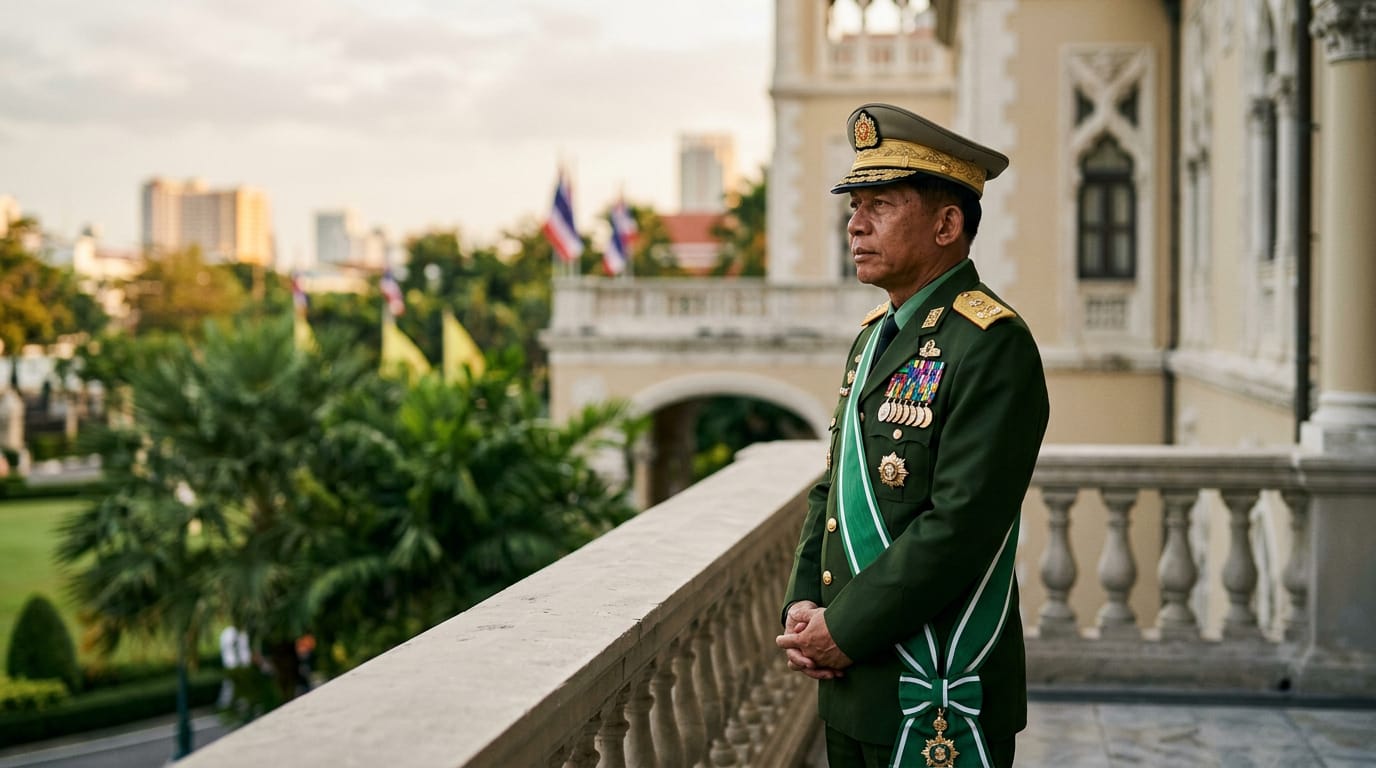
BANGKOK, Thailand – Myanmar's military leader-turned-President Min Aung Hlaing received a red-carpet welcome in Bangkok this week, undertaking a high-profile official visit to Thailand that underscored his persistent quest for international legitimacy amidst a brutal civil conflict and widespread international condemnation. The two-day trip, beginning Thursday, August 6, 2026, marked Min Aung Hlaing's first official visit to Thailand since assuming the presidency in April, drawing sharp criticism from human rights groups who argue the engagement lends undue credibility to his regime.
A Bid for Diplomatic Rehabilitation
Min Aung Hlaing's arrival in Bangkok, complete with an honor guard inspection alongside Thai Prime Minister Anutin Charnvirakul, signals a concerted effort by Myanmar's leadership to break free from international isolation. Since seizing power in a 2021 coup that toppled Aung San Suu Kyi's elected government, Min Aung Hlaing has faced extensive Western sanctions and widespread diplomatic shunning. His elevation to president in April followed elections in December 2025 and January 2026, which were largely dismissed as a sham by international observers and rejected by Western governments and the Association of Southeast Asian Nations (ASEAN) for lacking meaningful opposition.
During talks at Government House, discussions between Min Aung Hlaing and Thai officials reportedly centered on political reconciliation, regional cooperation, and economic ties. Memorandums of Understanding were signed concerning Myanmar migrant workers, water quality management in shared rivers, and space technology for Earth observation. Min Aung Hlaing also addressed a Thailand-Myanmar Business Forum, assuring attendees that Myanmar was "on the path of democracy and heading towards a better future" and encouraging investment in sectors such as energy, agriculture, manufacturing, healthcare, and technology. This visit follows similar diplomatic overtures made by Min Aung Hlaing to China, India, and Laos, all part of a broader strategy to secure recognition for his military-backed administration.
Thailand's "Calibrated Re-engagement" Strategy
Thailand's decision to host Min Aung Hlaing reflects what Bangkok describes as a "calibrated re-engagement" strategy with its conflict-ridden neighbor. Thai officials emphasize the necessity of maintaining dialogue to address shared challenges, particularly along their 2,400-kilometer border. Key concerns for Thailand include transnational crime, migration flows, and regional stability.
Economic interests also play a significant role. Thailand stands as a major foreign investor in Myanmar, with substantial stakes in sectors like hotels, banking, manufacturing, and energy. The revival of projects, such as the Dawei Special Economic Zone, underscores the economic imperative driving Thailand's engagement. By positioning itself as a mediator, Bangkok aims to facilitate communication with Naypyitaw and bolster ASEAN's central, albeit often challenged, role in regional peacemaking efforts. Prime Minister Anutin Charnvirakul expressed confidence that enhanced cooperation would yield "tangible benefits to the peoples of both countries," reflecting Thailand's pragmatic approach to a complex geopolitical situation.
Myanmar's Deepening Humanitarian Catastrophe
Min Aung Hlaing's visit unfolds against the backdrop of a severe and escalating crisis within Myanmar. Five years after the military coup, the country remains ensnared in a deepening political, humanitarian, and human rights catastrophe. The military's overthrow of the democratic government in February 2021 plunged the nation into a brutal civil war, resulting in an estimated 100,000 deaths and displacing 5.2 million people. As of August 2026, security forces have reportedly killed over 8,200 civilians and arrested 31,645 others.
The junta continues to employ "scorched earth" tactics, including aerial and artillery attacks, which human rights organizations condemn as war crimes and crimes against humanity. Resistance forces and ethnic armies now control approximately 42% of the country, while the junta holds about 21%, indicating a persistent and deadly stalemate. The humanitarian situation is dire, with needs having increased twenty-fold since the coup, leaving 19.9 million people in urgent need of assistance. Just days before Min Aung Hlaing's arrival in Thailand, former leader Aung San Suu Kyi was reportedly allowed to meet with a representative from the International Committee of the Red Cross, a rare development that analysts suggest could signal a potential shift in ASEAN's approach to the crisis.
International and Activist Outcry
The red-carpet reception extended to Min Aung Hlaing has ignited strong condemnation from human rights advocates and some international observers. Groups such as Justice For Myanmar and Fortify Rights have vehemently criticized the visit, asserting that it confers "false legitimacy" on a military regime responsible for widespread atrocities. Activists urged Thailand to abandon its "non-interference" policy and engage more proactively in promoting human rights. Concerns have also been raised about Thailand's deepening military cooperation with the junta, including secret meetings on unmanned aerial vehicles and naval exchanges, which critics fear could implicate Thailand in the military's international crimes.
ASEAN, while not endorsing Myanmar's recent elections, has struggled to implement its Five-Point Consensus (FPC), a peace plan agreed upon in April 2021 that calls for an immediate cessation of violence, dialogue among all parties, and humanitarian access. Despite the FPC being a framework, Myanmar's military has largely ignored its terms, leading ASEAN's special envoy to declare that the normalization of ties remains "still far off." The visit highlights ongoing divisions within ASEAN regarding how best to address the Myanmar crisis, balancing regional stability and economic interests against principles of human rights and democracy.
A Future Clouded by Conflict
Min Aung Hlaing's visit to Thailand represents a critical moment in his ongoing efforts to project an image of legitimate governance to the international community. While Thailand views engagement as a pragmatic necessity for border management and economic ties, the red-carpet treatment risks undermining international efforts to hold the Myanmar military accountable for its actions. The visit also exposes the persistent fault lines within ASEAN, as member states navigate a complex crisis that continues to destabilize the region. With the civil war raging and humanitarian suffering mounting, the quest for legitimacy by Myanmar's leadership remains deeply intertwined with the urgent, unresolved question of peace and democratic restoration for its people.


