Myanmar's 'Sham' Election Fails to Sway Europe's Firm Stance Against Junta
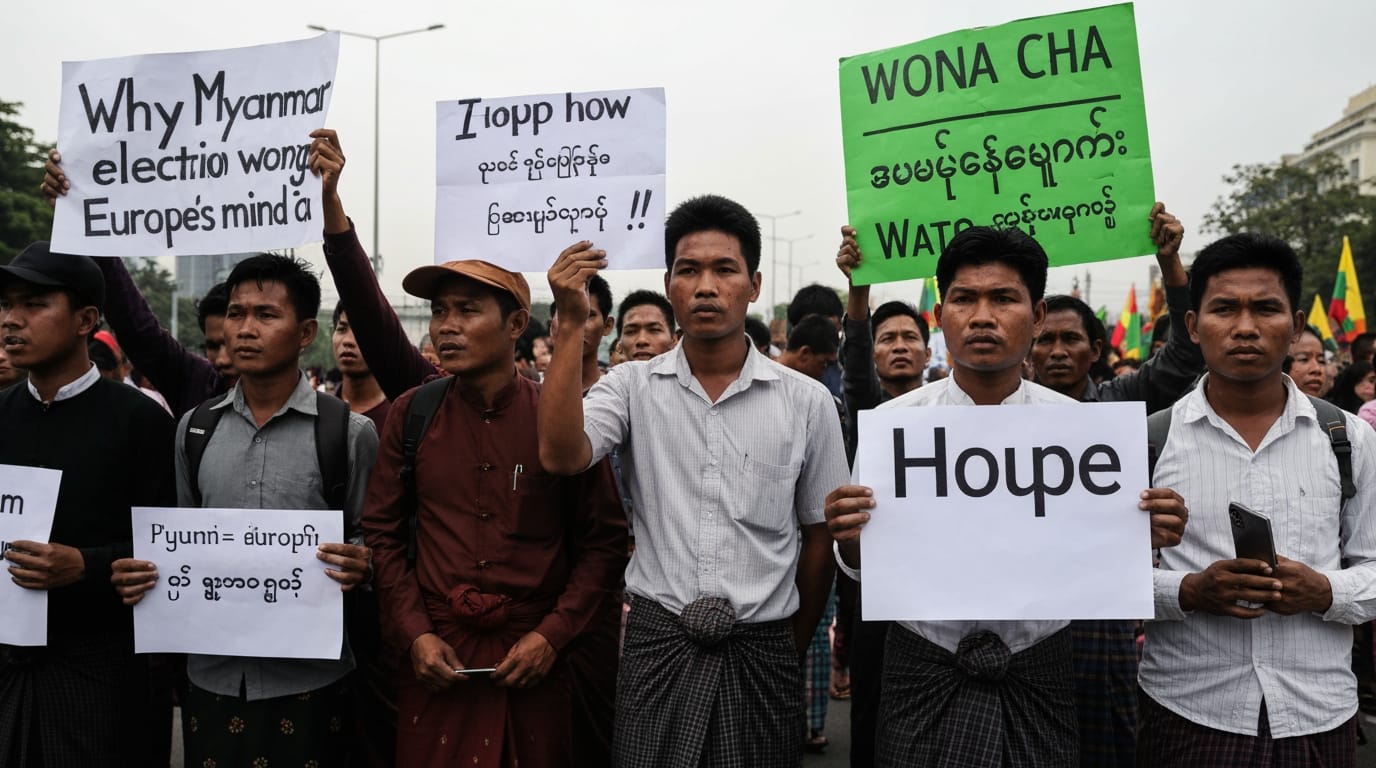
Brussels, Belgium – As Myanmar's military junta proceeds with a multi-phase election described by critics as a "sham," European nations and the European Union remain resolute in their condemnation, signaling that the vote will do little to alter their steadfast opposition to the regime. Nearly five years after seizing power in a coup, the military’s attempt to legitimize its rule through a controlled electoral process has been met with widespread international skepticism, deepening the chasm between the junta and democratic governments.
The staged elections, which commenced in December 2025 and are slated to conclude in January 2026, are largely perceived by the international community as a thinly veiled effort to consolidate military control rather than a genuine stride toward democracy. European officials emphasize that the prevailing conditions in Myanmar — marked by widespread repression, conflict, and the systematic dismantling of democratic institutions — preclude any possibility of a free, fair, or credible electoral outcome. Their stance underscores a commitment to principled diplomacy and human rights, asserting that manufactured polls cannot grant legitimacy to an unelected military government.
The Shadow of the 2021 Coup and Europe's Immediate Response
The current political landscape in Myanmar is a direct consequence of the military coup on February 1, 2021, when the armed forces, known as the Tatmadaw, overthrew the democratically elected government led by Aung San Suu Kyi's National League for Democracy (NLD). The military justified its actions with unsubstantiated allegations of widespread voter fraud in the November 2020 general elections, a claim that was rejected by both domestic and international observers. This abrupt seizure of power plunged Myanmar into a profound crisis, reversing a decade of nascent democratic reforms.
In the immediate aftermath of the coup, the European Union, along with individual European nations, swiftly condemned the military's actions. This condemnation quickly translated into concrete measures, including multiple rounds of sanctions targeting individuals and entities associated with the junta. These restrictive measures, which encompass travel bans, asset freezes, and an arms embargo, are specifically designed to undermine the military regime's economic interests and ability to oppress its population, while aiming to avoid undue harm to the people of Myanmar. The EU's robust response established a clear precedent: the unconstitutional overthrow of a legitimate government would not be tolerated or recognized.
An Electoral Farce: Disenfranchisement and Preordained Outcomes
The elections orchestrated by the junta, officially known as the State Administration Council (SAC), have been widely dismissed as illegitimate. Key opposition parties, most notably the NLD, which secured an overwhelming victory in the 2020 elections, have been dissolved or disqualified, and their leaders, including Aung San Suu Kyi, remain imprisoned on what are largely viewed as politically motivated charges. This systematic exclusion of legitimate political actors ensures that the military-backed Union Solidarity and Development Party (USDP) faces virtually no genuine competition, making the outcome a foregone conclusion.
Further undermining the credibility of the polls are stringent new laws criminalizing any criticism of the election process, imposing severe penalties, including lengthy prison sentences. Reports of coercion and pressure on citizens to participate in the vote have also emerged, painting a picture of an electoral exercise driven by fear rather than free will. Moreover, the ongoing civil conflict means that vast swathes of the country are outside the junta's control, leading to the exclusion of numerous townships and villages from the voting process. The military leader, Min Aung Hlaing, has conceded that the election cannot be held across the entire country, further highlighting the vote's inherent limitations and lack of nationwide legitimacy.
Europe's Principled Stand and Support for Democracy
The European Union and its member states have consistently articulated that the conditions for free and fair elections simply do not exist in Myanmar under military rule. Kajsa Ollongren, the EU Special Representative for Human Rights, has explicitly stated that the bloc will not send election observers, deeming the planned vote a "regime-sponsored exercise" unlikely to yield a credible outcome. This position aligns with the broader international consensus among democratic nations, which largely views the elections as a maneuver by the junta to secure domestic and international legitimacy that it otherwise lacks.
Crucially, the European Parliament has extended its recognition to the National Unity Government (NUG), formed by elected lawmakers who were ousted in the 2021 coup. The NUG, which comprises representatives from the NLD, ethnic minority groups, and other parties, operates as a government-in-exile, advocating for a return to democracy and actively resisting military rule. This recognition underscores Europe's commitment to the democratic aspirations of the Myanmar people and its rejection of the military regime as the legitimate governing authority.
The Deepening Humanitarian and Human Rights Crisis
The insistence on holding elections amidst an escalating civil war further exacerbates an already dire humanitarian and human rights situation in Myanmar. Since the 2021 coup, the country has descended into widespread violence, characterized by arbitrary arrests, torture, extrajudicial killings, and indiscriminate attacks on civilians. Civilian casualties have surged, with thousands killed and millions displaced, reflecting a brutal campaign by the military against its own population.
The UN Special Rapporteur on human rights in Myanmar has urged the international community to reject the elections and redouble efforts to isolate the junta. The reports of intensified hostilities, indiscriminate air strikes, and the denial of humanitarian aid paint a grim picture of a country in crisis. For European policymakers, these ongoing atrocities serve as a constant reminder that any electoral process conducted under such repressive conditions cannot be considered legitimate or representative of the people's will. The elections are perceived not as a solution, but as another layer of the complex and tragic human rights catastrophe unfolding in Myanmar.
Conclusion
Myanmar's military junta's planned elections, characterized by the exclusion of major opposition, severe repression, and an ongoing civil war, are unlikely to soften Europe's firm stance. The European Union and its member states continue to view the regime as illegitimate, maintaining sanctions and refusing to acknowledge an electoral process widely condemned as a "sham." Their unwavering support for democratic principles and the recognition of the National Unity Government reflect a clear message: true legitimacy can only stem from the genuine consent of the governed, not from a manufactured mandate enforced by military power. As Myanmar grapples with profound internal conflict and a humanitarian crisis, Europe's position underscores the international community's continued demand for a return to authentic democracy and respect for human rights.


