NATO Jets Down Drone Over Latvia Amid Rising Regional Tensions
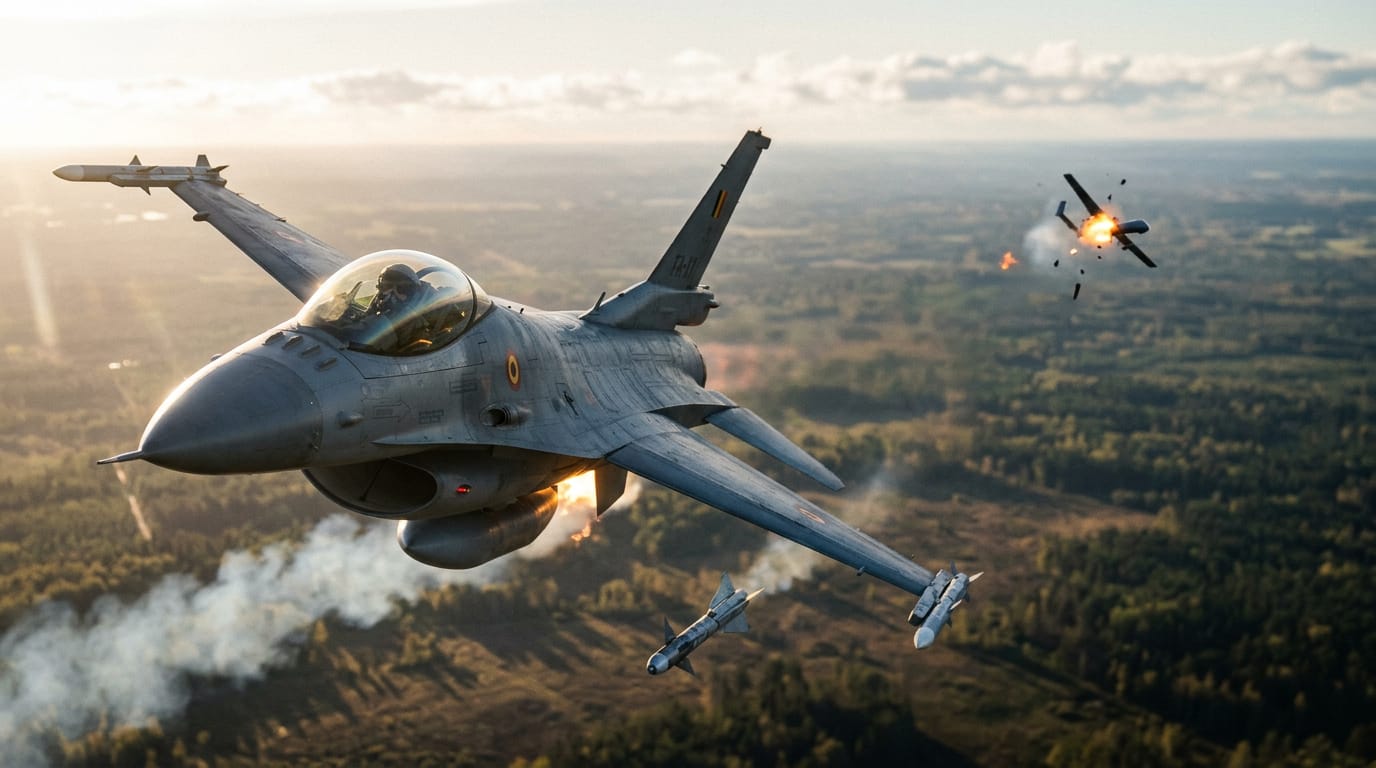
NATO fighter jets intercepted and shot down an unmanned aerial vehicle (UAV) over eastern Latvia early Friday, marking the latest incident in a series of drone incursions that underscore the volatile security landscape of the Baltic region. The Latvian military confirmed the foreign drone entered its airspace, with initial assessments pointing to Russian electronic warfare activities as the cause for the UAV being diverted off its intended course. The dramatic interception comes as the ongoing conflict in Ukraine continues to spill over into neighboring territories, prompting heightened alert levels across NATO's eastern flank.
The incident unfolded in the pre-dawn hours of August 14, 2026, when authorities in five Latvian districts, including Augšdaugava, Preiļi, Rēzekne, and Balvi regions, issued air alerts around 4 a.m., urging residents to seek shelter. NATO's Baltic Air Policing mission swiftly responded, scrambling fighter jets to investigate the unauthorized aerial presence. Italian Eurofighters, operating from Lithuania, and Turkish F-16s from Estonia, were involved in the intercept, with one of the Italian Eurofighters ultimately neutralizing the threat over an unpopulated area of the Balvi municipality. The Latvian National Armed Forces later confirmed that the threat had been neutralized, and the air alerts were lifted. No injuries or damage on the ground were reported following the shootdown.
The Interception and Its Immediate Aftermath
The specific location of the shootdown was identified as the Rugaji parish within the Balvi municipality, near Latvia's borders with Belarus and Russia. While the exact origin of the drone was not immediately disclosed by Latvian officials, military statements suggested it was a "foreign unmanned aerial vehicle" that had veered into Latvian airspace due to "Russian electromagnetic warfare" interference. This assessment indicates the drone was not deliberately targeting Latvia but was instead a casualty of the intense electronic warfare environment prevalent in the region due to the Russia-Ukraine war.
The rapid response by NATO forces highlights the alliance's commitment to protecting the airspace of its member states. The Baltic Air Policing mission maintains a round-the-clock quick-reaction alert, ready to scramble jets against any aircraft entering allied airspace without proper authorization or a working transponder. Latvian Prime Minister Andris Kulbergs publicly thanked the Latvian Armed Forces and NATO allies for their "professional and prompt response," emphasizing the security of Latvia's airspace while also acknowledging the need to strengthen surveillance along the eastern border. Teams are currently surveying the crash site, though the precise location of the debris has not been publicly disclosed.
A Pattern of "Stray Drones" and Geopolitical Spillover
This incident is not an isolated event but rather the latest in a troubling pattern of drone incursions into the airspace of NATO member states in the Baltic region and Finland. It marks the second time in recent months that NATO jets have shot down a drone over Latvia, with a similar incident occurring in June 2026. Earlier in 2026, in March and May, several Ukrainian or suspected Ukrainian military drones also entered the airspace of Lithuania, Latvia, Estonia, and Finland, often crossing from Russia during Ukrainian long-range attacks on Russian targets.
The prevailing theory among Baltic officials and NATO is that these drones, often believed to be Ukrainian strike drones, are being intentionally or unintentionally diverted by sophisticated Russian electronic warfare systems. The latest shootdown coincided with reports of large-scale Ukrainian drone attacks on Russian targets in Leningrad Oblast, including the Ust-Luga port on the Baltic Sea. The short route to such targets often passes near the eastern borders of Latvia and Estonia, increasing the likelihood of unintended airspace violations. Ukrainian Foreign Minister Andrii Sybiha previously accused Russia of deliberately redirecting Ukrainian drones towards neighboring countries to create friction, offering to dispatch Ukrainian anti-drone specialists to help allies defend against such incidents. These incidents underscore the complex and dangerous interplay of electronic warfare and drone technology in the ongoing conflict.
NATO's Steadfast Vigilance in the Baltic Region
The repeated drone incursions highlight the critical role of NATO's Baltic Air Policing mission, which has continuously safeguarded the skies of Latvia, Lithuania, and Estonia since their accession to NATO in 2004. The mission ensures that any unauthorized or unidentified aircraft entering allied airspace is met with a swift and decisive response, demonstrating the alliance's collective defense capabilities. The downing of the drone serves as a tangible demonstration of Article 5's practical implications, reinforcing that an attack or significant threat to one member is considered a threat to all.
Despite the prevailing assessment that the drone was diverted rather than being an intentional threat to Latvia, the incidents serve as stark reminders of the ongoing security challenges posed by the proximity to the conflict in Ukraine. The heightened state of readiness by allied forces, involving contributions from various NATO member states, is a clear signal of the alliance's resolve to maintain the integrity of its borders and protect its member nations. Latvia, along with its Baltic neighbors, remains a frontline state in the evolving geopolitical tensions, necessitating continuous investment in air defense and surveillance capabilities.
Escalating Incidents and Future Implications
The frequency of drone-related incidents in the Baltic Sea region has undeniably escalated in 2026. Beyond the two recent events in Latvia, a Romanian Air Force F-16 fighter jet, also part of the Baltic Air Policing mission, intercepted and destroyed a suspected Ukrainian drone over Estonia in May. Finland also reported suspected territorial violations by UAVs in March, with one identified as a Ukrainian AN-196. In Lithuania, multiple incidents in May saw air warnings issued and air traffic temporarily suspended due to drone activity.
These recurrent events underscore a pressing need for enhanced collaboration and technological solutions to manage the spillover effects of modern warfare. While the primary blame for these diversions is attributed to Russian electronic warfare, they nonetheless create significant security challenges and operational complexities for NATO members. The potential for miscalculation or accidental escalation remains a constant concern. The Latvian military's statement, "As long as Russia's aggression in Ukraine continues, a recurrence of cases where foreign drones enter or approach Latvian airspace is possible," encapsulates the ongoing reality for the region.
The downing of the drone over Latvia on Friday serves as a potent reminder of the fragility of peace and the ever-present need for vigilance on NATO's eastern flank. It illustrates the alliance's readiness to defend its airspace and highlights the complex, often unpredictable, consequences of electronic warfare on modern battlefields that extend far beyond the immediate conflict zones. As the war in Ukraine continues, NATO members in the Baltic region must brace for continued aerial incidents and adapt their defense strategies to counter these evolving threats.


