Niger's Capital Airport Rocked by Renewed Gunman Attack Amidst Persistent Insurgency
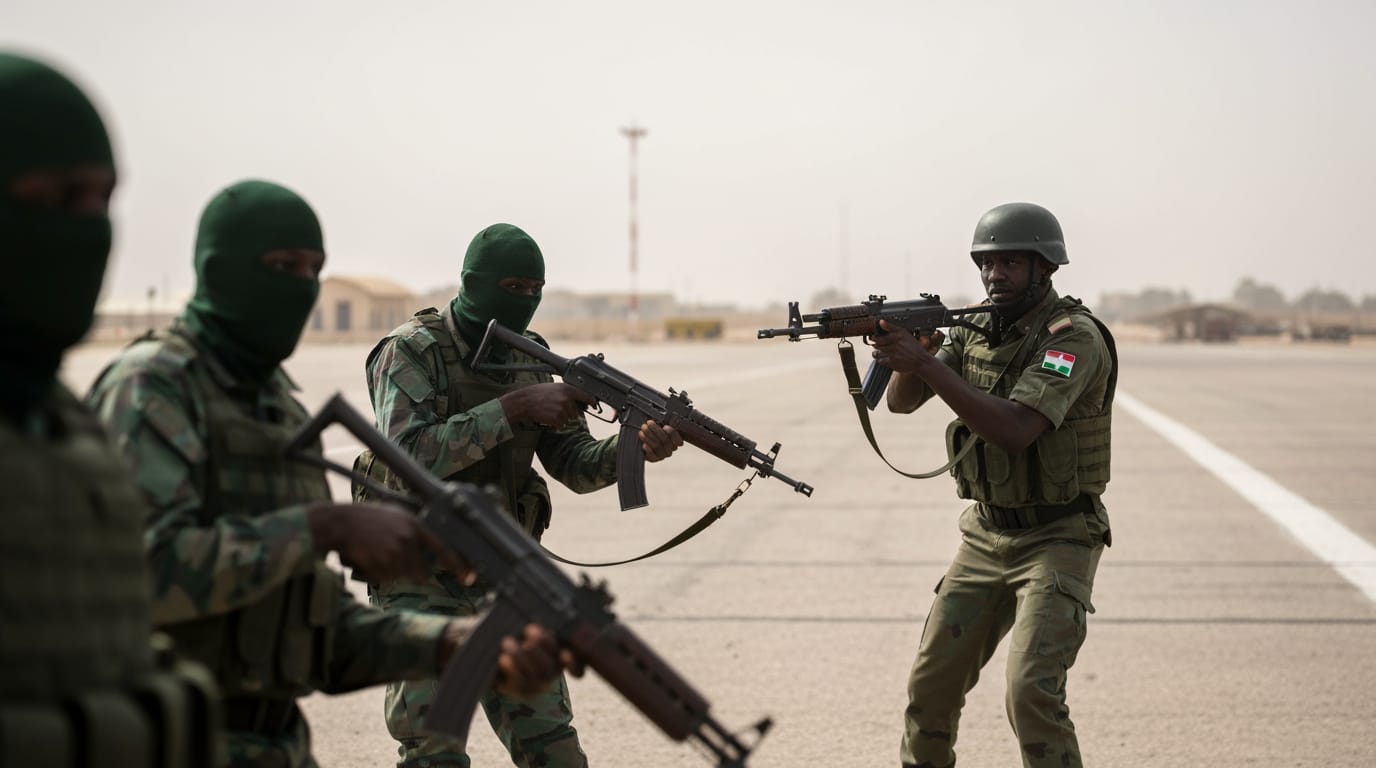
NIAMEY, NIGER – Gunmen launched a fresh assault on Diori Hamani International Airport in Niamey, Niger’s capital, early Thursday morning, sparking an exchange of gunfire and explosions. The incident marks the second such attack on the strategic facility this year, underscoring the severe and escalating security challenges facing the military-led government in the West African nation. Security forces were swiftly deployed to repel the assailants, though immediate details regarding casualties or the identity of the attackers remain limited.
This latest breach of security echoes a more detailed and devastating assault that occurred just months prior, on January 29, 2026, when a coordinated attack by Islamic State affiliates targeted the same airport and the adjacent Air Base 101. That earlier incident highlighted the increasing sophistication and audacity of extremist groups in the Sahel, a region grappling with widespread instability and ongoing jihadist violence.
The January Onslaught: A Precedent for Urban Warfare
The early hours of January 29, 2026, saw Diori Hamani International Airport plunged into chaos as more than 30 militants, identified as belonging to the Islamic State's Sahel Province and West Africa Province, launched a multi-pronged assault. Utilizing motorcycles, drones, and mortars, the attackers executed a "surprise and coordinated" strike on both the civilian side of the airport and the vital Air Base 101. Heavy gunfire and explosions resonated across the capital, marking a significant escalation in the conflict.
The militants managed to infiltrate the airport facilities, firing upon commercial and military aircraft and various buildings. The battle raged for approximately two hours before Nigerien ground and air forces, aided by the Russian Africa Corps stationed at the base, successfully regained control. Official reports from the Nigerien government stated that 20 attackers were killed and 11 captured, while four Nigerien soldiers sustained injuries. However, unofficial accounts suggested a higher toll, with some sources alleging 24 Nigerien soldiers and three Russian mercenaries were killed.
The damage inflicted during the January attack was substantial. At least five military aircraft, including one helicopter, were reportedly destroyed. Commercial airliners were not spared, with a passenger plane operated by Air Côte d'Ivoire and two Asky Airlines aircraft suffering damage to their fuselages and wings while on the tarmac. Satellite imagery later confirmed damage to at least three hangars at Base 101. The Islamic State, through its Amaq News Agency, swiftly claimed responsibility, boasting of a "significant damage" and later releasing photos and videos of the assault. Analysts noted the presence of Hausa and Kanuri speakers in the footage, suggesting collaboration between the Islamic State's Sahel and West Africa provinces.
Niamey: A New Front in the Sahelian Conflict
The January 29 attack represented a critical turning point, marking the first major jihadist assault on Niamey, a capital that had largely been spared the direct impacts of the Islamist insurgency that has plagued other parts of Niger and neighboring countries for over a decade. The choice of Diori Hamani International Airport as a target was highly symbolic and strategic. Base 101, located within the airport complex, serves as a crucial hub for Niger’s military aircraft and drones, and is the headquarters for the newly established counter-terrorism unit of the Alliance of Sahelian States (AES), comprising troops from Burkina Faso, Mali, and Niger.
This shift towards urban targets by extremist groups underscores a troubling evolution in their tactics. While rural areas and border regions have long been epicenters of violence, the deliberate targeting of critical infrastructure within the capital signals a bid to undermine state authority and project a wider reach. Such attacks serve to destabilize the government, which, since the 2023 coup, has prioritized improving security as a cornerstone of its legitimacy.
Geopolitical Realignments and Regional Instability
Niger has been grappling with a complex and deteriorating security landscape, exacerbated by a military coup in July 2023 that ousted the democratically elected president, Mohamed Bazoum. Following the coup, Niger's military government severed long-standing security ties with Western nations, including France and the United States, and instead forged closer cooperation with Russia. This geopolitical pivot has seen the Russian Africa Corps play an increasingly prominent role in assisting Nigerien forces.
The broader Sahel region has witnessed a significant uptick in extremist activity, with militants affiliated with both Al-Qaeda (such as Jama'at Nusrat al-Islam wal-Muslimin, JNIM) and the Islamic State escalating their campaigns throughout 2025. These groups exploit porous borders, weak governance, and socio-economic grievances to expand their influence. The current military juntas in Niger, Mali, and Burkina Faso, having formed the AES, face a formidable challenge in containing this widespread violence.
In the immediate aftermath of the January airport attack, Niger’s military government provocatively accused France, Benin, and Ivory Coast of sponsoring the terrorists – allegations that were vehemently denied by the accused nations. The incident also prompted the U.S. State Department to order the evacuation of non-emergency personnel and their families from Niger, highlighting international concerns over the volatile security situation.
A Persistent Threat to Stability
The recurrence of an attack on Diori Hamani International Airport, as reported on Thursday, reinforces the grim reality that Niger's capital and its critical infrastructure remain highly vulnerable to extremist violence. While details of the latest incident are still emerging, the January attack demonstrated the capacity of jihadist groups to orchestrate complex operations aimed at high-profile targets.
The military government, despite its efforts and newfound alliances, continues to struggle with containing the pervasive insurgency that threatens to unravel the fabric of the state. The repeated targeting of key facilities like the airport not only undermines public confidence but also poses significant questions about the effectiveness of current security strategies and the long-term stability of Niger and the wider Sahel region. The ongoing battles in Niamey serve as a stark reminder of the relentless and evolving nature of the extremist threat in a region already besieged by humanitarian crises and political upheaval.


