North Korea Accelerates Submarine Arsenal with Apparent Progress on Nuclear-Powered Vessel
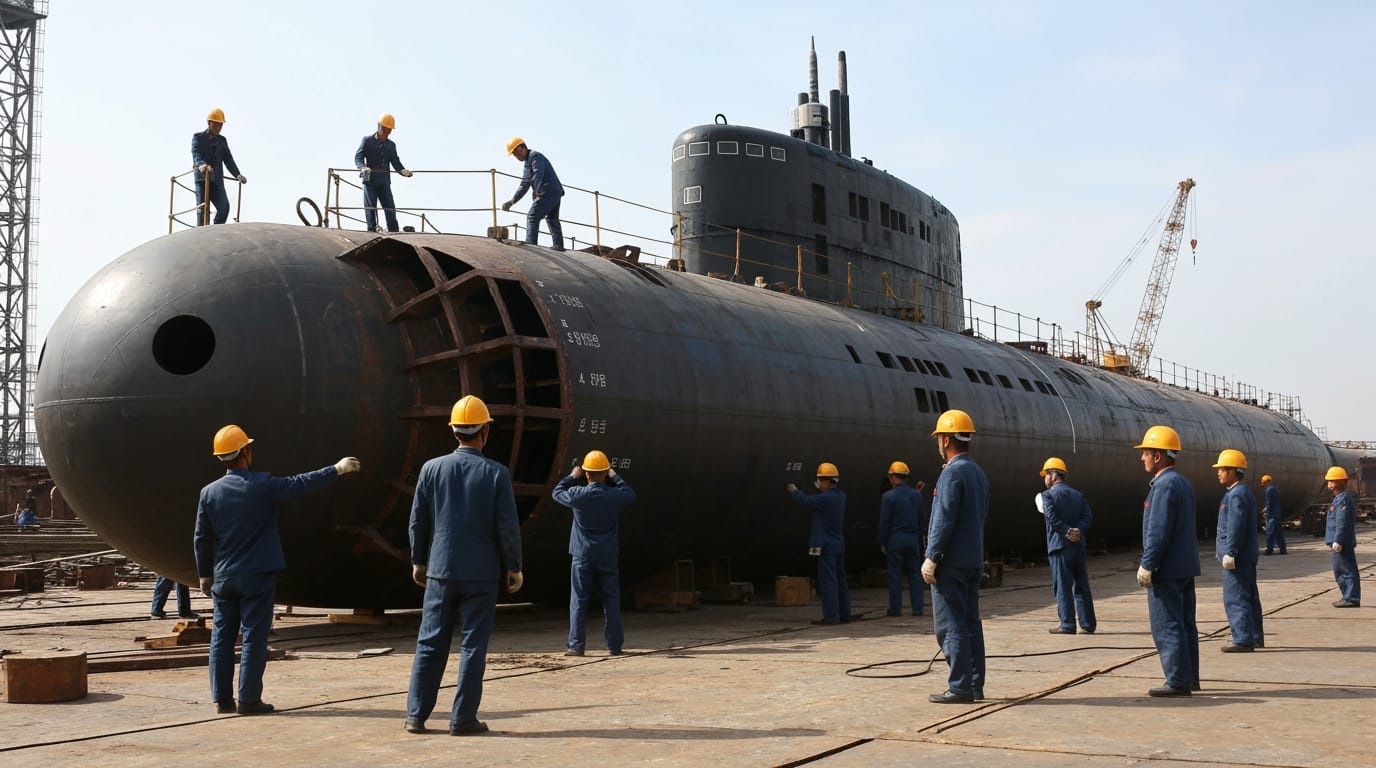
Pyongyang, DPRK – North Korea has unveiled significant strides in its ambitious drive to bolster its naval capabilities, with state media releasing images this week suggesting substantial progress in the construction of an 8,700-ton nuclear-powered strategic guided-missile submarine. This development marks a potentially pivotal moment in the reclusive nation's pursuit of an advanced sea-based nuclear deterrent, following the launch of a "tactical nuclear attack submarine" in 2023 that remains unoperational. The dual-track approach underscores North Korea's determination to enhance its underwater strike capabilities, escalating concerns across the Korean Peninsula and beyond.
Pyongyang's Dual Push for Underwater Nuclear Prowess
Recent state media reports from North Korea, specifically the Korean Central News Agency (KCNA), detailed leader Kim Jong Un's inspection of a shipyard, where a massive, burgundy-colored submarine hull was showcased inside an assembly hall. This vessel, described as an "8,700-ton-class nuclear-propelled submarine" and a "strategic guided missile submarine," appears far more complete than images previously released in March, indicating accelerated construction. Kim Jong Un hailed the project as an "epoch-making" step in strengthening the nation's nuclear war deterrent and a crucial component in the modernization and nuclear armament of North Korea's navy.
This push for a genuinely nuclear-powered submarine follows closely on the heels of the September 2023 launch of the "Hero Kim Kun Ok" (Submarine No. 841), a diesel-electric vessel North Korea controversially designated as a "tactical nuclear attack submarine." While the 2023 submarine's "nuclear" designation refers to its intended armament rather than its propulsion, the latest revelation confirms Pyongyang's long-term goal of acquiring true nuclear-powered vessels capable of extended underwater operations.
The "Hero Kim Kun Ok" – A Stepping Stone with Challenges
The "Hero Kim Kun Ok," launched on September 6, 2023, at the Sinpo South Shipyard, represented North Korea's first vessel explicitly equipped with vertical launch tubes for submarine-launched ballistic missiles (SLBMs). Attended by Kim Jong Un, the ceremony marked the introduction of a heavily modified Romeo-class diesel-electric submarine, a Soviet-era design acquired by North Korea in the 1970s. Analysts noted significant modifications, including a large hump attached aft of the sail with ten vertical missile hatches of varying sizes, believed capable of deploying North Korea's larger Pukguksong SLBMs and smaller modified KN-23 SLBMs, as well as cruise missiles.
Despite the fanfare, the operational status of the "Hero Kim Kun Ok" remains questionable. As of July 2025, satellite imagery consistently showed the vessel docked under a security canopy at the Sinpo South Shipyard, with no visible signs of deployment or sea trials. This prolonged inactivity suggests persistent technical hurdles in integrating advanced missile systems into the aging hull and achieving full operational readiness. Experts have raised doubts about the submarine's ability to operate normally, with some suggesting its design may be impractical or exaggerated for propaganda purposes. The delay has likely frustrated Kim Jong Un's "ambitions for a modern navy."
The Ambition of a True Nuclear-Powered Leviathan
The newly showcased 8,700-ton nuclear-powered submarine signals a more profound strategic ambition. Unlike the diesel-electric "Hero Kim Kun Ok," a nuclear-powered submarine can stay submerged for significantly longer periods, potentially for years, as it does not need to surface to recharge batteries. This capability would vastly increase its stealth, range, and ability to conduct covert patrols, making detection by adversaries considerably more challenging.
Kim Jong Un has previously articulated the necessity of possessing nuclear-powered submarines as one of the "five major strategic tasks" outlined at the 8th Workers' Party Congress in January 2021. By classifying the new vessel as "strategic," North Korea explicitly indicates its intention for this submarine to carry longer-range missiles, potentially targeting the United States, in contrast to the "tactical" role of the "Hero Kim Kun Ok" aimed at regional adversaries. The exact type of nuclear reactor and the extent of indigenous expertise for its development remain subjects of debate. Analysts suggest the reactor could be the most challenging and time-consuming component. While North Korea's history suggests a "good enough" indigenous design is possible, external assistance, potentially from Russia given recent closer ties, cannot be ruled out.
Regional Alarm and International Skepticism
The apparent progress in North Korea's nuclear submarine program has predictably triggered strong reactions from regional powers and the international community. South Korea views Pyongyang's submarine developments with grave concern, particularly as Seoul itself pursues the acquisition of nuclear-powered submarine technology with backing from the United States. North Korea has, in turn, condemned South Korea's naval ambitions as an "offensive act" that infringes on its security and destabilizes the Korean Peninsula, reiterating its commitment to a "merciless retaliatory attack" should its strategic sovereignty be threatened.
The United States and its allies continue to monitor North Korea's activities closely. While North Korea presents its submarine advancements as a necessary deterrent against perceived threats, international observers remain skeptical about the immediate operational readiness of these complex vessels, particularly the 2023 "Hero Kim Kun Ok." Concerns persist regarding North Korea's ability, constrained by international sanctions and limited resources, to independently build and operate such sophisticated platforms without significant external technological assistance.
Conclusion
North Korea's sustained efforts in developing a sea-based nuclear deterrent, culminating in the apparent construction progress on an 8,700-ton nuclear-powered submarine, signifies a profound shift in its military posture. This development, alongside the earlier launch of the "Hero Kim Kun Ok" tactical submarine, represents Pyongyang's determined pursuit of a credible second-strike capability and an enhanced ability to project power. While significant technical and operational hurdles likely remain, the advancements underscore North Korea's unwavering commitment to its nuclear armament program. The long-term implications for regional stability are considerable, potentially ushering in a new and more complex phase of strategic competition in Northeast Asia and necessitating continued vigilance and diplomatic engagement from the international community.


