North Korean Women's Football Team Makes Rare Visit to South, Sparking Cautious Hopes Amid Tensions
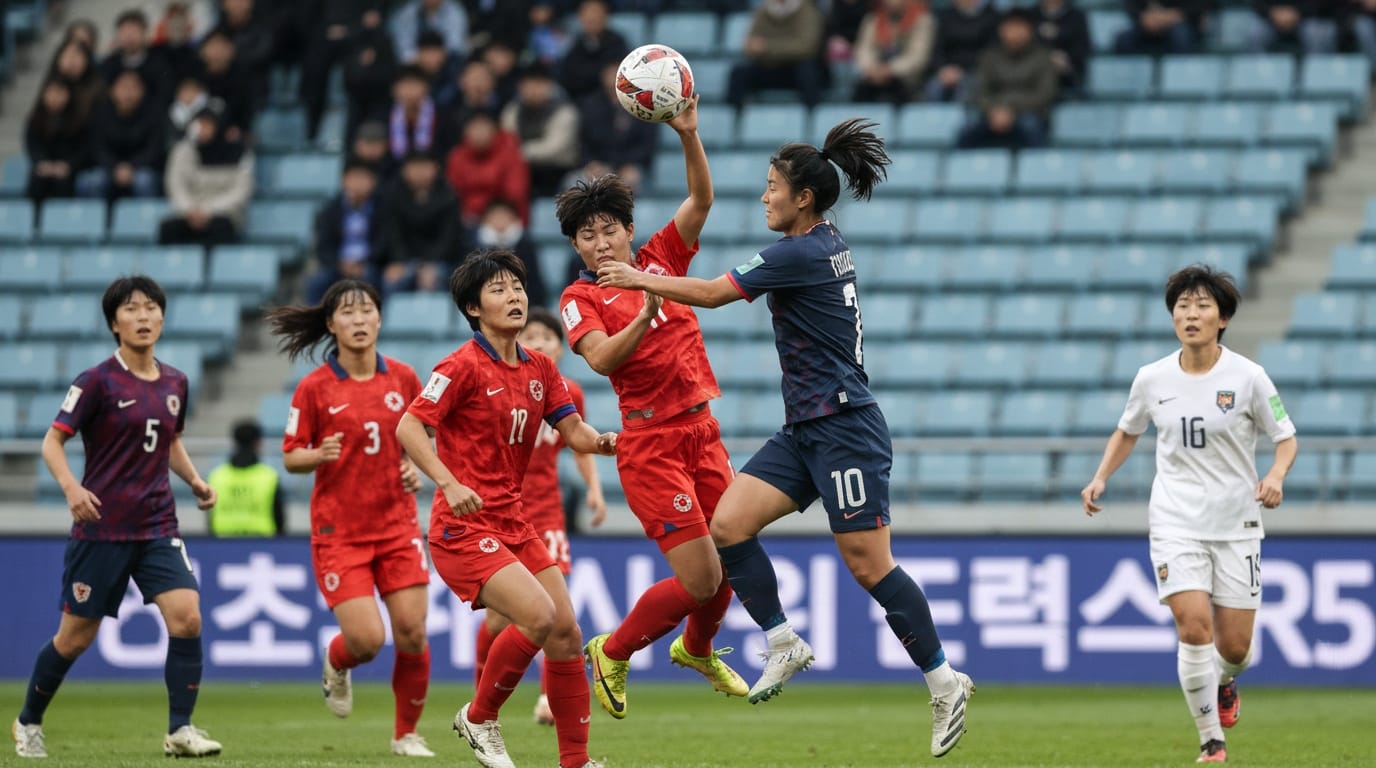
SUWON, South Korea – In a rare cross-border interaction amidst deeply strained diplomatic relations, North Korea's Naegohyang Women's FC arrived in South Korea on Sunday, May 17, marking the first visit by North Korean athletes to the South in eight years. The Pyongyang-based football club is set to compete against South Korea's Suwon FC Women in the semifinals of the Asian Football Confederation (AFC) Women's Champions League, an event drawing significant attention not only for its sporting significance but also for its delicate political implications. The arrival of the 39-member delegation has ignited a cautious glimmer of hope for potential, albeit limited, engagement between the two Koreas, even as Pyongyang continues to label Seoul its "most hostile state."
A Fragile Bridge: The Historic Arrival
The North Korean delegation, comprising 27 players and 12 staff members, touched down at Incheon International Airport after traveling by air from Beijing. Their arrival was met by a contingent of nearly 100 reporters and international media, eager to document the unusual moment. While the players remained largely silent, some activists present at the airport offered shouts of "Welcome! Welcome!" and citizens filmed their arrival with mobile phones, underscoring the public's keen interest in this rare exchange. The team is scheduled to stay in South Korea through next weekend, potentially until May 24, should they advance to the final match.
This visit represents a significant moment, as it is the first time a North Korean women's football team has competed on South Korean soil since the 2014 Incheon Asian Games. More broadly, it marks the first time any North Korean sports delegation has visited the South since December 2018, when a unified Korean table tennis team participated in a tournament in Incheon. The journey of Naegohyang Women's FC, whose name translates to "My Homeland" in Korean, to Suwon to face their South Korean counterparts, is more than just a sporting fixture; it is a brief, heavily scrutinized moment of direct contact across one of the world's most fortified borders.
Sporting Diplomacy Amidst Deepening Chasm
The setting for this historic match is the Suwon Sports Complex, where the semifinal is scheduled for Wednesday, May 20, at 7 p.m. local time. However, the diplomatic backdrop against which this sporting event unfolds is far from harmonious. Inter-Korean relations have plummeted to one of their lowest points in years, with North Korean leader Kim Jong Un having recently declared inter-Korean ties as relations between "two hostile states," effectively abandoning the long-held view of the two Koreas as one people temporarily divided. This stance has led to a near-total estrangement between Seoul and Pyongyang.
In stark contrast, South Korean President Lee Jae Myung, who took office in June 2025, has made the revival of inter-Korean dialogue a central policy goal. Despite this, analysts caution against interpreting the current football exchange as a significant sign of a diplomatic thaw. Lee Wootae, a senior research fellow at Seoul's Korea Institute for National Unification (KINU), noted that it would be more accurate to view this as a "limited South-North Korean contact within the framework of international sports" rather than an improvement in bilateral relations. The political burden of this visit is considered relatively low because it is a club team participating in an international tournament, rather than a national team or a government-initiated exchange. The AFC, as the organizer, emphasizes the event should proceed as a "purely sporting occasion."
Rules of Engagement: Logistics and Symbolism
The nature of the competition as an international club event dictates specific protocols, ensuring that political symbols are kept at bay. In line with Asian Football Confederation rules, the matches will not feature national anthems or political symbols, including the Korean Unification flag. This flag, a white banner adorned with a blue silhouette of the Korean peninsula, has historically been used in international sports events involving both sides to symbolize unity.
Despite the official non-political stance, the South Korean government is actively facilitating the visit. Seoul's Unification Ministry has approved the stay under the inter-Korean exchange law and is providing necessary logistical support for the visiting team. Furthermore, the ministry has allocated approximately 300 million won (about $200,000 USD) from an inter-Korean cooperation fund to support cheering squads for both teams. This initiative aims to foster mutual understanding, with civic groups planning to organize a joint cheering squad of around 3,000 people.
Public interest in the match has been exceptionally strong. All 7,087 tickets made available to the general public for Wednesday's semifinal sold out within a single day, according to Yonhap News Agency and the South Korean football federation. While the Naegohyang squad will stay at a hotel in Suwon, local reports indicate that their dining areas and travel routes will be kept separate from the South Korean team to minimize unscheduled encounters.
A History of Sporting Engagement
Sporting events have, at times, served as crucial avenues for inter-Korean interaction and potential reconciliation. A notable period of rapprochement occurred in 2018, when North Korea sent athletes, cheerleaders, and a high-level delegation to the Pyeongchang Winter Olympics in the South. During those games, the two Koreas even fielded their first unified Olympic team – a joint women's ice hockey squad. Prior to that, Ri Sol Ju, the wife of North Korean leader Kim Jong Un, visited South Korea in 2005 as part of a North Korean cheering squad for the Asian Athletics Championships.
However, the brief period of inter-Korean détente largely ended after U.S.-North Korea nuclear talks collapsed in 2019, primarily due to disputes over international sanctions on Pyongyang. Since then, North Korea has escalated its provocative weapons tests and consistently rejected offers from South Korea and the United States to resume diplomatic talks. This makes the current football visit particularly salient as an isolated instance of exchange rather than a precursor to broader dialogue.
From a purely sporting perspective, North Korea boasts a formidable women's football program, recognized as one of the strongest in the region and ranking 11th globally. Their youth teams have achieved remarkable success, winning the FIFA U-17 Women's World Cup a record four times and the U-20 equivalent three times. Naegohyang FC itself is a powerful club, having won the North Korean top flight in the 2021-22 season and previously defeated Suwon FC Women 3-0 during the Champions League group stage in Myanmar last November.
Conclusion: A Ball on the Edge
The arrival of Naegohyang Women's FC in South Korea is a delicate dance between sport and geopolitics. While the match itself promises to be a thrilling contest between two strong teams, its primary significance lies in its rarity as a direct interaction between two nations technically still at war. The event offers a temporary, albeit fragile, bridge across a deeply entrenched divide, allowing for human connection and athletic competition where diplomatic channels remain largely frozen.
While hopes for a significant breakthrough in inter-Korean relations may be tempered by the current political realities and expert assessments, the sold-out stadium and the government's support for a joint cheering squad reflect a persistent yearning among the South Korean public for engagement and mutual understanding. This football encounter, carefully managed to avoid political friction, serves as a poignant reminder that even in times of heightened tension, sport retains its unique ability to bring people together, if only for a fleeting moment, on the field of play. The final whistle on Wednesday will conclude a match, but the broader game of inter-Korean relations continues, with this rare visit representing a small, yet notable, play in its complex unfolding.


