Palestinian Family of Four, Including Two Children, Killed by Israeli Troops in West Bank Incident
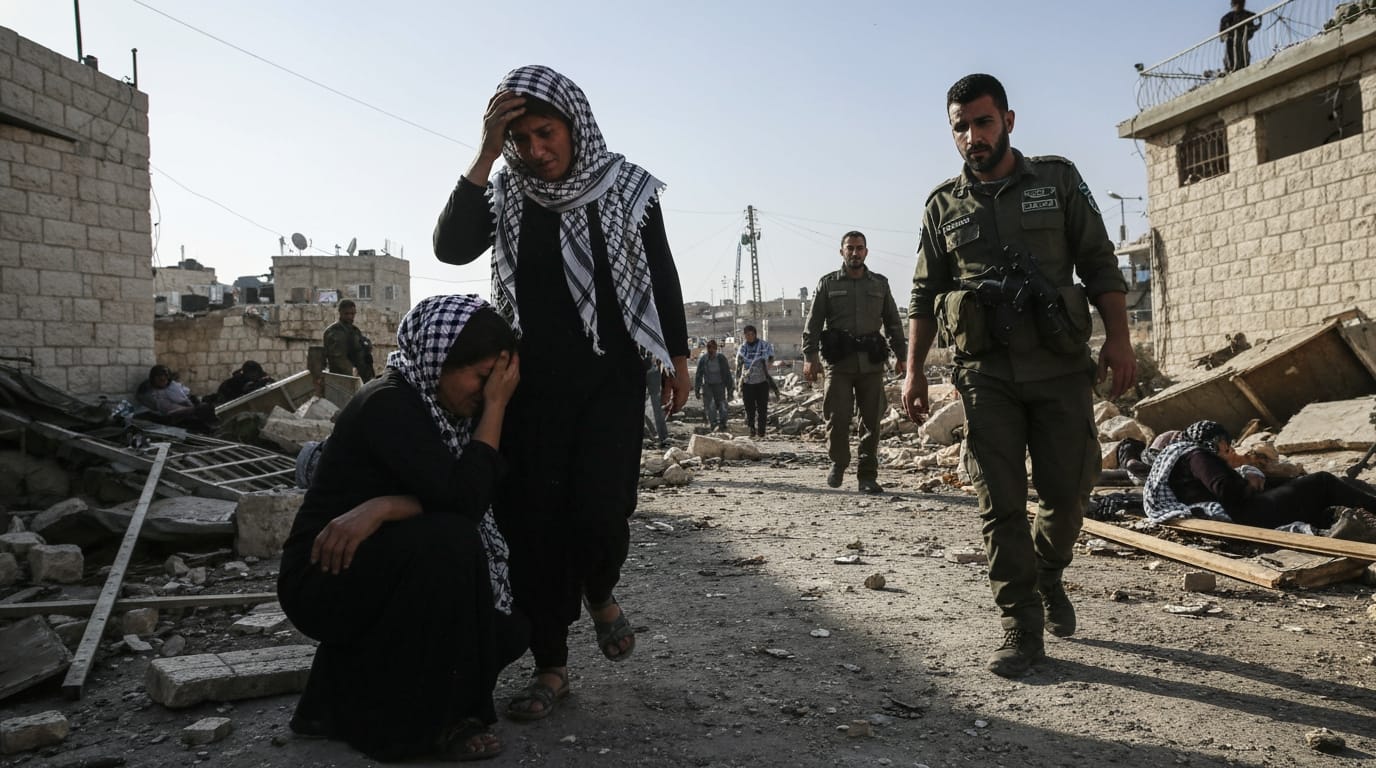
TAMMUN, West Bank – A Palestinian family of four, including two young children, was killed by Israeli forces in the northern West Bank town of Tammun on Saturday, March 15, 2026, according to Palestinian health authorities and initial reports from the scene. The incident, which left two other children from the same family wounded, has sparked immediate condemnation and renewed calls for investigation amidst a significant escalation of violence across the occupied territory. The family was reportedly returning home from shopping for Eid al-Fitr, a Muslim holiday, when their vehicle came under fire.
The Tragic Incident in Tammun
The victims have been identified by Palestinian authorities as Ali Khalid Bani Odeh, 37, his wife Waad Othman Bani Odeh, 35, and their two youngest sons, Mohammad, 5, and Othman, 7, who was reportedly blind and had special needs. All four were reportedly shot in the head, with Ali also sustaining gunshot wounds to the chest, thigh, and arm. The Palestinian Red Crescent rescue service indicated that the family's two other children, aged eight and eleven, survived the shooting but suffered shrapnel wounds, including to the eye and head. According to reports, Israeli forces initially prevented ambulances from reaching the scene, a claim the Red Crescent has frequently made regarding incidents in the West Bank, alleging that such barriers tighten movement and make emergency response significantly more difficult. The family’s car was later seen riddled with bullets and was reportedly towed away by the Israeli military.
Najah al-Subhi, who lost her son and grandchildren in the attack, told The Associated Press that the family had gone to a mall in Nablus to purchase clothes for the upcoming Eid al-Fitr holiday. One of the surviving children, Khaled, 11, recounted hearing his mother crying and his father praying before they died, and also claimed that Israeli soldiers physically assaulted him and his brother after the killings, making derogatory remarks.
Conflicting Narratives and Official Responses
The Israeli military and police issued a joint statement acknowledging the incident, stating that forces opened fire after a car accelerated towards them in Tammun. They claimed the forces were pursuing suspects involved in "terrorist activity" and that the shooting incident is currently under investigation. However, when pressed on what threat was posed by four unarmed family members, including children, or whether the shooting violated Israeli rules of engagement, the police and military declined to comment, referring questions to each other.
Palestinian and international human rights organizations have strongly criticized the Israeli military's account. The Israeli rights group B'tselem reported that the Odeh family's car was extensively damaged by bullets and that one of the wounded surviving children was "violently interrogated" by Israeli forces. Critics, including Yesh Din, another Israeli rights group, assert that an effective mechanism for accountability rarely exists, noting that Israeli soldiers accused of harming Palestinians are infrequently penalized, with indictments in less than 1% of cases stemming from complaints between 2016 and 2024.
Escalating Violence and Humanitarian Concerns in the West Bank
This tragic event comes amid a disturbing surge in violence across the occupied West Bank. Since the alleged start of a regional conflict involving Iran on February 28, Israeli settlers and soldiers have killed at least eight Palestinians, bringing the total number of Palestinians killed to eleven in a period of just over two weeks. The United Nations Office for the Coordination of Humanitarian Affairs (OCHA) reported that 1,062 Palestinians, including at least 231 children, were killed in the occupied West Bank between October 7, 2023, and March 7, 2026. This period has been described by Human Rights Watch as the deadliest for Palestinians in the West Bank since 2005, with 719 Palestinians killed by Israelis between October 7, 2023, and October 7, 2024.
The increased violence has been accompanied by heightened movement restrictions imposed by Israeli authorities, including the intermittent closure of hundreds of gates and checkpoints. These restrictions severely impede the movement of residents, ambulances, and commercial traffic, making emergency responses significantly more challenging. Settlements in areas like Tammun have also faced frequent raids and road closures, impacting the daily lives and livelihoods of residents. Furthermore, unchecked settler violence has been a persistent issue, leading to displacement and attacks on Palestinian communities, often with alleged impunity.
International Condemnation and Calls for Accountability
The international community, including various UN bodies and the European Union, has consistently voiced grave concerns over the escalating violence and the lack of accountability for civilian deaths in the West Bank. The UN Human Rights Office (OHCHR) has condemned the killing of the family in Tammun, highlighting a "persistent trend of unlawful killings of Palestinians with impunity." OHCHR has also raised alarm over the "systematic asphyxiation" of Palestinian rights in the West Bank, noting that Israeli policies and practices resemble an apartheid system, with discriminatory laws affecting every aspect of Palestinian life, from access to water and schools to movement.
UN experts have called for an immediate end to violence by both settlers and Israeli security forces, emphasizing Israel's obligation under international law to protect civilians under occupation and to ensure accountability for violations. The EU has urged the Israeli government to take immediate and effective action to prevent further attacks against Palestinian civilians and to ensure that those responsible are held accountable, warning that impunity risks provoking further violence. These calls underscore a growing international demand for investigations into alleged unlawful killings and for an end to the cycle of violence and perceived impunity that has characterized the region.
A Cycle of Loss and Impunity
The tragic deaths of the Odeh/Bani Odeh family serve as a stark reminder of the devastating human cost of the ongoing Israeli-Palestinian conflict, particularly in the West Bank. The conflicting accounts surrounding the incident further highlight the deep divisions and lack of trust between the involved parties. As investigations are promised by Israeli authorities and demanded by international bodies, the focus remains on ensuring transparency and accountability. Without a clear mechanism to address these fatalities and the broader pattern of violence, the cycle of loss and impunity is likely to continue, perpetuating suffering and undermining prospects for lasting peace in the region. The escalating violence, coupled with stringent movement restrictions and humanitarian concerns, points to an urgent need for concerted international action to protect civilians and uphold international law.