Poland Revokes Zelenskyy's Top Honor Amid WWII Historical Disputes
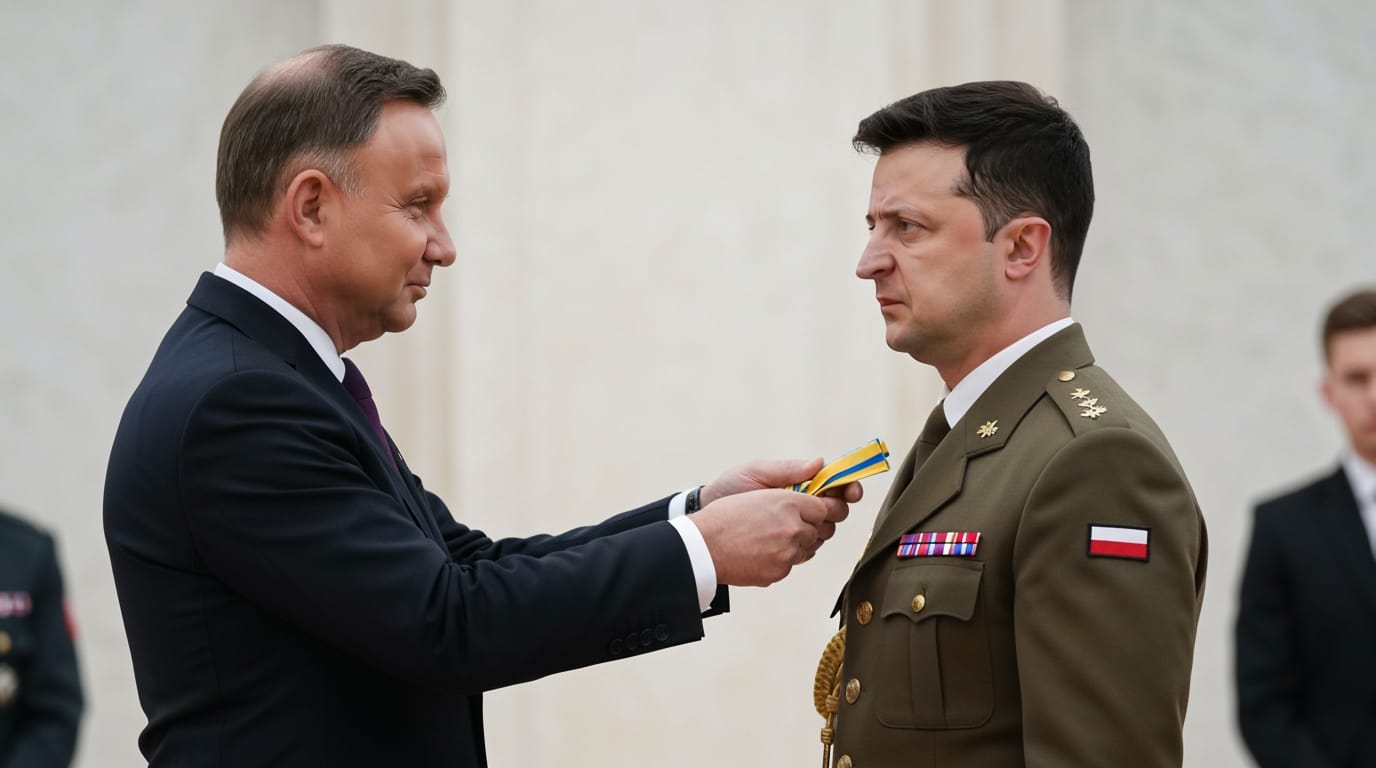
WARSAW, Poland — In a move underscoring the enduring sensitivity of World War II history, Poland's President Karol Nawrocki announced on June 19, 2026, his decision to strip Ukrainian President Volodymyr Zelenskyy of the Order of the White Eagle, the country's highest state honor. The unprecedented revocation stems from Ukraine's recent decision to name a military unit after the Ukrainian Insurgent Army (UPA), a paramilitary organization deeply controversial in Poland for its role in massacres of Polish civilians during the 1940s. While President Nawrocki maintained that the decision does not signal a retreat from Poland's strategic support for Ukraine against Russian aggression, it highlights a profound historical rift threatening to complicate crucial bilateral relations as Kyiv seeks closer integration with Western structures.
The Revocation and Its Historical Flashpoint
The Order of the White Eagle, an award bestowed upon Zelenskyy in 2023 by then-President Andrzej Duda for his "services to security, resilience and the defence of human rights," represents Poland's highest expression of trust and gratitude. However, this honor is now being withdrawn following a decree issued by President Zelenskyy on May 26, which designated a unit of Ukraine's Special Operations Forces with the honorary title "named after the Heroes of the UPA." This decision reignited painful memories in Poland, where the UPA is largely remembered as a force responsible for the brutal killings of tens of thousands of Poles, primarily in the Volhynia and Eastern Galicia regions between 1943 and 1945. The Polish parliament officially recognized these atrocities as genocide in 2016, solidifying the UPA's contentious legacy within Polish national consciousness.
The UPA's history is complex, reflecting the tumultuous geopolitical landscape of World War II. Formed with the aim of establishing an independent Ukrainian state, the organization engaged in armed struggle against various occupying powers, including Nazi Germany and the Soviet Union. For many Ukrainians, the UPA's members are celebrated as heroes who fought for their nation's sovereignty against imperial forces. Yet, this perspective starkly contrasts with the Polish narrative, which focuses on the UPA's ethnic cleansing campaigns against Polish civilians. The naming of a contemporary military unit after such a group is viewed in Warsaw as an intolerable glorification of perpetrators of war crimes, violating deeply held Polish values and the memory of its citizens.
Poland's Unwavering Support, Yet Firm Stance
President Nawrocki, addressing the nation in a nearly 13-minute speech, emphasized that the decision to revoke the honor is "not directed against the Ukrainian people" and does not alter Poland's fundamental security policy. He reiterated Poland's unwavering support for Ukraine in its defense against Russian aggression, acknowledging Russia as the aggressor and Vladimir Putin as a criminal responsible for the war. "We supported and continue to support Ukraine because we know that Russian aggression poses a threat to the security of Poland and all of Europe. Nothing has changed in that assessment," Nawrocki stated.
Despite this continued strategic alliance, the Polish president conveyed a firm commitment to defending national memory and symbols. He asserted that Poland "will not agree to the glorification of those who murdered defenceless Polish civilians." Nawrocki also highlighted that Poland had repeatedly communicated its concerns to the Ukrainian side regarding the implications of such decisions on bilateral relations, urging reconsideration. However, he noted that "the Ukrainian side's position has not changed." This insistence on confronting difficult historical chapters honestly is presented by Warsaw as a prerequisite for Ukraine's eventual integration into European structures, with Nawrocki stating, "Those who do not understand this have no place in the European Union, and Poland certainly will not allow it."
Ukrainian Disappointment and Diplomatic Fallout
Kyiv's reaction to the revocation has been one of profound disappointment and strategic concern. Ukrainian Foreign Minister Andrii Sybiha publicly condemned Poland's decision as a "strategic mistake... from which only Moscow benefits." Sybiha expressed regret that "emotions have prevailed in Warsaw" and led to "unjustified, impulsive, and disrespectful steps" not only toward President Zelenskyy but, more broadly, toward the Ukrainian state. In a poignant gesture demonstrating the depth of Ukrainian discontent, Sybiha also announced his refusal of the Commander's Cross award, which had previously been conferred upon him by Warsaw.
Ukrainian officials maintain that the intention behind naming the military unit was to honor historical traditions of national military and recognize the unit's performance in defending Ukraine's territorial integrity and independence, with no anti-Polish intent. They view the UPA's struggle primarily through the lens of resistance against Soviet imperialism, a narrative that resonates strongly with their current fight against Russia. The divergence in historical interpretation remains a sensitive point, with Ukraine believing that Polish authorities are allowing historical grievances to overshadow the critical imperative of wartime unity against a common foe.
Implications for Bilateral Ties and European Aspirations
The revocation of President Zelenskyy's top Polish honor marks a significant moment in the complex relationship between Poland and Ukraine. While both nations share a border and a common threat from Russia, their intertwined histories, particularly the painful chapters of World War II, continue to present formidable challenges to their alliance. The incident threatens to cast a shadow over ongoing cooperation and future diplomatic engagements, including an upcoming major event in Poland focused on Ukraine's post-war reconstruction, which President Zelenskyy is expected to attend.
The symbolic weight of stripping a head of state of such a prestigious award cannot be overstated. It sends a clear message from Warsaw about the inviolability of its historical memory and its determination to defend it, even at the cost of diplomatic friction with a crucial wartime ally. For Ukraine, the incident complicates its narrative of historical rehabilitation and its aspirations for full integration into the European Union, where adherence to shared values, including a common understanding of historical atrocities, is often emphasized. The event underscores that while the immediate threat of Russian aggression has forged an alliance, the ghosts of the past continue to haunt the path toward a fully reconciled and integrated European future.
The coming months will reveal the extent to which this historical dispute will impact the broader strategic partnership between Poland and Ukraine. Both nations face a critical balancing act: maintaining unity against external threats while navigating deeply entrenched historical narratives that evoke strong emotions and national identity. The challenge for Warsaw and Kyiv will be to find a way to honor their respective national memories without undermining the urgent need for a united front in the face of ongoing conflict and the shared vision of a secure and stable Europe.


