Political Earthquake Rocks AAP: Raghav Chadha and Six Rajya Sabha MPs Join BJP
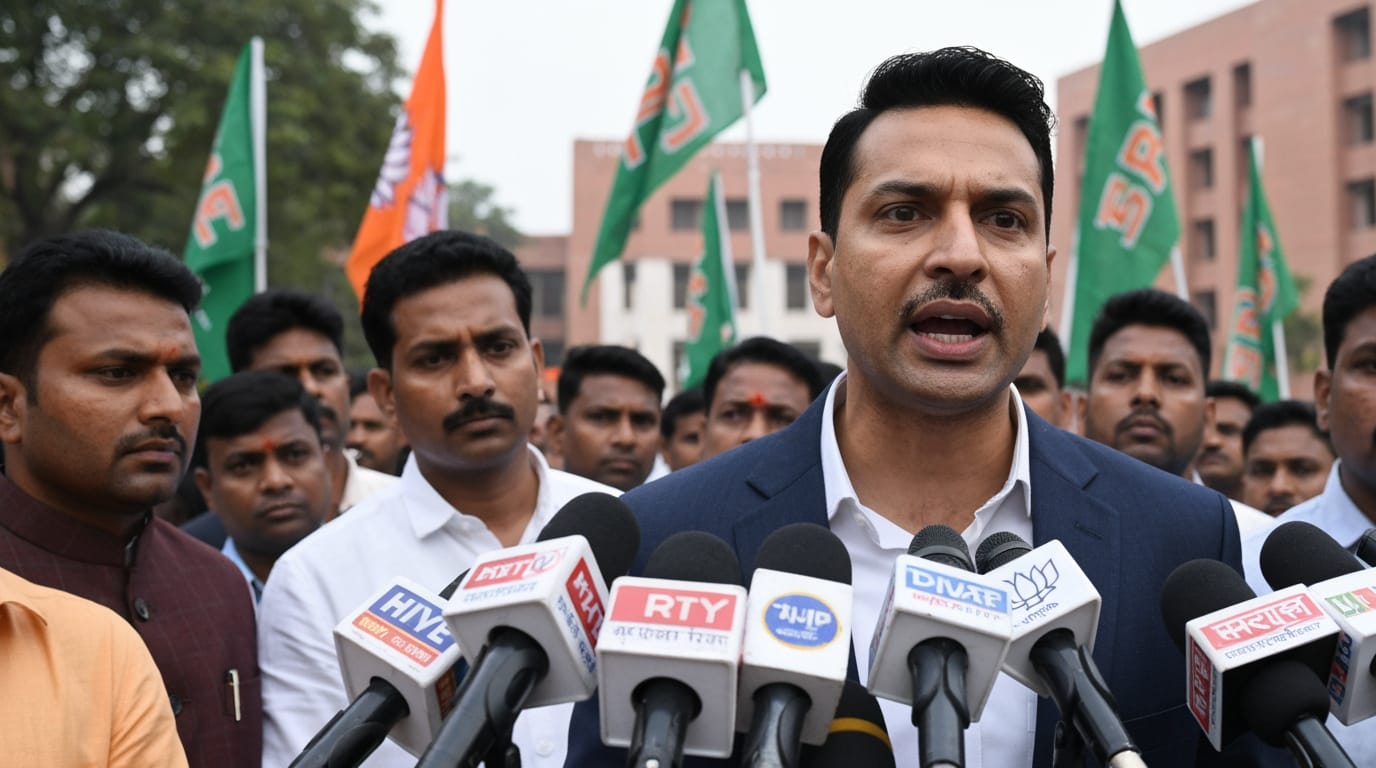
In a significant political upheaval that has sent ripples across the Indian political landscape, Aam Aadmi Party (AAP) Rajya Sabha MP Raghav Chadha, along with six other parliamentary colleagues, formally resigned from the party and merged with the Bharatiya Janata Party (BJP) on Friday, April 24, 2026. This dramatic move constitutes a substantial blow to the AAP, challenging its standing in the Upper House of Parliament and triggering fierce accusations of political maneuvering, while simultaneously bolstering the BJP's strength and strategic positioning.
The Sudden Defection and Its Key Players
The unexpected announcement came during a press conference in New Delhi, where Raghav Chadha, flanked by fellow defectors Sandeep Pathak and Ashok Mittal, declared the merger, citing constitutional provisions that allow for such a move when more than two-thirds of a legislative party's members agree. The seven Rajya Sabha MPs — Raghav Chadha, Sandeep Pathak, Ashok Mittal, former cricketer Harbhajan Singh, Swati Maliwal, Rajinder Gupta, and Vikram Sahni — represent a clear majority of AAP's total of ten members in the Upper House. This strategic alignment was executed by invoking the Tenth Schedule of the Constitution, a provision often scrutinized in anti-defection debates, which permits a legislative party to merge with another without inviting disqualification if at least two-thirds of its members agree to the merger. The MPs submitted signed documents to Rajya Sabha Chairman C. P. Radhakrishnan to formalize their decision. The development was welcomed by BJP President Nitin Nabin, who extended his best wishes to the newly joined members, expressing confidence in their ability to contribute under the leadership of Prime Minister Narendra Modi.
Reasons Cited and AAP's Outcry
Addressing the media, Raghav Chadha, a prominent young face and articulate spokesperson for the AAP, articulated his disillusionment with his former party. He stated that the AAP, which he had helped nurture for 15 years, had "deviated from its principles, values and core morals" and had become "trapped in the hands of corrupt and compromised individuals." Chadha further described feeling like "the right man in the wrong party," citing "suffocation" and a perceived lack of opportunity to serve the public interest within the AAP's current trajectory. This defection follows a period of internal strain for Chadha, coming only days after his demotion from the post of Deputy Leader in the Rajya Sabha, a move that some speculate may have contributed to his decision. Interestingly, Ashok Mittal, who had replaced Chadha as Deputy Leader, also joined him in the mass exodus to the BJP, highlighting potential deeper fissures within AAP's parliamentary ranks.
The Aam Aadmi Party reacted swiftly and vehemently to the defections, launching a scathing critique of the BJP and the departing MPs. AAP leaders, including party chief Arvind Kejriwal, accused the BJP of orchestrating "Operation Lotus," a term frequently used by opposition parties to allege poaching of their elected representatives through inducements or pressure. Kejriwal accused the BJP of "betraying Punjab," while Rajya Sabha MP Sanjay Singh condemned the defectors for "betraying the people of Punjab" and the very party that had provided them a platform. Singh announced his intention to urge the Rajya Sabha Chairman to disqualify the membership of Chadha, Mittal, and Pathak, arguing that their actions constituted voluntarily relinquishing membership of their original party, which should trigger anti-defection penalties under the Tenth Schedule. AAP maintained that the defections were a politically motivated conspiracy aimed at destabilizing the Punjab government and obstructing its welfare work.
Strategic Implications for the Rajya Sabha and BJP
The merger of seven AAP MPs into the BJP marks a significant strategic gain for the ruling party, particularly in the Rajya Sabha. While the BJP-led National Democratic Alliance (NDA) already holds a substantial strength of 141 in the Upper House, the addition of these seven members further solidifies its position. This enhanced strength could prove crucial in passing contentious legislation and streamlining parliamentary proceedings, reducing the need for extensive cross-party negotiations. For the BJP, attracting prominent opposition figures like Raghav Chadha, who previously held significant sway within AAP, sends a powerful message of political momentum and electoral appeal. The absorption of these MPs from a regional party like AAP, which has been a vocal critic of the BJP, also helps to project an image of a unifying national force. The move is likely to be framed by the BJP as an endorsement of Prime Minister Modi's leadership and the party's national agenda, particularly in states where AAP has a presence, like Punjab and Delhi.
A Blow to AAP and the Road Ahead
For the Aam Aadmi Party, the defection of seven of its ten Rajya Sabha MPs represents a severe setback, questioning the party's internal cohesion and future prospects. This loss of prominent voices in the national parliament diminishes AAP's ability to effectively champion its agenda and challenge the government on key issues. The scale of the defection, constituting more than two-thirds of its Rajya Sabha strength, creates a crisis of confidence within the party and raises uncomfortable questions about its leadership and internal management. The accusations of "Operation Lotus" by AAP highlight its belief that these defections are part of a larger pattern of the ruling party weakening its political adversaries. The party will now face the challenge of rebuilding its parliamentary strength and morale, especially as it prepares for future electoral contests. The loss of figures like Chadha, who were instrumental in shaping AAP's narrative and policy positions, will leave a void that will be difficult to fill. The ongoing legal battle over the disqualification of the defecting MPs, as threatened by AAP, will also likely dominate political discourse and serve as a litmus test for the interpretation of anti-defection laws.
Conclusion
The defection of Raghav Chadha and six other AAP Rajya Sabha MPs to the BJP on April 24, 2026, marks a pivotal moment in contemporary Indian politics. It underscores the fluidity of political allegiances and the continuous power struggle between national and regional parties. While the BJP has undeniably gained a strategic advantage in the Upper House and bolstered its national image, the Aam Aadmi Party faces a daunting task of damage control, internal introspection, and revitalizing its political narrative. The incident is not merely about a shift in parliamentary numbers but reflects deeper anxieties about party loyalty, constitutional provisions governing defections, and the ever-evolving dynamics of India's multi-party democracy. As both parties prepare for forthcoming political battles, the implications of this mass defection will undoubtedly continue to unfold, shaping electoral strategies and public perception in the months to come.


