Pope Leo XIV Delivers Scathing Rebuke Against Using God to Justify War at Palm Sunday Mass
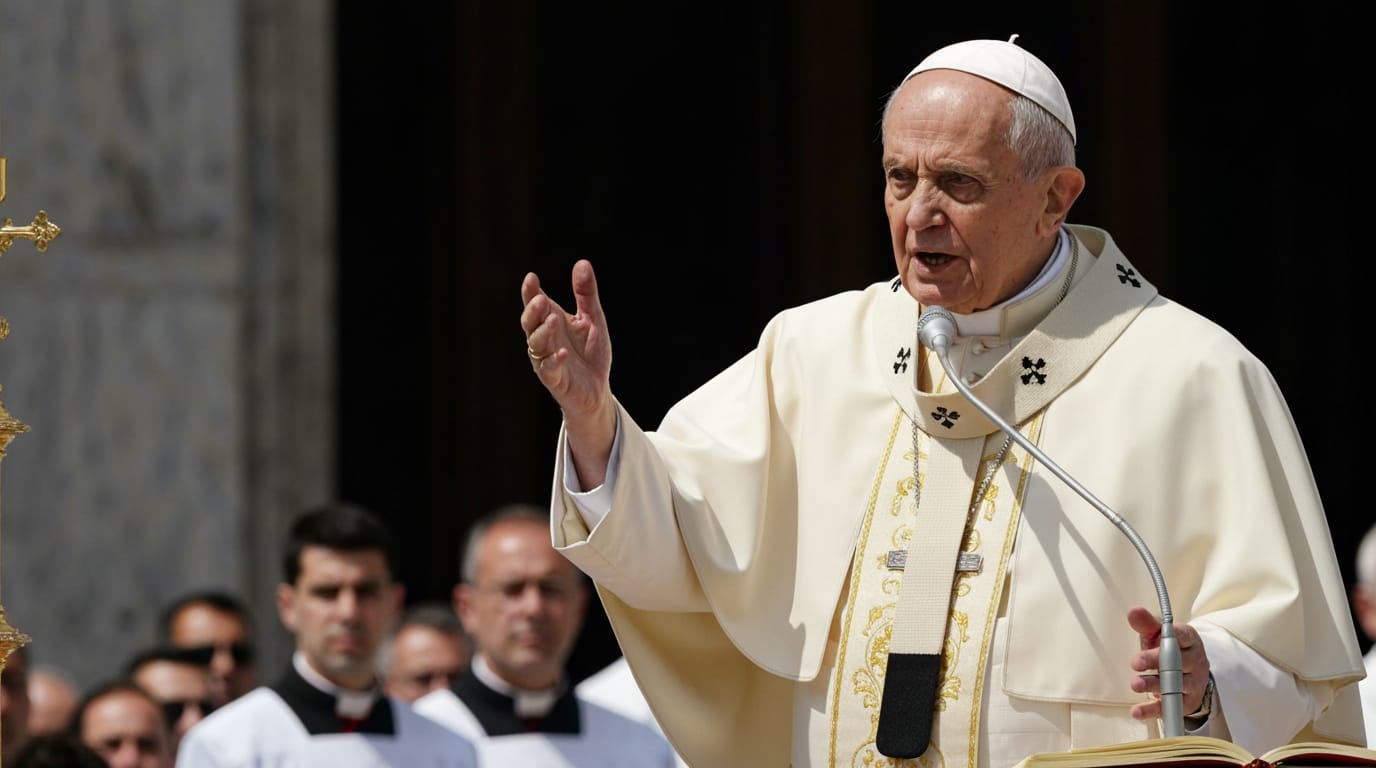
VATICAN CITY – In a powerful and unreserved homily delivered during Palm Sunday Mass, Pope Leo XIV strongly condemned the invocation of God's name to rationalize war, telling tens of thousands gathered in St. Peter's Square that the divine does not heed the prayers of those with "hands full of blood." The pontiff's remarks, marking his first Holy Week since ascending to the papacy, resonated globally amidst escalating conflicts, including the intensifying US-Israeli war on Iran and Russia's ongoing campaign in Ukraine, where religious justifications for violence have been increasingly cited by warring factions.
The sacred occasion, commemorating Jesus' triumphant entry into Jerusalem before his crucifixion, was transformed into a poignant platform for the Pope's forceful appeal for peace. Speaking under a brilliant Roman sun, Pope Leo XIV asserted that Jesus is the "King of Peace" who unequivocally rejects war, emphasizing that no one can legitimately employ his name to sanctify conflict. His message served as a stark moral counterpoint to world leaders and religious figures who have recently woven faith into their rhetoric of warfare, drawing a clear line between divine will and human aggression.
A Denunciation of Divine Justification for Conflict
Pope Leo XIV's message was direct and uncompromising. He proclaimed that God "cannot be enlisted by darkness" and that the divine purpose is solely to bring "light, hope and peace to humanity". The pontiff's words were amplified by a pointed reference to a biblical passage, underscoring that God "does not listen to the prayers of those who wage war, but rejects them, saying: 'Even though you make many prayers, I will not listen: your hands are full of blood'". This striking imagery was interpreted by many as a clear indictment of leaders who claim religious righteousness while engaging in violence. He further elaborated that Jesus "did not arm himself, or defend himself, or fight any war," but rather "revealed the gentle face of God, who always rejects violence". The Pope lamented the "absurdity" of believing that problems and differences can be resolved through warfare, chastising those who wield God's name in such "dark and deadly pursuits".
Global Conflicts and the Perils of Sacred Rhetoric
The Pope's address unfolded against a backdrop of severe international tensions and active military engagements. The US-Israeli war on Iran, now in its second month, has seen leaders on both sides invoking religious principles to justify their actions. Notably, US Defense Secretary Pete Hegseth has been cited for using his Christian faith to cast the conflict as a struggle by a "Christian nation" against its adversaries. Hegseth, who reportedly prefers to be called the "Secretary of War", recently prayed for "overwhelming violence of action against those who deserve no mercy," a sentiment that stands in stark contrast to the pontiff's call for peace. Similarly, the Russian Orthodox Church has characterized Russia's invasion of Ukraine as a "holy war," aligning with a narrative of Western moral decay. These examples highlight the pervasive and dangerous trend of intertwining religious belief with military objectives, a practice the Pope unequivocally condemned.
A New Pontiff's First Holy Week
This Palm Sunday marked a significant moment in the Catholic Church, as it was Pope Leo XIV's inaugural Holy Week since his unexpected election. The pontiff, widely recognized as the first U.S. pope, assumed leadership following the passing of his predecessor, Pope Francis. Last year, Pope Francis had been recovering from double pneumonia and delegated the Holy Week liturgical celebrations, ultimately succumbing to a stroke on Easter Monday. Pope Leo XIV has consistently used his platform to advocate for an immediate ceasefire in ongoing conflicts, urging for dialogue and condemning indiscriminate military airstrikes. His consistent calls for peace underscore a papacy seemingly dedicated to confronting global violence head-on, particularly when it is cloaked in religious justifications.
Holy Week Under the Shadow of Conflict
The solemnity of Palm Sunday was also tempered by news from the Holy Land, where Christians face immense challenges in observing their most sacred week. The Latin Patriarchate of Jerusalem announced the cancellation of its traditional Palm Sunday procession from the Mount of Olives and postponed the Chrism Mass, citing ongoing hostilities. Pope Leo XIV expressed profound concern for Christians in the Middle East who are "suffering the consequences of an atrocious conflict," noting that many are unable to fully participate in the rites of Holy Week. This somber reality served to emphasize the urgency of the Pope's message, highlighting the human cost of conflicts that are, in his view, antithetical to true faith. The Vatican's focus on the plight of those in war-torn regions reinforces the universality of the Pope's condemnation, extending beyond specific political actors to the broader human experience of suffering.
A Resounding Call for Peace
As Holy Week begins, Pope Leo XIV's resolute words serve as a powerful and timely reminder of the core tenets of Christianity: peace, compassion, and the rejection of violence. His condemnation of using God's name to justify war is a profound challenge to leaders and individuals alike, urging a re-evaluation of actions and rhetoric. By emphatically declaring that divine power does not endorse bloodshed, the pontiff has positioned the Catholic Church as a unequivocal voice for peace in a world increasingly fraught with conflict. The message from St. Peter's Square on Palm Sunday 2026 echoes globally, calling for an end to the "folly of war" and a renewed commitment to resolving differences through dialogue and understanding.


