Roadside Bombings Claim Seven Lives in Northwest Pakistan, Heightening Security Concerns
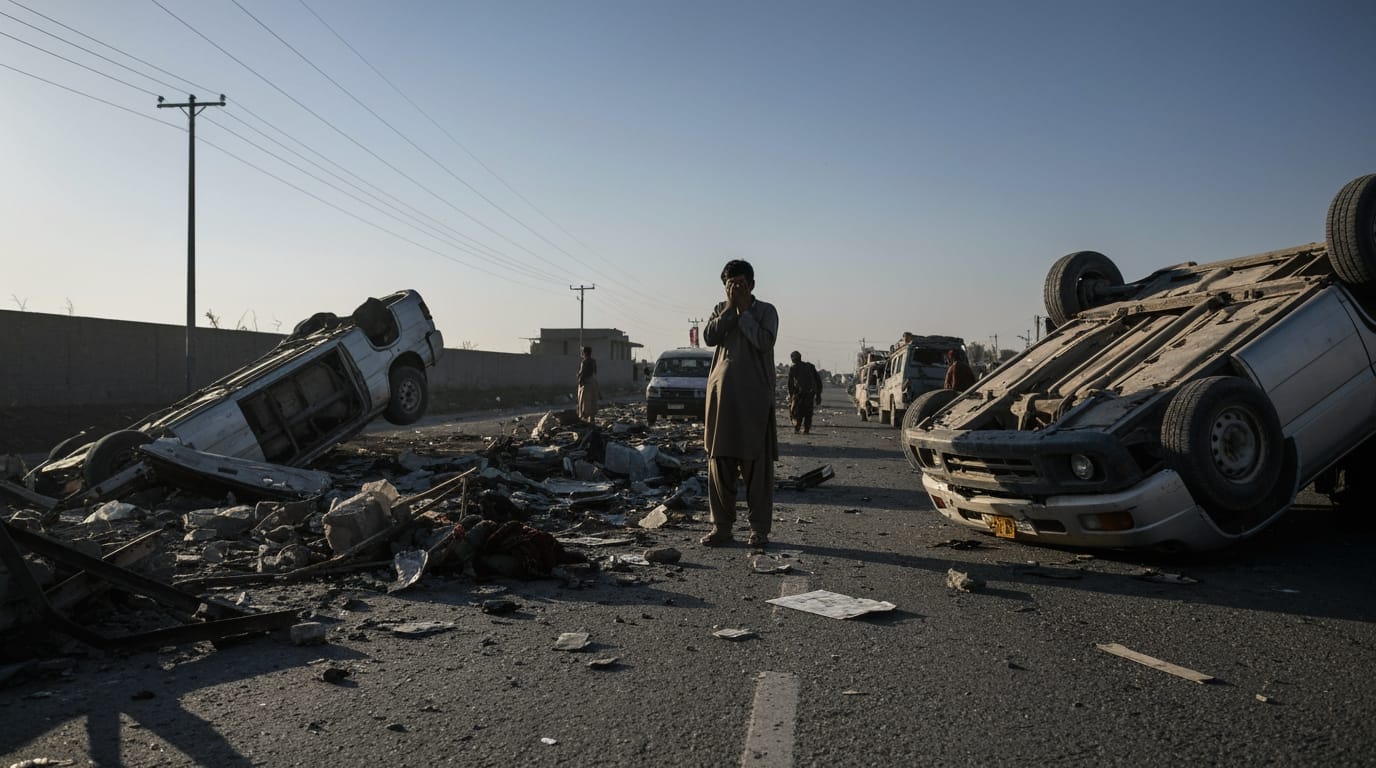
PESHAWAR, Pakistan – Two successive roadside bomb blasts in Pakistan's restive northwestern Khyber Pakhtunkhwa province on Saturday claimed the lives of at least seven civilians and wounded three others, underscoring the persistent and evolving threat of militancy in the region. The deadly incident, which unfolded in the Bannu district, saw the first explosive device strike a civilian passenger vehicle, followed by a second, equally devastating explosion targeting rescuers responding to the initial scene. The attacks have cast a somber shadow over efforts to stabilize an area frequently plagued by violence linked to various militant groups.
The coordinated nature of the bombings, particularly the second blast designed to inflict further casualties among emergency responders, points to a sophisticated and ruthless methodology employed by those seeking to sow terror and destabilize local communities. While no group immediately claimed responsibility for the bloodshed, authorities swiftly indicated that suspicion likely falls upon the Tehrik-e-Taliban Pakistan (TTP), also known as the Pakistani Taliban, given their history of similar assaults in the volatile border region with Afghanistan.
A Day of Double Tragedy in Bannu
The initial explosion occurred when a passenger vehicle traveling through the Phing Musakhel area of Bannu district was struck by a remotely detonated improvised explosive device (IED). The blast resulted in the immediate deaths of five individuals and caused injuries to several others. As local residents and emergency services rushed to the scene to aid the victims and retrieve the deceased, a second IED, also remotely controlled, detonated. This subsequent blast killed two more people, intensifying the casualty count and exacerbating the chaos and despair at the site. Senior police official Yasir Afridi confirmed the sequence of events, highlighting the deliberate targeting of both civilians and those attempting to offer assistance. The incident serves as a grim reminder of the perilous environment in which residents and first responders operate in parts of Khyber Pakhtunkhwa.
Khyber Pakhtunkhwa: A Hotbed of Militancy
Khyber Pakhtunkhwa, a province bordering Afghanistan, has long been at the epicenter of Pakistan's struggle against extremist groups. The region, particularly its tribal districts, has endured decades of conflict, characterized by insurgencies, counter-terrorism operations, and cross-border tensions. The Tehrik-e-Taliban Pakistan (TTP), an umbrella organization of various militant groups, emerged in 2007 with the stated objective of overthrowing the Pakistani government and enforcing a strict interpretation of Sharia law. The TTP has been responsible for numerous deadly attacks targeting security forces, government installations, and civilians across Pakistan, primarily in Khyber Pakhtunkhwa.
The resurgence of the Afghan Taliban in 2021 significantly emboldened the TTP, which shares ideological ties with its Afghan counterpart, albeit operating as a separate entity. Pakistani officials frequently assert that TTP leaders and fighters have found sanctuary across the border in Afghanistan, a claim that the Afghan Taliban government denies. This cross-border dynamic remains a significant point of contention between the two nations and complicates Pakistan's efforts to curb militancy within its borders. The period following the Afghan Taliban's takeover has witnessed a marked increase in TTP activity, with hundreds of attacks reported annually in Pakistan, a substantial portion of which occur in Khyber Pakhtunkhwa.
Civilian Toll and National Response
The recent bombings in Bannu tragically underscore the ongoing human cost of militancy, with civilians often bearing the brunt of the violence. The targeting of a passenger vehicle and subsequently, the rescuers, highlights a brutal tactic designed to maximize fear and disruption within society. Such incidents not only result in loss of life and injury but also inflict deep psychological trauma on communities already living under the shadow of insecurity.
In the wake of the attacks, Pakistani President Asif Ali Zardari strongly condemned the bombings, conveying his condolences to the grieving families and praying for the swift recovery of the injured. Without explicitly naming any specific group, President Zardari issued a stern warning to "internal and external handlers of terrorism," criticizing those who provide safe havens, logistical support, and financial assistance to militant networks. This statement reflects the Pakistani government's consistent stance on the external linkages of militant groups operating within its territory. The military has also reiterated its commitment to conducting search operations to eliminate terrorists and ensure that perpetrators are brought to justice, as seen in responses to other recent attacks in the region.
The Enduring Challenge
The twin roadside bombings in Bannu serve as a stark reminder of the complex and enduring security challenges confronting Pakistan, particularly in its northwestern regions. The tactical shift to target not only primary objectives but also emergency responders indicates a desperate yet calculated effort by militant groups to maximize casualties and instill fear. Despite sustained counter-terrorism operations by Pakistani security forces, groups like the TTP continue to exploit pockets of instability and cross-border dynamics to carry out their deadly agenda. The international community, too, has long recognized the TTP as a significant terrorist organization, with its history marked by high-profile attacks.
The path to lasting peace and stability in Khyber Pakhtunkhwa remains fraught with challenges, requiring a multifaceted approach that combines robust security measures with socio-economic development and effective border management. As the nation mourns the latest victims, the resolve to confront and dismantle terrorist networks operating within its borders, and those supported from beyond, stands as a critical imperative for Pakistan's future.


