Romania on Edge: Prime Minister Bolojan Faces Crucial Confidence Vote Amid Coalition Collapse
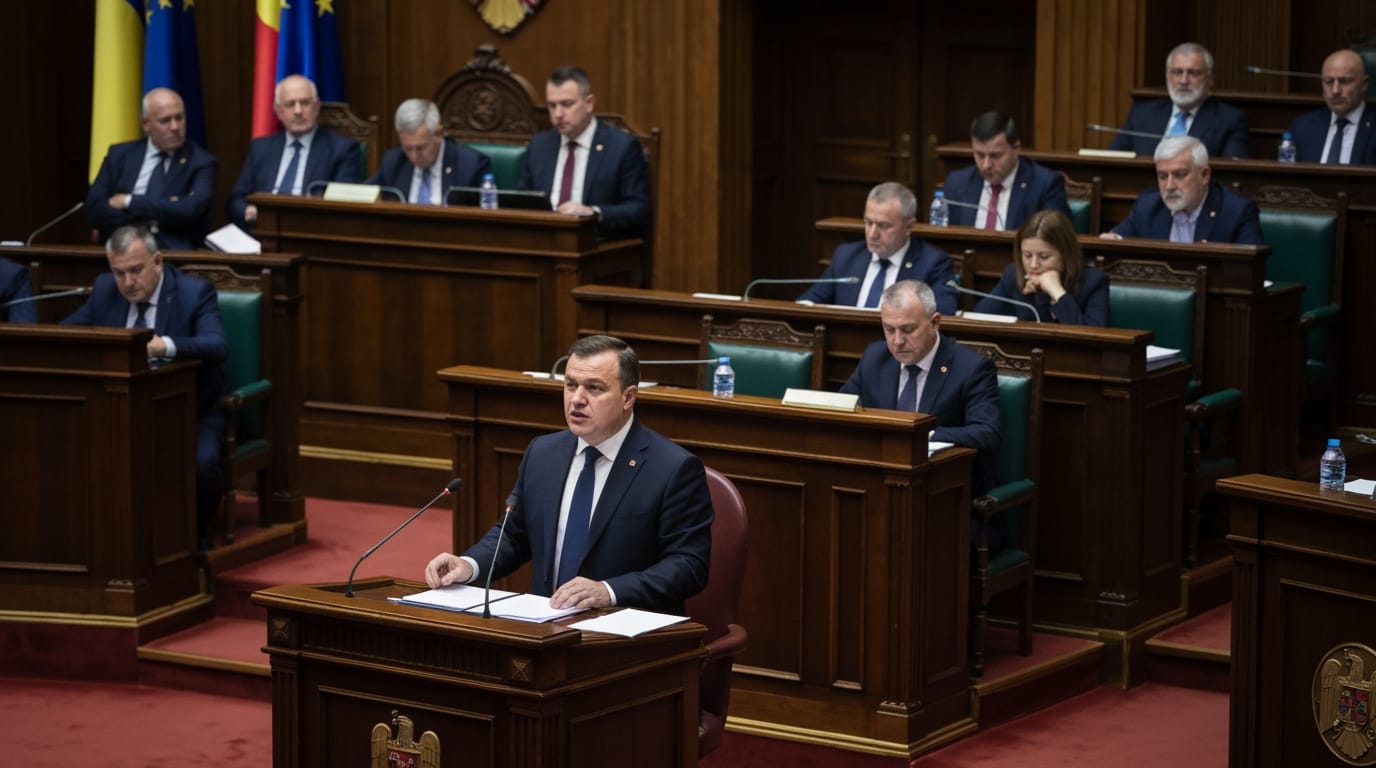
BUCHAREST, Romania – Prime Minister Ilie Bolojan's government faces a critical test of survival today as the Romanian Parliament convenes for a vote of no confidence. The vote follows the dramatic withdrawal of the Social Democratic Party (PSD), the largest party in the legislature, from Bolojan's grand coalition last month, plunging the Black Sea nation into a fresh wave of political instability. The motion, backed by an unusual alliance between the center-left PSD and the far-right Alliance for the Union of Romanians (AUR), garnered 251 signatures, surpassing the 233 votes required to oust the prime minister in the 464-seat parliament. The outcome of this vote is poised to reshape Romania's political landscape, with significant implications for its economic trajectory and pro-European alignment.
The Looming Vote: A Parliament Divided
The vote of no confidence, scheduled for May 5, 2026, marks the culmination of weeks of escalating tensions within the ruling coalition. Prime Minister Ilie Bolojan, a member of the National Liberal Party (PNL), took office on June 23, 2025, leading a broad coalition that initially included the PNL, PSD, Save Romania Union (USR), and the Democratic Union of Hungarians in Romania (UDMR). However, the PSD's abrupt departure in late April left Bolojan at the helm of a minority government, with only 181 seats in the bicameral parliament. The Social Democrats' decision to join forces with the staunchly opposition AUR to initiate the motion underscores the depth of the political chasm. Observers anticipate the motion has "a very high chance of passing," which would leave Bolojan in an interim capacity while President Nicușor Dan navigates complex negotiations to form a new government.
Fiscal Fault Lines: The Root of the Rift
At the heart of the political crisis lies a profound disagreement over the government's stringent fiscal consolidation measures. Romania has grappled with a burgeoning budget deficit, which reached 9.3% of its Gross Domestic Product (GDP) in 2024 and an estimated 7.7% in 2025, ranking among the highest in the European Union. To address this, Prime Minister Bolojan championed a series of austerity policies, including tax increases and freezes on public sector wages. These measures, while deemed necessary by the government to stabilize public finances and avert a potential credit rating downgrade, sparked fierce opposition from the PSD.
The Social Democrats argued that Bolojan's reforms were pushing the economy towards crisis, harming ordinary citizens, and reducing living standards. They positioned themselves as "defenders" against what they termed liberal economic policies, despite sharing responsibility for the state of public finances as part of the previous grand coalition. Furthermore, a rotational premiership agreement had been in place, stipulating that a PSD member would assume the prime ministership in 2027. The PSD's decision to withdraw was reportedly influenced by a strategic calculation to avoid the political cost of unpopular austerity measures that could weaken their position ahead of this planned rotation. Efforts by the PSD to force Bolojan's resignation earlier this month were unsuccessful, leading directly to their withdrawal from the government and the subsequent no-confidence motion.
An Unholy Alliance and its European Implications
The most striking aspect of the current crisis is the unprecedented cooperation between the center-left PSD and the far-right AUR. While their shared immediate goal is the removal of Prime Minister Bolojan, their broader political objectives diverge significantly. The AUR, which has seen a surge in popularity and aims to capitalize on anti-establishment sentiment, seeks to trigger early elections. In contrast, the PSD, despite its alliance with AUR for this motion, has stated its intention to form a new "pro-European coalition" and has explicitly ruled out governing with the far-right party.
This tactical alliance has drawn considerable criticism both domestically and internationally. Critics argue that the PSD's cooperation with AUR risks legitimizing a surging far-right movement that has previously been isolated and marginalized. At the European level, this move has raised concerns about Romania's commitment to its pro-European trajectory, especially given AUR's nationalist and Eurosceptic stance. Observers fear that such precedents could expand, potentially affecting Romania's standing within EU institutions and its ability to contribute to consensus decisions. President Dan has reiterated Romania's unwavering commitment to its pro-Western direction, seeking to allay fears of a far-right government.
Economic Fallout and Stability Concerns
The political turmoil has already begun to ripple through Romania's economy. The national currency, the Romanian leu, has depreciated by nearly 3% since the announcement of the no-confidence motion, reflecting capital outflows and rising investor risk aversion. Prolonged political instability threatens to exacerbate these economic woes, potentially leading to a credit rating downgrade and higher borrowing costs for the state.
Romania is a significant recipient of EU funds, including substantial allocations tied to reform milestones under mechanisms like the Recovery and Resilience Facility. Any disruption in governance could delay the implementation of these crucial reforms, jeopardizing access to billions of euros in European financing. This scenario could undermine Romania's economic credibility and its capacity to fund essential public services and infrastructure. The current crisis also unfolds against a backdrop of already high inflation and a technical recession experienced last month.
The present political fragility is not an isolated event but rather a continuation of instability that has plagued Romania since the annulment of the 2024 presidential election due to alleged foreign interference. This period has seen increased political radicalization and a boost in support for anti-establishment parties. Interestingly, despite the institutional upheaval, recent polling suggests that nearly 40% of Romanians support Bolojan remaining in office, a figure significantly higher than his party's standing. However, other surveys indicate a majority believe he should resign.
Conclusion: An Uncertain Path Forward
As the Romanian Parliament prepares to cast its votes, the immediate future of Prime Minister Ilie Bolojan and his government hangs precariously in the balance. Should the no-confidence motion pass, Romania will enter a period of complex political negotiations, with President Dan tasked with finding a viable solution. The PSD's declared aim of a new "pro-European coalition" without Bolojan, coupled with their rejection of a government with AUR, suggests that forming a stable majority will be challenging.
The political maneuvering highlights a deep struggle over economic policy and power within Romania's political class. The long-term implications of this crisis will depend heavily on the ability of mainstream parties to navigate the current instability, address pressing economic issues, and maintain Romania's Euro-Atlantic orientation. The outcome of today's vote will set the stage for whether Romania can quickly regain its footing or if it will face prolonged political uncertainty with potential domestic and international repercussions.


