Samsung Workers Rally for Larger Share of AI Profits, Threaten Major Strike
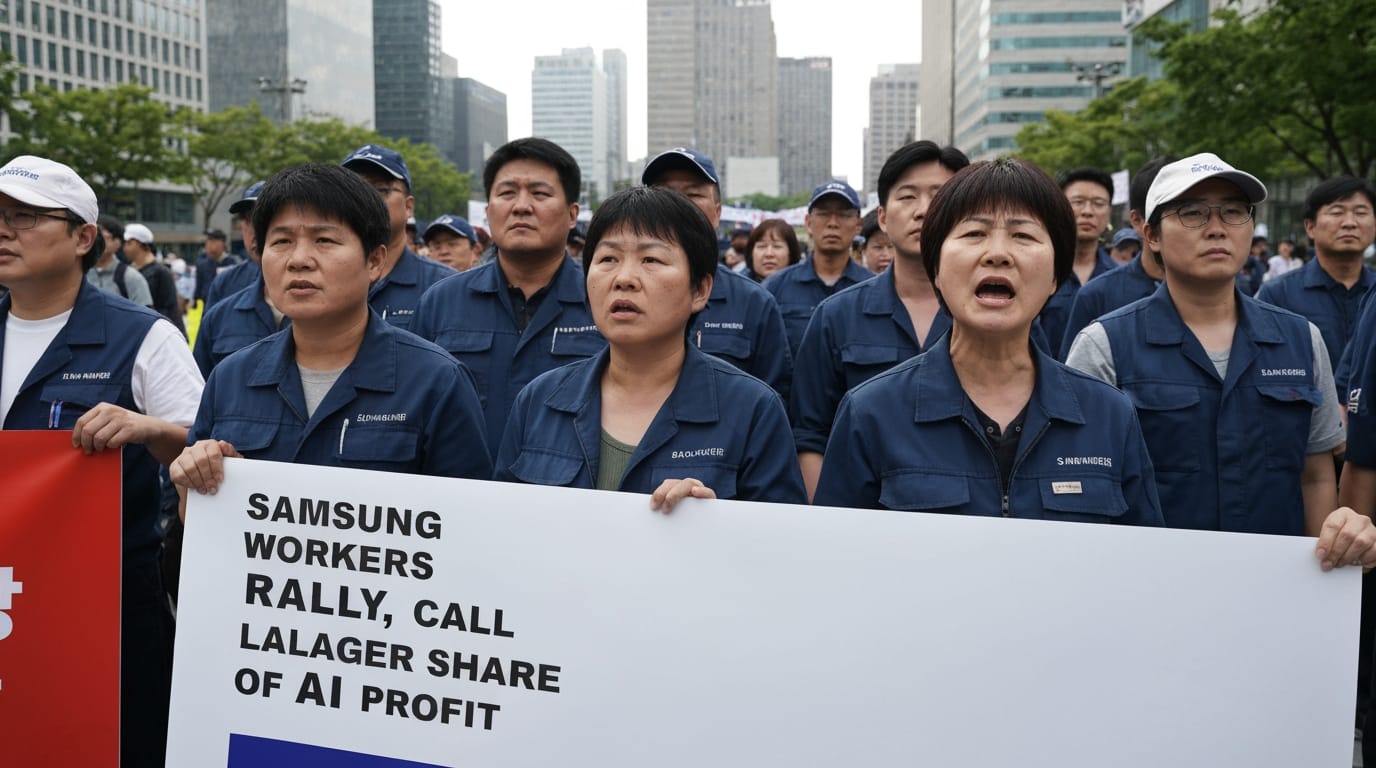
Pyeongtaek, South Korea – Tens of thousands of Samsung Electronics workers staged a massive rally on Thursday, demanding a larger share of the company's soaring profits, particularly those driven by the booming artificial intelligence sector. The unprecedented demonstration, held at Samsung's sprawling semiconductor complex in Pyeongtaek, underscores a growing labor dispute that could have significant implications for global memory chip supply chains if a threatened strike materializes. Union leaders, representing a majority of Samsung's South Korean workforce, have warned of an 18-day walkout beginning May 21 unless their demands for higher bonuses and transparent profit-sharing are met.
The Escalating Demand for Equitable Compensation
The rally, which saw an estimated 30,000 to 40,000 workers gather, marked the largest demonstration to date by Samsung's unionized employees. Waving banners and shouting slogans, the workers expressed frustration over what they perceive as inadequate compensation despite the company's robust financial performance. The National Samsung Electronics Union (NSEU), a leading force within a joint struggle headquarters comprising three Samsung unions, is spearheading the demands. Their core proposals include the complete removal of a cap on performance bonuses, currently limited to 50% of an individual's base salary, and a commitment to allocate 15% of Samsung's annual operating profit to performance-related pay for chip-division employees. Based on recent profit levels, this 15% allocation could translate to over $400,000 per worker on average for those in the chip division. The union's membership has surged, now representing more than 90,000 workers, or over 70% of Samsung's South Korean workforce. "We won't stop this fight until our fair demands are met," declared Choi Seung-ho, a union leader, at the rally.
Riding the Wave of AI-Driven Profits
The workers' demands come at a time when Samsung Electronics is experiencing a significant financial rebound, largely fueled by burgeoning global demand for artificial intelligence technologies. After six consecutive quarters of profit decline, the company reported a staggering 933% year-over-year increase in first-quarter operating profits in 2024, reaching $4.8 billion (6.6 trillion Korean won). This turnaround was primarily driven by the recovery in memory chip prices and the surging demand for advanced High-Bandwidth Memory (HBM) chips, which are crucial components for AI applications.
Samsung has forecast an impressive first-quarter operating profit of 57.2 trillion won ($38.6 billion) for 2026, signaling strong conditions in the memory chip market. The company's full-year revenue for 2024 also jumped to KRW 300.8 trillion ($206 billion), with an operating profit of KRW 32.73 trillion ($22.48 billion). The memory business, a cornerstone of Samsung's semiconductor division, has returned to profitability by addressing the heightened demand for high-value-added products, especially those powering generative AI. While Samsung shipped next-generation HBM4 earlier this year, it has faced challenges in securing Nvidia's certification for its HBM3E chips, an issue that reportedly impacted its Q4 2024 earnings. Despite this, the overall outlook for memory chips remains positive, with prices expected to continue climbing through 2024 due to robust AI demand.
The Widening Gap: Worker Grievances and Industry Comparisons
A significant driver of the workers' discontent is the perceived disparity in compensation compared to Samsung's primary rival, SK Hynix. Workers argue that their pay has not kept pace with Samsung's impressive profits and that the compensation gap with SK Hynix has widened. SK Hynix, a leader in supplying high-bandwidth memory chips for AI applications, posted record quarterly revenue and operating profit for the January-March period, driven by strong demand from data centers and AI infrastructure. Last year, SK Hynix notably agreed to allocate 10% of its annual operating profit to a performance bonus pool, a benchmark that Samsung workers are now referencing.
This compensation discrepancy has led to talent outflow, with some Samsung employees reportedly leaving for better pay at SK Hynix. Union leaders contend that it is the employees, through their dedication and hard work in manufacturing, improving processes, and raising yields, who have sustained Samsung Electronics and propelled it to its position as a world-leading semiconductor producer, particularly amidst the current AI boom. Their push for greater transparency in compensation further highlights a desire for a clearer link between the company's financial success and their individual rewards.
Company's Stance and Potential Ramifications
Samsung Electronics has acknowledged the ongoing wage negotiations and stated its commitment to reaching an agreement. Management has put forward a counter-proposal, which includes allocating 10% of operating profit to bonuses and offering additional incentives specifically for memory division staff. However, the union has rejected this, as well as an earlier proposal for bonuses in restricted stock, maintaining their demand for uncapped bonuses and the 15% profit allocation.
The company has warned internally that any production stoppages, even limited ones, could severely damage customer trust and take years to recover. Analysts echo these concerns, suggesting that a prolonged strike could tighten global chip supplies and potentially drive up prices, although some anticipate automation and subcontracting might mitigate the immediate impact. The union, for its part, estimates that an 18-day walkout could cost Samsung upwards of 1 trillion won ($676 million) per day, with total potential losses ranging from 20 trillion to 30 trillion Korean won. Adding another layer to the dispute, a counter-rally by shareholders criticized the union's demands as excessive, highlighting the complex stakeholder dynamics at play. This labor dispute at Samsung reflects a broader trend in South Korea, where trade unions have gained significant influence in recent years after decades of limited leverage, emboldening employees to publicly press their cases.
A Critical Juncture for Tech Labor
The unfolding dispute at Samsung Electronics represents a critical juncture for labor relations within the global technology industry. As AI continues to redefine economic landscapes and generate unprecedented profits for tech giants, the question of how these gains are distributed among the workforce is becoming increasingly prominent. The outcome of these negotiations between Samsung and its employees could set a precedent for compensation models across the sector, particularly for those whose innovation and labor directly contribute to the development and production of cutting-edge AI infrastructure. With the threat of a major strike looming, both sides face high stakes, and the resolution will undoubtedly shape future discussions around equitable profit-sharing in an era of rapid technological advancement.