South Korea and China Forge Path to Renewed Partnership Amid State Visit
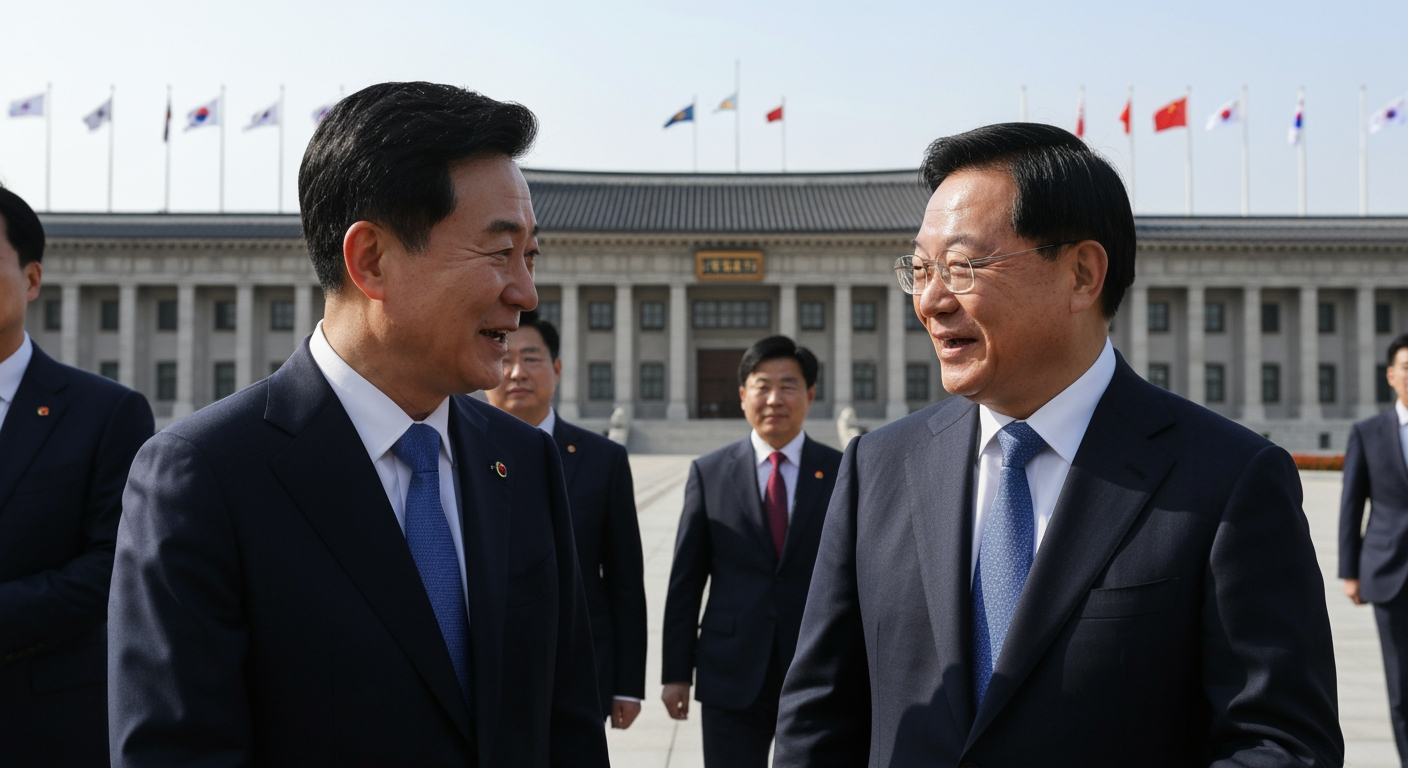
Beijing, China – South Korean President Lee Jae-myung arrived in Beijing this week for a landmark state visit, initiating a concerted effort by both Seoul and Beijing to reset and fortify their bilateral relationship. The four-day visit, which commenced January 4, 2026, marks the first state visit by a South Korean president to China in nine years, signifying a critical juncture in the diplomatic ties between the two East Asian economic powerhouses. Both nations are seeking to establish a more predictable and sustainable footing for their future interactions, aiming to make 2026 a pivotal year for the full restoration of bilateral relations.
Diplomatic Re-engagement Signals a New Chapter
President Lee Jae-myung’s current visit to China follows closely on the heels of Chinese President Xi Jinping’s state visit to South Korea in late 2025, which occurred during the Asia-Pacific Economic Cooperation (APEC) summit in Gyeongju. The reciprocal nature and short interval between these high-level engagements underscore a mutual commitment to intensifying communication and rebuilding trust. President Lee, who assumed office in June 2025, described the current visit as a significant milestone, intended to lay out a roadmap for the next three decades of bilateral cooperation. Chinese state media highlighted the visit as reflecting Beijing's desire to consolidate momentum toward fully restoring relations and strengthening economic collaboration and tourism. This intensified diplomatic activity is observed against a backdrop of complex global dynamics, including ongoing major-power competition, significant supply-chain restructuring, and heightened regional security concerns, which collectively elevate the strategic value of stable relations between China and South Korea. Both leaders acknowledged the twists and turns experienced in their relationship since establishing diplomatic relations in 1992, pledging to sustain positive momentum to prevent a recurrence of past difficulties.
Economic Ties Remain a Cornerstone of Cooperation
Economic cooperation stands as a primary focus of President Lee’s visit, reflecting the deeply intertwined economies of China and South Korea. For over two decades, China has consistently been South Korea's largest trading partner, demonstrating a profound interdependence across manufacturing, technology, and consumer markets. President Lee arrived in Beijing accompanied by a substantial delegation of approximately 200 South Korean business leaders, including the chairmen of major conglomerates such as Samsung, SK, Hyundai Motor, and LG. This robust representation signals a clear intent to adapt economic cooperation to a more complex global environment and explore forward-looking areas.
During the visit, nine cooperation agreements were signed between Chinese and South Korean companies, spanning various sectors. Discussions centered on expanding collaboration in emerging industries such as artificial intelligence, biopharmaceuticals, green economy, digital economy, high-tech manufacturing, and big data. Leaders also emphasized the need to accelerate negotiations on a bilateral Free Trade Agreement, aiming to foster more sophisticated, rules-based cooperation. A significant outcome included the signing of a memorandum to launch a new commercial cooperation dialogue, transforming previously sporadic ministerial-level talks into a regular channel for managing economic and trade issues. Another memorandum focused on strengthening cooperation for Korea-China industrial parks, designed to promote trade, investment, and joint entry into third-country markets, thereby deepening industrial and supply-chain integration.
Navigating Regional Security and the Korean Peninsula
Regional stability, particularly concerning the Korean Peninsula, constituted a critical agenda item during the high-level talks. Both President Lee and President Xi affirmed that peace and stability on the Korean Peninsula are shared interests, and China expressed its willingness to play a constructive role in this regard. President Lee explicitly urged Seoul and Beijing to work together to find practical solutions for peace, prosperity, and growth in the region. This dialogue comes at a sensitive time, immediately following North Korea's recent test-firing of hypersonic missiles, which leader Kim Jong Un stated was necessary to maintain a powerful nuclear deterrent.
The leaders agreed to strengthen communication through various mechanisms, including high-level strategic dialogues and a revived diplomatic and security "2+2" dialogue at the vice-ministerial level. This 2+2 dialogue, previously agreed upon but recently upgraded from a director-general level mechanism, provides a platform for both countries to communicate positions on key issues and serve as a stabilizer of regional tension. These security discussions also extended to jointly upholding the international free trade system and ensuring the stability and smooth flow of global and regional industrial and supply chains, acknowledging shared responsibilities in maintaining regional peace and promoting global development.
Cultural Exchange and Managing Lingering Differences
Beyond economic and security matters, a notable outcome of the state visit was the agreement to work towards a gradual reopening of cultural and content exchanges. This move signals a potential thawing of the unofficial "Hallyu ban" – a restriction on Korean entertainment and cultural content in China that had been in place since South Korea’s 2016 decision to deploy the U.S. THAAD missile defense system. This agreement aims to expand cultural and content exchanges incrementally, starting in areas mutually acceptable to both sides.
Despite the overarching themes of cooperation, discussions also touched upon sensitive issues, demonstrating both nations' commitment to managing differences respectfully. These included constructive consultations on the issue of structures built by China in the Provisional Measures Zone, a jointly managed area under the Korea-China Fisheries Agreement of 2000. South Korea also requested that China strengthen guidance and enforcement against illegal fishing operations in the West Sea (Yellow Sea). Regarding the "one-China" principle, South Korea reiterated its respect for Beijing's stance, acknowledging that anything related to Taiwan is considered an internal matter. This careful navigation of contentious issues alongside areas of mutual benefit reflects a mature approach to bilateral relations.
A Future of Renewed Strategic Partnership
President Lee Jae-myung's state visit to China underscores a concerted effort to move beyond past challenges and usher in a new era of cooperation. With 14 memorandums of understanding signed across various fields, including economic and trade cooperation, science and technology, intellectual property, environment, and public safety, the visit laid a comprehensive foundation for future engagement. Both leaders expressed a shared vision for a strategic cooperative partnership that is sound, stable, and mutually beneficial. As China prepares to assume the APEC host role in 2026, enhanced coordination with South Korea is anticipated to advance regional economic integration and strengthen multilateral cooperation. The renewed commitment to dialogue, economic partnership, and cultural exchange signals a hopeful trajectory for the intricate and vital relationship between South Korea and China, aiming to contribute significantly to regional peace and global prosperity.
Related Articles

Ratko Mladić, "Butcher of Bosnia" and Convicted War Criminal, Dies at 84
THE HAGUE, Netherlands – Ratko Mladić, the former Bosnian Serb military commander known as the "Butcher of Bosnia" and convicted of genocide, war crimes, and crimes against humanity, has died at the age of 84. Serbian...

Long-Awaited 9/11 Mastermind Trial Set for 2028, Decades After Attacks
GUANTANAMO BAY, Cuba – Nearly a quarter-century after the devastating terror attacks of September 11, 2001, a military judge has finally set a trial date for Khalid Sheikh Mohammed, the alleged mastermind behind the...