South Korean President Begins Landmark State Visit to China Amid Regional Flux
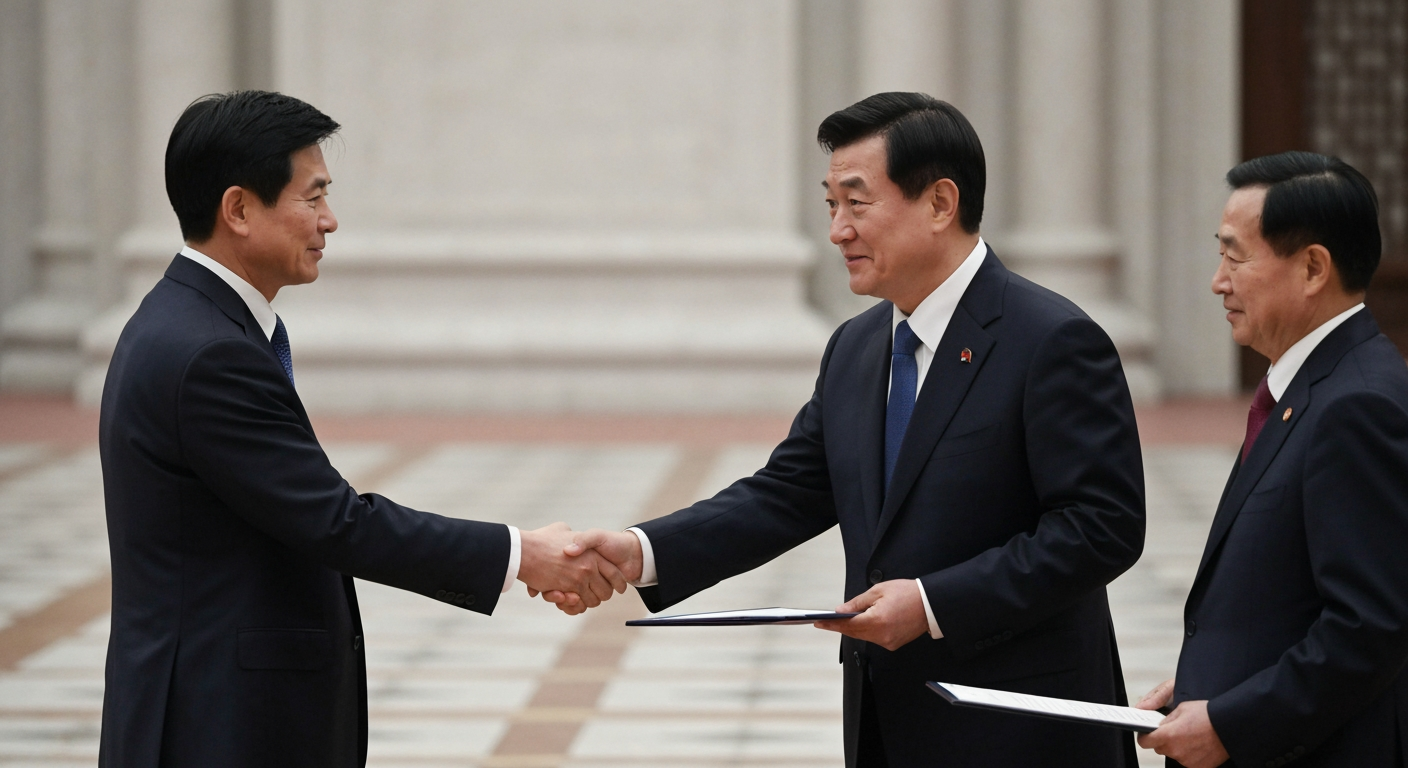
Beijing, China – South Korean President Lee Jae Myung embarked on a four-day state visit to China Sunday, marking the first such visit by a South Korean leader in nine years and signaling a concerted effort to recalibrate crucial bilateral ties amidst evolving geopolitical currents. The trip, anticipated to foster deeper economic and cultural cooperation, comes at a delicate juncture, underscored by North Korea's launch of multiple ballistic missiles just hours before President Lee's arrival in Beijing, a move widely interpreted as a deliberate message to both Seoul and Beijing.
Rekindling Diplomacy in a Shifting Landscape
President Lee's visit to China, scheduled from January 4 to 7, includes stops in Beijing and Shanghai, and follows an invitation from Chinese President Xi Jinping. The meeting between the two leaders marks their second in just two months, an unusually rapid succession that analysts suggest highlights China's keen interest in bolstering economic collaboration and tourism, particularly as tensions between Beijing and Tokyo have intensified over Taiwan. This high-level engagement is pivotal for South Korea, which has historically navigated a complex diplomatic path between its primary security ally, the United States, and its largest trading partner, China. President Lee's administration has explicitly aimed to "restore" ties with Beijing, acknowledging China's indispensable role in South Korea's economic landscape.
The visit is strategically timed, following a period of strained relations under Lee's predecessor, Yoon Suk Yeol, whose administration leaned more closely towards Washington and Tokyo. Ahead of his trip, President Lee affirmed South Korea's consistent respect for the "One-China" policy concerning Taiwan, emphasizing that healthy bilateral relations hinge on mutual respect and contribute to regional peace and stability. This stance is particularly significant given recent heightened tensions in the Taiwan Strait, with China conducting large-scale military drills and Japanese Prime Minister Sanae Takaichi's November remarks suggesting potential military involvement if China acts against Taiwan. National Security Adviser Wi Sung-lac stated that the visit aims to minimize or eliminate past misunderstandings and elevate the relationship to a new stage, allowing both countries to mutually support each other.
Forging Economic Bonds and Cultural Pathways
A central pillar of President Lee's visit is the expansion of economic and cultural cooperation. He is accompanied by a substantial business delegation comprising over 200 South Korean business leaders, including top executives from conglomerates like Samsung, SK Group, and Hyundai Motor Group. The delegation's presence underscores the economic imperative of the trip, with discussions expected to cover vital areas such as supply chain investment, the digital economy, artificial intelligence, and green energy. President Lee expressed optimism about China's capacity to drive economic growth and technological development, anticipating significant opportunities for bilateral cooperation.
The economic agenda also includes a Korea-China business forum in Beijing and a Korea-China startup summit in Shanghai, aiming to foster collaboration in cutting-edge industries. Beyond traditional trade, a key objective for the South Korean side is to urge China to ease its unofficial restrictions on Korean pop culture, or "Hallyu," which have been in place for nearly a decade following Seoul's decision to deploy the Terminal High Altitude Area Defense (THAAD) anti-missile system in 2016. While China officially denies such a ban, South Korean officials hope to see tangible progress on this front, emphasizing the importance of cultural exchanges and people-to-people ties. This move could significantly revitalize South Korea's entertainment and tourism industries.
The Lingering Shadow of North Korea
The sensitive issue of North Korea looms large over the discussions. President Lee is expected to press President Xi to leverage China's considerable influence over Pyongyang to play a constructive role in resolving issues on the Korean Peninsula and to persuade North Korea to return to denuclearization talks. South Korea, along with the United States, has consistently urged China, North Korea's traditional ally and economic lifeline, to use its sway.
The urgency of this diplomatic push was dramatically highlighted on the very day of President Lee's arrival, as North Korea launched multiple ballistic missiles into the sea off its east coast. South Korea's military reported that the missiles flew approximately 900 kilometers. This provocative act, the first such test of the new year, is seen by some analysts as a deliberate message from Pyongyang, aiming to deter closer ties between Seoul and Beijing and to counter any unified stance on denuclearization. Despite this overt act of defiance, President Lee underscored that "people's livelihoods and peace cannot be separated," reinforcing the need for China's active participation in regional stability.
Historical Reverence and Future Aspirations
The visit also includes a significant symbolic gesture: President Lee's trip to Shanghai to visit the historic provisional government building, which served as the Korean government's headquarters from 1926 to 1932 during Japan's colonial rule. This year marks the 100th anniversary of the building's use as a government seat and commemorates the 150th anniversary of the birth of Kim Koo, a prominent Korean independence activist who headed the provisional government. This act highlights the shared historical connections and struggles, providing a foundation for renewed cooperation. Former President Moon Jae-in also visited the site in Chongqing during his 2017 trip.
President Lee's visit aims to mend a relationship that, while crucial, has faced its share of turbulence. The previous state visit by President Moon Jae-in in 2017 was marred by reports of "diplomatic discourtesy" and an incident where South Korean journalists were assaulted by Chinese security agents. By contrasting with past challenges, President Lee's current visit seeks to reset the tone and forge a more robust, mutually respectful partnership. Both sides are committed to strengthening high-level exchanges, enhancing understanding and trust, and promoting sound and steady development of their strategic cooperative partnership.
A Delicate Balancing Act for Regional Stability
President Lee Jae Myung's state visit to China represents a critical diplomatic undertaking for South Korea. As the nation navigates complex alliances and regional rivalries, strengthening ties with Beijing is seen as essential for economic prosperity and regional stability. While the visit focuses on tangible economic and cultural benefits, it also serves as a platform to address intractable issues like North Korea's nuclear ambitions and to ensure South Korea's voice is heard in the intricate geopolitical calculus of Northeast Asia. The success of this visit will be measured not only by immediate agreements but also by its long-term impact on fostering a more balanced and constructive relationship between these two indispensable neighbors.
Related Articles

Ratko Mladić, "Butcher of Bosnia" and Convicted War Criminal, Dies at 84
THE HAGUE, Netherlands – Ratko Mladić, the former Bosnian Serb military commander known as the "Butcher of Bosnia" and convicted of genocide, war crimes, and crimes against humanity, has died at the age of 84. Serbian...

Long-Awaited 9/11 Mastermind Trial Set for 2028, Decades After Attacks
GUANTANAMO BAY, Cuba – Nearly a quarter-century after the devastating terror attacks of September 11, 2001, a military judge has finally set a trial date for Khalid Sheikh Mohammed, the alleged mastermind behind the...