SpaceX Achieves Orbital Flight With Starship in Milestone Demonstration
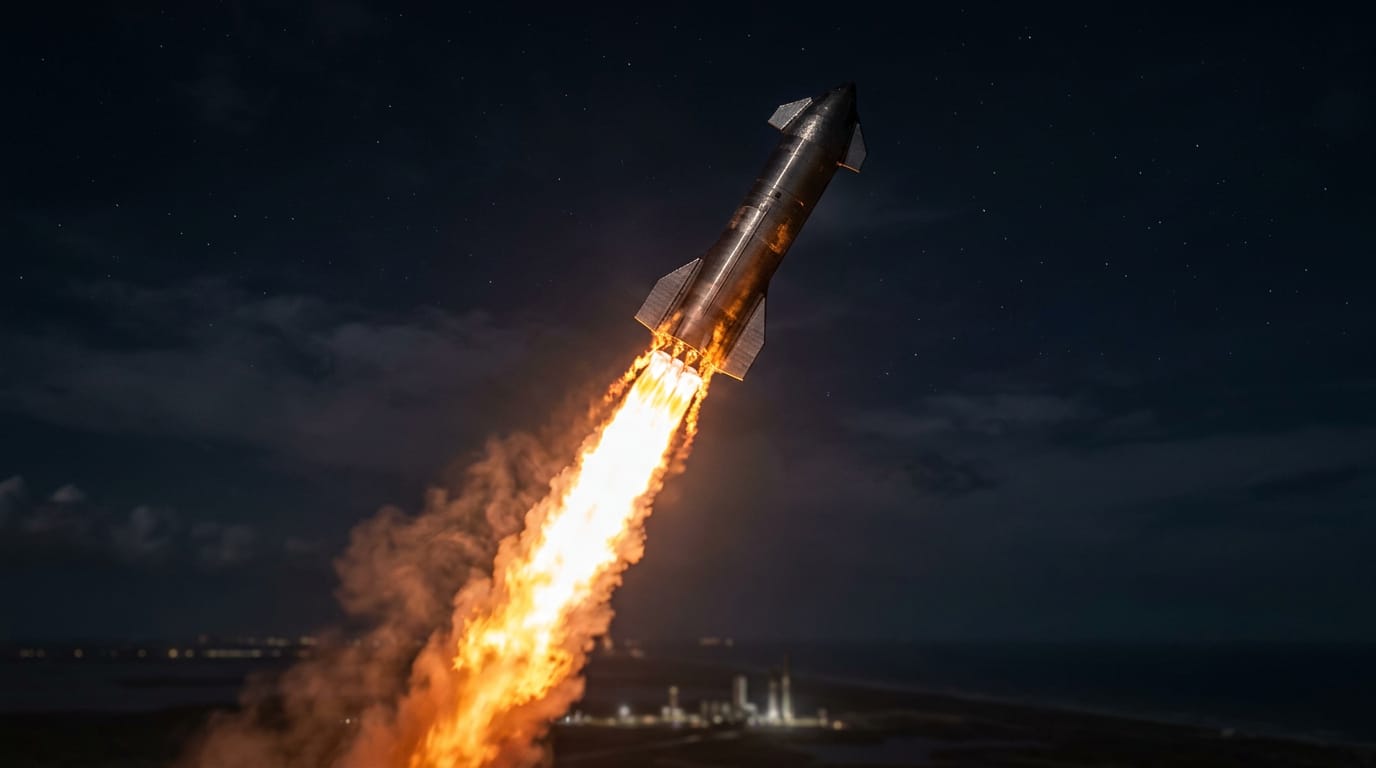
SpaceX launched its mammoth Starship vehicle into Earth orbit for the first time Monday, navigating early propulsion trouble to deliver advanced satellites to space before concluding with a controlled Pacific Ocean splashdown.
The launch represents the most ambitious trial yet for the largest rocket ever developed. Standing more than 400 feet tall on its launch pad, the two-stage spacecraft lifted off from the Starbase facility along the southern Texas coast. The mission marked the system's 14th full-scale flight test and its initial push beyond the suborbital arcs that characterized previous outings. By inserting the upper stage into a stable orbit around Earth, engineers took a critical step toward fulfilling key commitments for lunar exploration and commercial satellite operations.
A Tense Climb to Low Earth Orbit
The flight began early in the morning as 33 Raptor engines on the Super Heavy booster roared to life, propelling the vehicle into the sky over the Gulf of Mexico. The initial climb pushed through atmospheric resistance before the booster executed a hot-staging maneuver, releasing the upper stage to fire its own engines and continue upward. The first-stage booster then guided itself back toward the Gulf for a water landing.
Drama unfolded as the spacecraft mounted its push into space. A vacuum-optimized Raptor engine on the upper stage shut down ahead of schedule. The unexpected loss prompted ground teams to pause and evaluate system telemetry.
Because the remaining five engines burned longer to compensate for the lower thrust, the ship still reached its planned coast phase safely. After reviewing the status of the remaining sea-level thrusters, flight controllers determined the craft could safely finish the trip. A single Raptor engine reignited about 25 minutes after launch, accelerating the vehicle past 17,500 mph and into a true low Earth orbit at an altitude of roughly 170 miles.
Deploying the Next-Generation Payload
Once circularized in orbit, Starship served as an operational cargo carrier for the first time. A specialized deployment slot released a payload of 26 Version 3 Starlink internet satellites into the space environment.
These new satellites are substantially heavier and more capable than the thousands of earlier units already operating in low Earth orbit. SpaceX estimates that the expanded capacity provided by a single Starship launch will ultimately deploy constellations at an accelerated clip, delivering tenfold increases in bandwidth throughput over earlier launch configurations.
Several of the deployed satellites carried external cameras aimed back at the spacecraft. The imaging hardware captured detailed visual data on the heat-resistant ceramic tiles lining Starship’s outer belly. Gathering direct photographic evidence of how the thermal shield weathered the initial ascent remains a priority for ground teams seeking to perfect full and rapid reusability.
Precaution Prompts an Early Return
The initial flight plan envisioned an extended mission lasting nearly 10 hours and circling the globe six times before concluding with a descent off the coast of South America. However, mission leaders chose to curtail the orbital cruise out of caution following the early engine anomaly.
Rather than risking prolonged exposure with a degraded propulsion system, controllers activated the ship's deorbit sequence after roughly two orbits. Starship completed a single-engine retroburn to dip into the upper atmosphere, testing its heat shields against severe friction over the Pacific Ocean.
The vehicle survived the intense atmospheric entry, decelerated through the sound barrier, and reignited three engines to pull off its signature flip maneuver. It touched down on the open sea north of Hawaii roughly three hours after leaving the Texas launchpad. Although the vehicle tipped and sustained structural failure upon striking the water, the craft succeeded in testing orbital deorbit dynamics in a designated open-water zone.
Technical Strides and Future Hurdles
Monday’s flight highlights the rapid trial-and-error development philosophy that SpaceX has applied across its programs. By flying hardware to failure in early tests and gradually expanding flight parameters, engineers have steadily corrected guidance errors and structural flaws observed in earlier flights, which often exploded before leaving suborbital trajectories.
The achievement carries significant weight for outside partners as well. NASA has awarded billions of dollars in commercial contracts designating Starship as the crewed lunar landing craft for future Artemis missions. Those ambitious plans rely on Starship’s ability to loft vast amounts of equipment and fuel to orbit, where uncrewed tanker variants must refuel the landing craft before it ventures toward the moon.
Significant technological barriers still stand before routine service can begin. SpaceX must resolve the persistent reliability bugs affecting its Raptor engine clusters during high-altitude restarts. Furthermore, future tests will attempt pad returns using mechanical launch-tower arms to capture both the falling boosters and spacecraft, an unproven concept vital to fulfilling promises of low operational costs.
The successful orbit insertion proves that the supersized rocket can loft heavy equipment into space and perform key maneuvers under real flight conditions. While ground teams now comb through data from the early engine shutdown, the flight provides the clearest evidence yet that heavy-lift space transportation is entering an era defined by unprecedented scale.