Spanish Paleontologists Uncover First Confirmed Evidence of Diplodocus in Europe
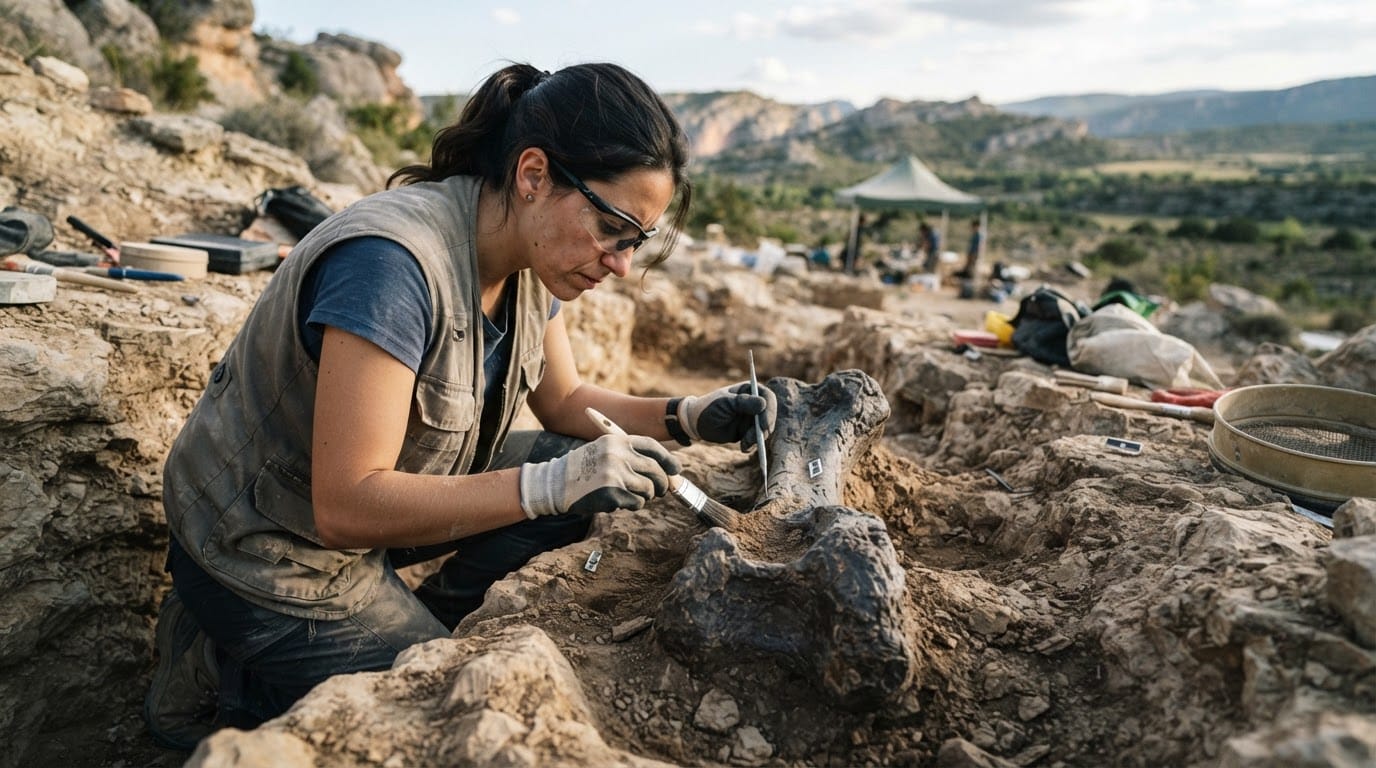
Paleontologists working in eastern Spain have identified the first confirmed fossil remains of a Diplodocus discovered outside North America, fundamentally altering scientific understanding of where the iconic long-necked dinosaur roamed.
The specimen, dated to roughly 150 million years ago, was excavated from the La Tejería fossil site near the village of El Castellar in the province of Teruel. Detailed in a peer-reviewed study published in the Journal of Vertebrate Paleontology, the findings establish that the towering herbivore traversed ancient continents during the Late Jurassic period, likely crossing temporary land bridges between modern-day North America and the Iberian Peninsula.
Breakthrough at La Tejería
The fossil material includes 14 exceptionally preserved tail vertebrae and several associated V-shaped chevron bones. Paleontologists first uncovered five of the vertebrae in 2008, with subsequent excavations in 2014 and 2015 yielding nine additional bones. The sequence corresponds to positions 22 through 35 in the middle and rear sections of the animal’s tail.
Despite lacking a skull, limbs, or cervical vertebrae, the tail segment ranks among the most complete diplodocid specimens ever recovered on European soil. Diplodocids are a family of sauropod dinosaurs known for their massive bodies, column-like legs, and elongated, whip-like tails.
Rigorous anatomical analysis revealed distinctive skeletal traits that match the genus Diplodocus. The bones feature elongated centra, deep longitudinal grooves running along their undersides, and pneumatic depressions linked to the dinosaur's internal air-sac system. Furthermore, the forked chevron bones preserve specialized medial cavities that set the genus apart from related European sauropods.
Skeletal scaling indicates the creature measured approximately 25 meters (82 feet) in length, matching the dimensions of standard adult specimens recovered in North America.
Redrawing the Prehistoric Map
Since the late 19th century, scientists considered Diplodocus strictly native to North America. The first fossils emerged from Wyoming in 1877, and subsequent discoveries centered almost exclusively within the fossil-rich Morrison Formation, which blankets parts of Colorado, Utah, and Wyoming. Replicas of the dinosaur—most notably the famous cast nicknamed "Dippy" at London’s Natural History Museum—introduced the animal to audiences worldwide, but actual physical remains remained confined to the Western Hemisphere.
The discovery in Teruel dismantles that geographical boundary. During the Late Jurassic, the supercontinent Pangaea was fragmenting, and the proto-Atlantic Ocean was beginning to form. However, the widening ocean was not yet an insurmountable barrier.
Geological models indicate that fluctuating sea levels periodically exposed corridors of dry land connecting eastern North America and Iberia. Researchers point to earlier evidence of shared predatory genera between both landmasses, including Allosaurus, Ceratosaurus, and Torvosaurus. The arrival of a colossal sauropod like Diplodocus provides concrete proof that herbivorous megafauna also crossed these temporary terrestrial connections before rising oceans severed the two landmasses permanently.
Spain's Jurassic Sanctuary
The finding reinforces the Iberian Peninsula's reputation as one of the world's premier paleontological corridors. The Teruel basin, managed scientifically by the Dinópolis Paleontological Foundation, contains an unusually dense concentration of Late Jurassic dinosaur fossils.
Diplodocus shared this ancient floodplain ecosystem with other massive sauropods, including the native giant Turiasaurus riodevensis and Losillasaurus giganteus. Because these species possessed distinct anatomical designs and tooth structures, researchers believe they avoided direct competition by feeding on vegetation at different canopy levels.
For the local community of El Castellar, an agricultural municipality with fewer than 100 residents, the discovery provides an economic and cultural boost. The area forms part of a protected geotourism network, where marked trails allow visitors to view preserved fossil tracks and excavation quarries in situ.
Ongoing Scientific Inquiries
While the anatomical match firmly places the fossils within the genus Diplodocus, researchers continue to debate its exact classification at the species level. Additional comparative scans are underway to determine whether the animal represents an existing American species, such as Diplodocus hallorum, or a distinct European offshoot that evolved in regional isolation.
The fossils are housed for public exhibition and further study at the Museo Aragonés de Paleontología in Teruel.
By pushing the geographic boundaries of the world's most recognizable sauropod across the Atlantic, the Spanish excavation provides researchers with a critical benchmark. The discovery proves that the Late Jurassic world was far more interconnected than earlier fossil records suggested, opening the door for future field campaigns to unearth new chapters of prehistoric migration.


