Sydney Airport on Edge After Near-Collision Between Jetstar and Qatar Airways Jets
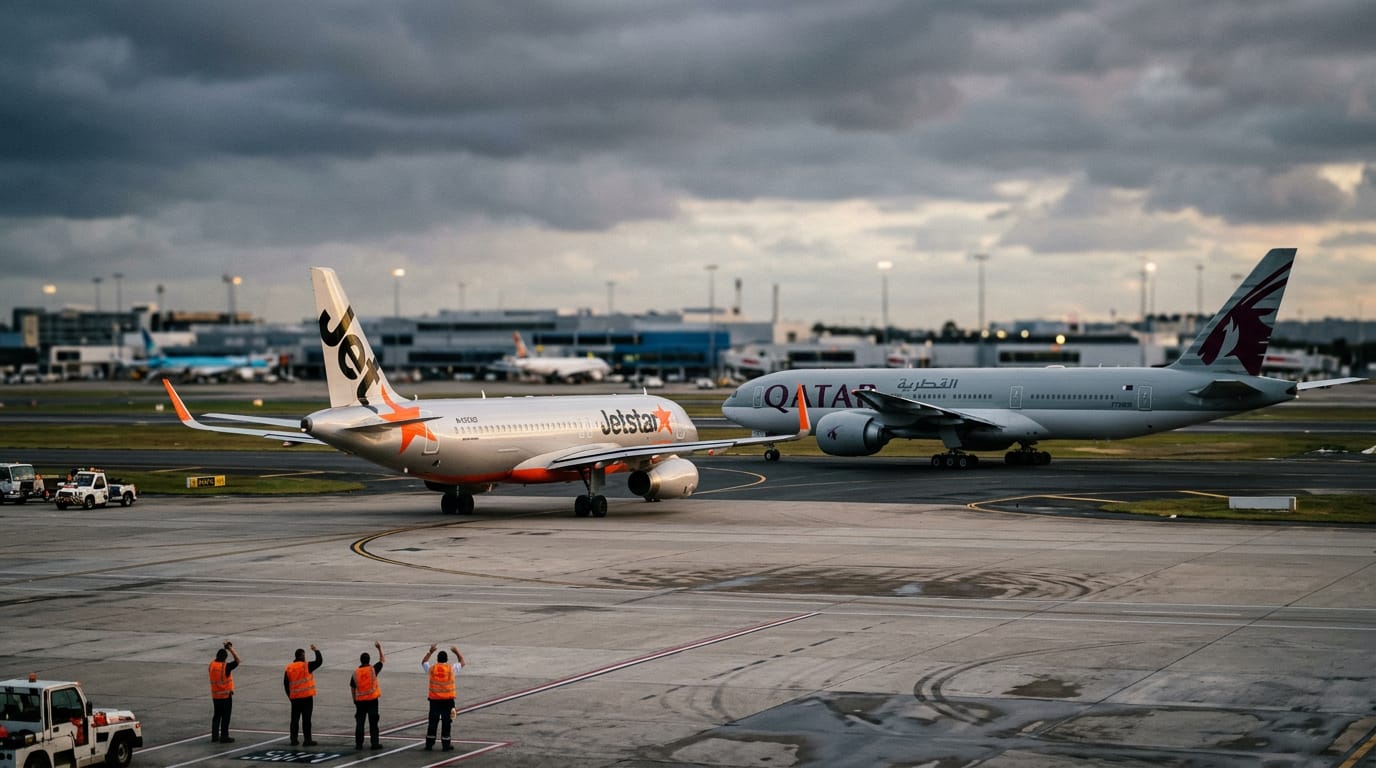
Sydney, Australia – A potential aviation disaster was narrowly averted at Sydney Kingsford Smith Airport (SYD) early Sunday morning when a Jetstar Airways A320 passenger jet and an empty Qatar Airways Boeing 777 aircraft came within perilous proximity on a crossing taxiway, forcing the Jetstar pilots to execute an abrupt emergency stop. The incident, which left one Jetstar cabin crew member injured and disrupted airport operations, has triggered urgent investigations by Australia's top safety regulators and raised renewed concerns about ground safety at the nation's busiest airport amidst ongoing staff shortages.
Averting Disaster on the Tarmac
The critical moment unfolded around 7:00 AM on Sunday, August 9, 2026. Jetstar flight JQ402, an Airbus A320, was taxiing on the tarmac preparing for its scheduled departure to Gold Coast Airport with passengers on board. Simultaneously, a Qatar Airways Boeing 777, empty of passengers and under tow by an aircraft tug, was also maneuvering on a crossing taxiway. According to reports, the flight crew of the Jetstar A320 observed the Qatar Airways jet in "close proximity" and acted swiftly, applying the brakes "firmly" to avoid a collision. The sudden deceleration resulted in a Jetstar cabin crew member sustaining injuries, who subsequently received medical attention from paramedics at the scene. Fortunately, no passengers on board the Jetstar flight were reported injured. The abrupt stop also caused minor damage to the connection point between the Boeing 777's nose gear and its tug vehicle. Following the incident, Jetstar flight JQ402 was canceled, and its passengers were re-booked on later services.
Immediate Investigations Launched
The gravity of the near-collision quickly prompted a multi-faceted investigation. The Australian Transport Safety Bureau (ATSB) has officially launched an inquiry into the "near collision," indicating it will meticulously examine all contributing factors. Investigators plan to interview the flight crew of the Jetstar A320, the operators of the aircraft tug, air traffic controllers, and any other relevant witnesses. Additionally, any available CCTV footage pertinent to the incident will be reviewed. Both Jetstar and Qatar Airways have also initiated their own internal investigations into the matter. While formal findings are pending, initial inquiries have suggested that the tug vehicle responsible for moving the Qatar Airways aircraft may not have adhered to air traffic control instructions. Conversely, Jetstar has stated that its aircraft was operating under the explicit instructions of air traffic control at the time of the incident. Airservices Australia, the federal agency overseeing air traffic management, confirmed it is reviewing the incident and providing assistance to safety investigators.
Growing Concerns Over Airport Operations and Staffing
This latest near-collision unfolds against a backdrop of increasing concerns regarding operational safety and staffing levels at Australia's busiest airport. The incident occurred on a Sunday morning when air traffic control was reportedly operating under restrictions between 6:00 AM and 8:00 AM, leading to reduced flight movements due to staff shortages. This marks a continuation of a trend observed throughout the weekend, with over 150 flights experiencing delays on Saturday alone as Sydney Airport grappled with a lack of personnel. Stephen Beckett, chief executive of Airlines for Australia and New Zealand, has openly criticized Airservices Australia, noting its inability to staff adequately for three consecutive days. He has called for Airservices to identify the root cause of these staffing issues and outline concrete plans for resolution.
Moreover, this incident is not an isolated event. Just weeks prior, on July 27, the ATSB commenced an investigation into another near-miss at Sydney Airport involving two Qantas aircraft. In that earlier incident, a Qantas flight was cleared to cross a runway in front of another Qantas plane that had just landed. Although air traffic control detected the "conflict" and alerted both crews, preventing a collision, these back-to-back occurrences highlight potential systemic vulnerabilities in ground operations. Sydney Airport's complex layout, characterized by its multiple runways and extensive taxiway system necessitating frequent aircraft crossings, presents a unique challenge for air traffic controllers. Authorities have invested significantly in improving runway safety, including advanced lighting and signage, yet the risk of incursions remains a persistent concern.
Broader Implications for Aviation Safety
The series of ground incidents at Sydney Airport, particularly the near-collision between the Jetstar and Qatar Airways planes, underscores the critical importance of adherence to air traffic control instructions and the robust functioning of airport operational systems. Runway and taxiway incursions, globally recognized as a significant safety risk, can have catastrophic consequences, as tragically evidenced by past international incidents. While Australia has maintained a strong safety record regarding such events, the recent occurrences serve as a stark reminder that vigilance and continuous improvement in safety protocols are paramount.
The investigations will undoubtedly delve into communication procedures, the training and experience of personnel involved, and the effectiveness of current ground movement protocols at Sydney Airport. Any findings could lead to recommendations for procedural changes, enhanced technological safeguards, or intensified training programs for both ground crews and air traffic controllers. Ensuring a seamless flow of accurate information and unambiguous instructions between all parties involved in aircraft ground movements is fundamental to preventing future close calls. The integrity of air traffic control instructions forms the bedrock of airport safety, and any deviation, whether due to human error, equipment malfunction, or staffing pressures, can compromise this delicate balance.
As investigations proceed, the aviation community and the traveling public will closely watch for findings that clarify the exact circumstances of this near-miss. The incident serves as a potent reminder that despite advanced technology and rigorous training, the human element and operational environment remain critical variables in maintaining the highest standards of aviation safety. The outcomes of these inquiries will be crucial in informing necessary adjustments to ensure the continued safety and efficiency of operations at Sydney Airport and across Australia's aviation network.


