Syrian Army Seizes Key Oil and Gas Fields, Consolidating Control in Northern and Eastern Regions
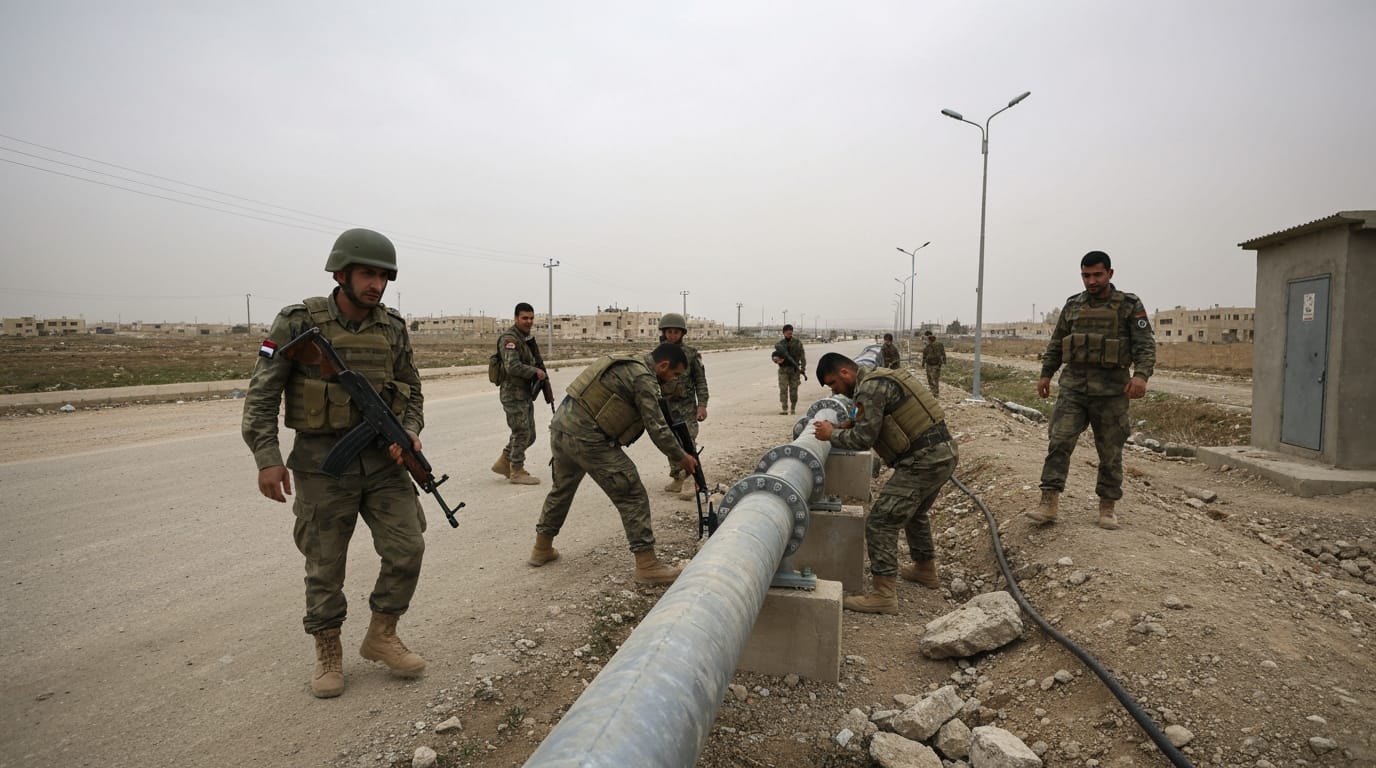
DAMASCUS – The Syrian army has launched a swift and decisive offensive in northern and eastern Syria, securing control of the nation's largest oil and gas fields and critical strategic infrastructure from Kurdish-led forces. The dramatic advances, unfolding over the weekend, mark a significant shift in the country's complex power dynamics, promising to bolster the government's economic prospects while dealing a severe blow to the Kurdish administration that had held these territories for over a decade.
The push by Syrian government forces, fighting Kurdish-led units, culminated on Sunday with the seizure of the Omar oil field, Syria's largest, and the Conoco gas field in the country's east. These gains followed earlier successes on Saturday, when the army announced it had taken control of the Safyan and Al-Tharwa oil fields near Al-Tabqa city in Raqqa province. Concurrently, state media confirmed the army's capture of the strategic city of Tabqa, its military airport, and the colossal Euphrates Dam, Syria's largest, further cementing Damascus's hold over vital infrastructure.
The Rapid Advance and Strategic Acquisitions
The Syrian army's recent operations represent a concerted effort to reclaim areas west and east of the Euphrates River, previously administered with effective autonomy by the Kurdish-led Syrian Democratic Forces (SDF) and its backbone, the People's Protection Units (YPG). The offensive commenced with gains in two neighborhoods of Aleppo last week, followed by control of an area east of the city on Saturday. This initial success paved the way for the broader assault on the resource-rich territories.
The capture of the Safyan and Al-Tharwa oil fields on Saturday near Al-Tabqa was swiftly followed by the occupation of the Al-Rusafa junction, a critical transport crossroads. The Syrian Petroleum Company, the state-run entity, quickly moved to take over these facilities, expressing intentions to resume production, highlighting the immediate economic imperative behind the military push. By Sunday, the offensive had extended eastward, securing the highly coveted Omar oil field and the Conoco gas field, effectively placing a significant portion of Syria's hydrocarbon wealth back under government control. These fields were major revenue generators for the Kurdish-led administration.
The swiftness of the advance has been attributed in part to the involvement of allied Arab tribal fighters, who reportedly facilitated the movement of Syrian forces and their allies across more than 150 kilometers of territory along the eastern bank of the Euphrates.
Economic Lifeline: The Imperative of Energy Control
The recovery of these oil and gas fields is of paramount economic and strategic importance for the Syrian government. Prior to the civil war that erupted in 2011, Syria was an oil exporter, with sales accounting for a substantial 25.1% of state revenue in 2010, generating approximately $3.2 billion for the government. While Syria is a relatively modest oil producer on a global scale, its energy sector is crucial for the nation's economy, especially given its low GDP per capita. The Omar oil field, for instance, even under ISIS control in 2014, was estimated to produce around 9,000 barrels per day, serving as a vital revenue stream.
The ongoing conflict has severely hampered Syria's oil production, which plummeted from approximately 385,000 barrels per day in 2010 to less than 0.05% of global production by 2016. The control over energy resources has been a constant point of contention throughout the war, with various factions vying for the economic power they provide. Reasserting control over these fields is critical for the Syrian government's ability to fund reconstruction efforts, stabilize its currency, and meet domestic energy demands for electricity generation and industrial activities. The Syrian Petroleum Company's immediate plans to restart production underscore the urgency of this economic recovery.
Geopolitical Repercussions and Shifting Alliances
The Syrian army's offensive has triggered immediate reactions from international actors and has exposed underlying tensions in the region. The US Central Command (CENTCOM) issued calls for a de-escalation of hostilities, urging Syrian government forces to cease offensive actions between Aleppo and Al-Tabqa. In an attempt to diffuse the escalating situation, US envoy Tom Barrack reportedly traveled to Erbil to meet with SDF commander Mazloum Abdi and Iraqi Kurdish leader Masoud Barzani. This highlights the complex balancing act for the US, which has historically backed the SDF in its fight against ISIS while now facing a resurgent Syrian government.
The advances also come despite a March 2025 deal intended to integrate Kurdish forces into the state, an agreement that has reportedly stalled, leading to renewed clashes. The SDF, for its part, accused Syrian government forces of violating a withdrawal agreement that was meant to proceed at a more gradual pace. Further exacerbating tensions, Syrian state media reported that the SDF destroyed two bridges over the Euphrates in Raqqa city and cut off the city's water supply, accusations denied by Kurdish authorities.
Adding another layer of complexity, Syrian President Ahmed al-Sharaa recently issued a decree recognizing Kurdish as a national language and granting official recognition to the minority group. However, Kurdish leaders have reportedly indicated that this measure falls short of their long-standing aspirations for greater autonomy.
A Look Ahead: Stability and Reconstruction
The Syrian government's recent military successes mark a pivotal moment in its ongoing efforts to reunify the fractured nation after years of conflict. The recapture of significant energy assets and strategic locations like Tabqa and the Euphrates Dam provides Damascus with increased leverage and vital resources.
While the immediate impact on the SDF is a severe reduction in its revenue streams, the long-term implications for the Kurdish-led administration and the broader Syrian landscape remain to be seen. The swiftness of these recent developments underscores the fluid and often unpredictable nature of the Syrian conflict, where military gains rapidly reshape political realities. As Syrian troops consolidate their control, the focus will undoubtedly shift to the formidable task of reconstruction and the delicate process of integrating formerly autonomous regions back into the central government's fold. The path to lasting stability in Syria continues to be fraught with challenges, but the recent military actions have undeniably altered the trajectory of the nation's future.


