Taiwan Deploys Naval Assets as Beijing Escalates "Law Enforcement" Operations East of Island
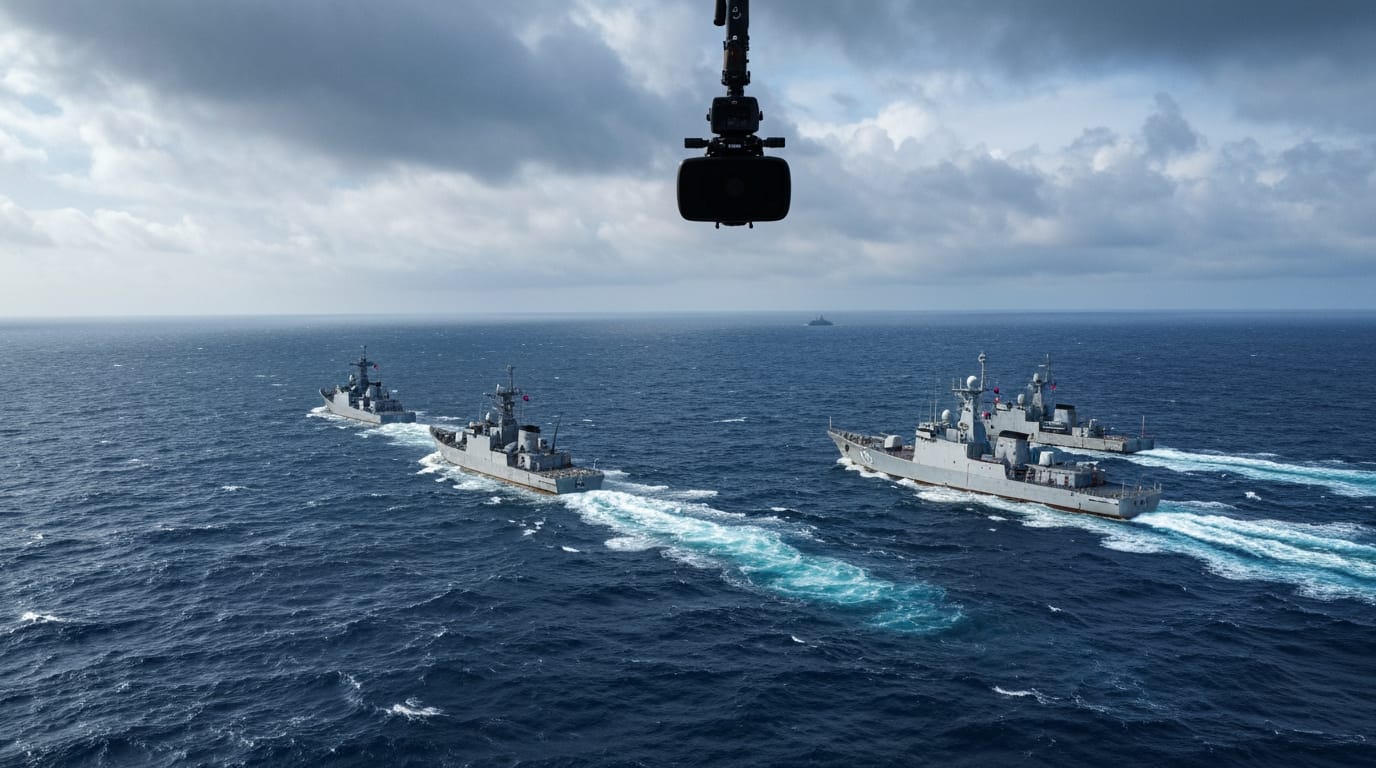
Taipei, Taiwan – Taiwan's Coast Guard Administration (CGA) has deployed vessels to monitor and "respond appropriately" to a recent Chinese "law enforcement operation" in waters east of the island, marking a new phase in Beijing's escalating pressure tactics against the self-governed democracy. The move comes as China intensifies its maritime presence and military drills around Taiwan, challenging international norms and increasing regional tensions.
The latest incident, which unfolded on Sunday, June 7, 2026, saw Taiwan dispatching more than five of its own vessels for surveillance after detecting four Chinese government ships departing from Xiamen port. These Chinese vessels were reportedly heading towards waters east of Taiwan, an area where Taipei unequivocally states Beijing possesses no sovereign rights under international law. China's state media had reported on Saturday that the "law enforcement operation" was a direct response to recent discussions between Japan and the Philippines concerning the delimitation of a maritime boundary in the affected waters, talks which Beijing has branded as "illegal."
Escalation in Eastern Waters
The deployment of Taiwanese coast guard vessels represents a direct counter to what Taiwan perceives as a clear violation of international law and a challenge to its sovereignty. The Chinese operation follows a pattern of increasingly assertive actions by Beijing, which claims Taiwan as its own territory despite the island's democratic self-rule since 1949. Taiwan’s coast guard affirmed that it has been monitoring the Chinese ships "throughout the entire process" and had deployed the necessary assets to appropriately respond to their presence. This recent incursion into waters east of the island signifies an expansion of China's operational scope, moving beyond the more frequently contested Taiwan Strait and areas immediately adjacent to the mainland.
A Pattern of Pressure: Joint Sword Drills
The June 2026 incident is part of a broader, more aggressive strategy by the People's Republic of China (PRC), which has systematically increased the frequency and complexity of its military exercises and maritime patrols around Taiwan. These operations often coincide with significant political events in Taiwan or perceived provocations by its international partners.
In May 2024, just three days after the inauguration of Taiwan's new President William Lai Ching-te, China's Eastern Theater Command of the People's Liberation Army (PLA) launched "Joint Sword-2024A" military drills. These exercises involved all branches of the military – army, navy, air force, and rocket force – across the Taiwan Strait and around several outlying islands. During Joint Sword-2024A, China deployed 111 aircraft and 46 naval vessels, with 82 Chinese military aircraft crossing the median line of the Taiwan Strait. Notably, the China Coast Guard (CCG) also participated in joint operations with the PLA for the first time during these drills, blurring the lines between military and ostensibly civilian law enforcement activities.
Another significant exercise, "Joint Sword-2024B," was conducted in October 2024 following President Lai's National Day speech. These drills saw Chinese military and coast guard personnel encircle Taiwan's main island, with the PLA deploying the Liaoning aircraft carrier group. Taiwan's Ministry of National Defense reported tracking 125 Chinese military aircraft and 34 naval and coast guard vessels during this period, responding with its own warships, fighter jets, unmanned aerial vehicles (UAVs), and mobile anti-ship missile batteries. The CCG's involvement during 2024B was particularly pronounced, with vessels reportedly encircling the Taiwan-controlled Matsu islands and operating on both sides of Taiwan proper, prompting warnings from Taiwan regarding potential attempts to board civilian ships.
Simulated Blockades and Strategic Implications
Beyond the 2024 Joint Sword exercises, Beijing has continued to demonstrate an increasing capacity for comprehensive power projection and blockade simulation. In December 2024, China conducted what was described as its largest military exercise in nearly three decades, involving its Eastern, Southern, and Northern Theater Commands. This unannounced drill saw the deployment of approximately 60 PLA Navy warships, 30 China Coast Guard vessels, and over 134 warplanes. The exercises specifically focused on rehearsing attacks on foreign ships, blockading sea routes, and intercepting merchant vessels, highlighting a clear intent to test its ability to isolate Taiwan. Taiwan responded by activating its own "combat readiness exercises" and raising its alert level.
Further intensifying this pressure, "Justice Mission 2025," conducted in December 2025, involved ground, naval, air, and rocket forces simulating a blockade around Taiwan. PLA activities during this exercise reportedly came closer to Taiwan than ever before, with seven designated operational zones that, in some instances, overlapped with Taiwan's territorial waters. The drills included live-fire missile launches that landed closer to Taiwan than observed in previous exercises. Analysts suggest these simulated blockades aim to test China's capability to sever Taiwan's maritime lifelines for trade, food, and energy, particularly at ports handling liquefied natural gas (LNG), thereby creating economic and social pressure ahead of any potential full-blown invasion.
The Gray Zone and International Reactions
The increasing coordination between the PLA and the CCG is a notable aspect of China's strategy, often referred to as "gray-zone tactics." These actions involve coercive maneuvers that fall short of outright armed conflict but are designed to assert claims and test the resolve of opposing parties. The repeated crossings of the Taiwan Strait's median line by Chinese aircraft and the growing presence of CCG vessels in contested waters are prime examples of this strategy, gradually normalizing a more aggressive posture.
Taiwan views these ongoing operations not just as provocative, but as a direct challenge to its established international boundaries and a threat to regional peace and stability. While specific international reactions to the June 2026 "law enforcement operation" are still emerging, past Chinese military drills have consistently drawn concerns from regional powers and the United States, which often urges restraint and emphasizes the importance of maintaining peace and stability in the Indo-Pacific. Taiwan's defense forces remain on high alert, continuously monitoring Chinese activities and responding according to established rules of engagement, underlining the persistent and dangerous geopolitical tensions in the Taiwan Strait.


