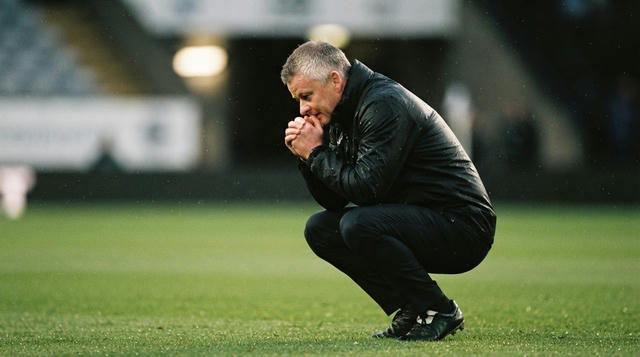
The Crumbling Dream: Unpacking the Crisis in Nigerian Football

Once a continental powerhouse and a beacon of African football, Nigeria's footballing landscape is in a state of profound crisis, marked by administrative turmoil, financial mismanagement, and a dramatic decline in on-field performance. The recent failure of the Super Eagles to qualify for a second consecutive FIFA World Cup, culminating in a disheartening loss to DR Congo, has amplified long-standing concerns and laid bare the systemic failures eroding the sport from its grassroots to its national teams. This unprecedented slump represents not merely a sporting disappointment but a national crisis, exposing decades of institutional decay that threaten to consign Nigeria's rich footballing heritage to memory.
The Steep Descent of National Pride
The Super Eagles, a team synonymous with flair and power, now find themselves in an unfamiliar and uncomfortable position, having missed two successive World Cups. The agonizing 4-3 penalty shootout loss to war-torn DR Congo on November 16, 2025, in Rabat, following a lackluster 1-1 draw, has become a potent symbol of Nigeria's footballing regression. This failure highlights a stark inconsistency in performance and a troubling lack of tactical identity within the national team, which frequently oscillates between moments of brilliance and disorganized play. Once feared by opponents across the continent, the Super Eagles have lost their intimidating aura, a sentiment even echoed by former national team star Augustine "Jay-Jay" Okocha, who pinpointed the decline to a lack of consistency after the 2002 Nations Cup.
The malaise extends far beyond the senior men's team. Nigeria's once-dominant youth teams, historically a factory for future stars and a record five-time winner of the FIFA U-17 World Cup, are also struggling profoundly. The Golden Eaglets have failed to qualify for the African U-17 Cup of Nations for three consecutive times, while the Flying Eagles recently suffered a humiliating 4-0 defeat to Argentina in the FIFA U-20 World Cup. These setbacks illustrate a systematic breakdown of Nigeria's youth development pipeline, a critical concern for the long-term health of the sport. The visible lack of passion displayed by some players when donning the national colors, in stark contrast to their commitment to European clubs, further underscores a deep-seated disconnect within the national setup.
The Rot Within: Governance, Corruption, and Financial Mismanagement
At the heart of Nigerian football's woes lies the Nigeria Football Federation (NFF), often described by observers as a "crime scene" necessitating a complete overhaul. Accusations of corruption and a glaring lack of transparency have plagued the NFF for years, with multiple high-profile investigations and charges of financial misappropriation. In 2018, the Economic and Financial Crimes Commission (EFCC) charged NFF officials with misusing $9.5 million and ₦1.3 million designated for football development, funds received from FIFA. Further allegations include the embezzlement of millions of dollars meant for appearance fees during the 2014 World Cup. More recently, a House of Representatives Special Investigative Committee is probing the NFF's handling of $25 million in grants from FIFA and CAF, revealing scandalous details such as a $1.2 million facility in Birnin Kebbi described as substandard. This culture of impunity, where failure can be more profitable than success, has been identified by former Sports Minister Solomon Dalung as a root cause of the sustained decline.
The financial impropriety directly impacts the welfare of players and coaches. Despite President Bola Tinubu's approval of ₦12 billion in January 2024 to settle outstanding national team debts, reports indicate that players remain unpaid for obligations dating back to 2019. This recurrent issue of unpaid salaries and bonuses has left many national team players, and even coaches, demoralized and disillusioned, leading to protests and a palpable lack of trust in the federation. The integrity of player selection is also compromised, with widespread complaints that players are often asked to pay bribes to secure a spot on the national team, resulting in selections based on favoritism rather than merit. Compounding these issues is the administrative chaos surrounding coaching appointments, where instability and frequent changes—three coaches managed the Super Eagles in just six qualifying matches—create a recipe for tactical disarray and inconsistent performance.
Ailing Domestic League and Crumbling Infrastructure
A robust domestic league is the bedrock of any successful footballing nation, yet Nigeria's Premier Football League (NPFL) is in "complete disarray." It is widely regarded as dysfunctional, plagued by corruption, poor officiating, and a severe lack of organizational structure. The NPFL struggles with inadequate investment, a lack of television coverage, and limited marketing, contributing to sparse stadium attendance and a significant decline in its relevance. This dismal state means Nigeria has become overly dependent on foreign-based players, many of whom only identify with their Nigerian roots after failing to secure a place in European national teams.
Infrastructure, crucial for player development and competitive hosting, is equally neglected. Only two stadiums in the entire country, Uyo and Abeokuta, meet CAF standards for international matches. Shockingly, the National Stadium in Abuja, built with ₦85 billion of taxpayer money, has been downgraded due to disrepair. Across the nation, stadiums and training facilities are crumbling due to chronic underfunding and poor maintenance, discouraging both players and fans. This absence of world-class facilities and modern analytical tools, such as performance data and injury tracking systems, places Nigerian football at a significant disadvantage compared to nations that prioritize these investments. The economic downturn in Nigeria further exacerbates these problems, affecting clubs' ability to manage finances, pay players, and maintain facilities, leaving them struggling to survive.
The Vanishing Pipeline: Grassroots Football in Crisis
The foundation of Nigeria's past footballing glory was its vibrant grassroots system, which nurtured talents like Jay-Jay Okocha and Nwankwo Kanu. However, this critical pipeline has been systematically destroyed. The grassroots and youth development programs suffer from a dire lack of proper infrastructure, qualified coaches, and essential medical support. Many schools lack basic sporting facilities, and sports are no longer a compulsory extra-curricular activity, effectively stifling the early identification and development of talent. The absence of a clear, defined structure for amateur, academy, and school football, as highlighted by grassroots advocate Monday N. Ozoya, means that potential talent goes undiscovered or undeveloped.
Age falsification, a persistent issue in youth categories, further compromises fair play and hinders genuine development. Poor scouting networks, coupled with financial mismanagement at this foundational level, mean limited investment in the very infrastructure that should be grooming the next generation of Super Eagles. While the streets of Nigeria continue to produce raw, instinctive talent, the transition from these informal settings to structured, professional development pathways is severely lacking, contrasting sharply with the sophisticated systems in European academies.
Conclusion: A Call for Radical Reform
The current state of Nigerian football is a complex tapestry woven from administrative ineptitude, rampant corruption, crumbling infrastructure, and a decaying development pipeline. The failure to qualify for consecutive World Cups is not an anomaly but a glaring symptom of deeper structural weaknesses that have festered for years. The issues are interconnected; the financial impropriety starves the grassroots and professional leagues of vital resources, leading to poor player welfare and inadequate facilities, which in turn impacts the quality and performance of national teams.
Reclaiming Nigeria's rightful place at the summit of African and world football demands courageous, radical reforms. This includes a complete overhaul of the NFF to ensure transparency, accountability, and merit-based appointments, alongside rigorous enforcement of anti-corruption measures. Investing significantly in modernizing stadium infrastructure and professionalizing the domestic league, with proper funding, marketing, and governance, is paramount. Most critically, a renewed and sustained commitment to grassroots football development, encompassing improved facilities, qualified coaching, and transparent talent identification, is essential to rebuild the talent pipeline that once fueled Nigeria's success. The question remains whether the will exists within the Nigerian football establishment and government to undertake these difficult but necessary changes to rescue the beautiful game for a nation that lives and breathes football.