Tragedy Strikes UN: Tibetan Activist Dies After Self-Immolation in New York Protest
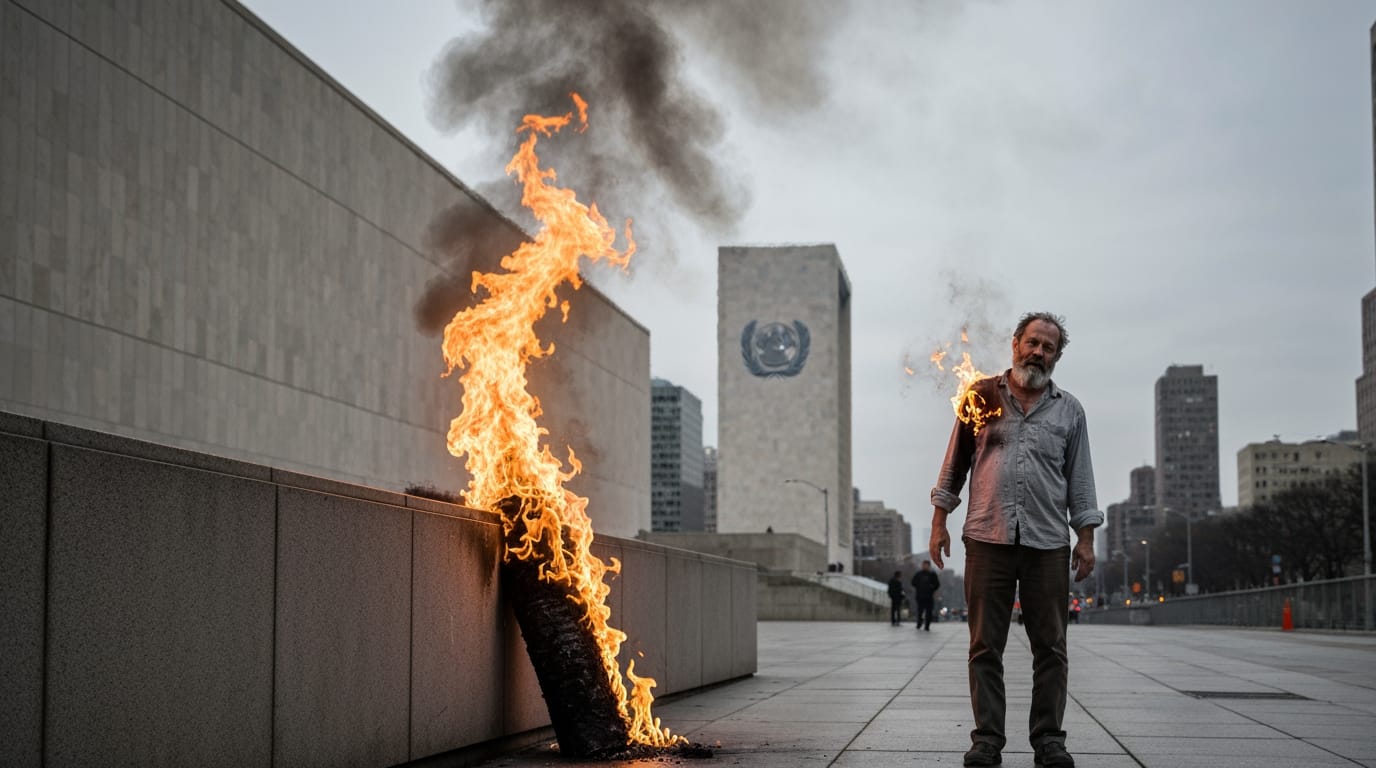
New York City, NY – A profound and desperate act of protest unfolded outside the United United Nations headquarters in New York City on Thursday evening, culminating in the death of a 52-year-old man who set himself on fire to draw global attention to the Tibetan independence movement. The incident, identified by activists as a solemn appeal against Chinese policies in Tibet, has sent shockwaves through the international community and reignited urgent conversations about human rights and political freedom.
The tragic event occurred around 6:30 p.m. to 7:00 p.m. ET near East 43rd Street and First Avenue, a bustling thoroughfare that serves as a gateway to the global diplomatic hub. Eyewitnesses and surveillance footage captured the harrowing moments as the man, later identified by Tibetan activists and media outlets as Lobga Rangzen, calmly placed a Tibetan flag on the sidewalk before dousing himself in a flammable liquid and igniting it. New York Police Department officers, responding to a 911 call, and security personnel swiftly intervened, extinguishing the flames within approximately 15 seconds. Despite their rapid response, Rangzen sustained severe burns and was rushed to Bellevue Hospital, where he was pronounced dead. The NYPD confirmed an ongoing investigation into the incident, though initial reports from authorities did not immediately specify a motive. A United Nations spokesperson stated that the incident occurred after all scheduled meetings for the day had concluded and did not disrupt any official UN activities.
A Desperate Plea for Tibetan Freedom
Lobga Rangzen, identified by friends and exiled Tibetan media as a long-time activist and Uber driver who had resided in the United States for about two decades, utilized his final act to amplify the urgent cries for Tibetan self-determination. At the scene, alongside the Tibetan flag, police discovered leaflets bearing the unambiguous slogan, "China Out of Tibet." This deliberate display underscored the political motivations behind his self-immolation, a form of protest that has tragically become synonymous with the Tibetan struggle. Voice of Tibet, a media outlet for exiled Tibetans, reported that Rangzen's act was preceded by a live appeal for Tibetan independence and unity, directly linking his protest to the contentious "Law on Promoting Ethnic Unity and Progress" recently enacted by Beijing. This new Chinese law, which took effect on July 1, 2026, aims to consolidate a "shared" national identity among China's diverse ethnic groups, including Tibetans and Uyghurs. However, critics, including human rights advocates and overseas campaigners, argue that the legislation is designed to accelerate the assimilation of ethnic minorities, thereby eroding their distinct cultural, linguistic, and religious identities under the guise of unity.
A History of Extreme Protest
Rangzen's self-immolation is not an isolated event but rather a continuation of a grim and heartbreaking protest tactic employed by Tibetans over the past two decades. Since 2009, more than 150 Tibetans, both within Tibet and in exile, have resorted to self-immolation as a radical expression of resistance against what they describe as oppressive Chinese rule. These acts are often carried out with specific demands: the return of the Dalai Lama, the release of the Panchen Lama, and the restoration of fundamental human rights and freedoms in Tibet. Advocacy groups like Free Tibet emphasize that such extreme sacrifices are made in the hope of drawing international attention to the plight of the Tibetan people and compelling global powers to address the human rights crisis in the region. The Free Tibet movement staunchly advocates for the restoration of Tibetan self-determination and the eventual return of the Dalai Lama, the spiritual leader of Tibetan Buddhism, to his homeland.
Geopolitical Tensions and International Response
The historical backdrop to Rangzen's protest dates back to 1950, when China asserted control over Tibet, describing it as a "peaceful liberation" from feudalistic serfdom. Many Tibetans, however, contend that their region maintained de facto independence for much of its history and view Beijing's governance as heavy-handed occupation aimed at exploiting the resource-rich region while systematically suppressing their distinct cultural identity. The Chinese government does not recognize the Tibetan government-in-exile, known as the Central Tibetan Administration, and formal dialogue with representatives of the Dalai Lama has been suspended since 2010.
The recent "Law on Promoting Ethnic Unity and Progress" has further exacerbated these tensions, drawing significant international concern. Both the United States and the European Union have voiced their apprehension regarding the law, which they believe provides Beijing with a legal framework to further restrict the rights of ethnic minorities and potentially take action against individuals outside its borders. This latest legislative measure is seen by many as another step in Beijing's intensified efforts to exert institutional control over Tibet and other minority regions, a policy that has been notably accelerated since President Xi Jinping came to power in 2012. The international community now faces renewed pressure to respond to these concerns, particularly in light of Rangzen's ultimate sacrifice.
A Stark Reminder
Lobga Rangzen's tragic death outside the United Nations headquarters serves as a stark and visceral reminder of the enduring struggle for Tibetan independence and the profound desperation that can drive individuals to such extreme measures. His act, while deeply sorrowful, has undeniably cast a renewed spotlight on the human rights situation in Tibet and the broader implications of China's ethnic policies. The incident forces a re-evaluation of the efficacy of international diplomacy and advocacy in addressing long-standing conflicts. As investigations continue and the world grapples with the weight of Rangzen's protest, his sacrifice stands as a powerful, albeit painful, testament to the unyielding pursuit of freedom and cultural preservation by the Tibetan people.


