Trump Threatens to Block Opening of Key US-Canada Bridge
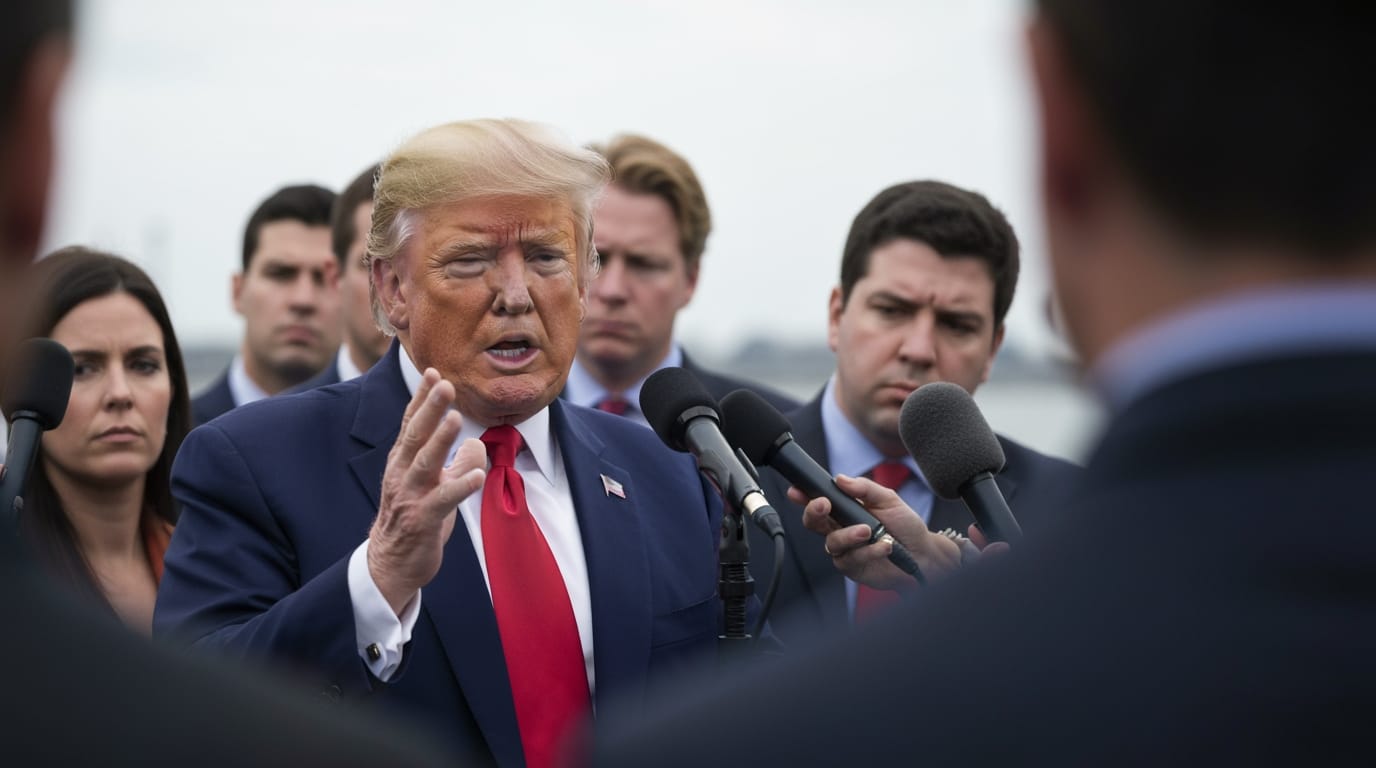
WASHINGTON D.C. – Former President Donald Trump has issued a stark threat to halt the impending opening of the Gordie Howe International Bridge, a crucial trade link between Detroit, Michigan, and Windsor, Ontario, demanding the United States be "fully compensated" for past dealings with Canada. The declaration, made via social media on Monday, February 9, 2026, injects significant uncertainty into a multi-billion dollar infrastructure project nearing completion and escalates already strained trade relations between the two North American allies.
The President's Demands and Accusations
In a lengthy social media post, Trump asserted that he would not permit the bridge to open until Canada provides full compensation for alleged past concessions and treats the United States with "Fairness and Respect". He claimed that Canada has exploited the U.S. for decades, citing specific grievances such as Canadian tariffs on American dairy products and Ontario's restrictions on U.S. alcoholic beverages. Furthermore, Trump controversially suggested the U.S. should gain "at least one half" ownership of the bridge, arguing that the revenues generated from the U.S. market would be "astronomical". He also criticized the bridge's construction, alleging a lack of U.S. content, specifically American steel, despite Canada funding the project. The former president also expressed concern over Canada's "closer trading relationship with China," making an unsubstantiated claim about China's influence on Canadian ice hockey. He called for "immediate" negotiations to address these perceived imbalances.
The Gordie Howe International Bridge: A Binationally Funded Link
The Gordie Howe International Bridge, named after the legendary hockey player, is a colossal infrastructure undertaking designed to significantly boost cross-border trade and travel between the U.S. and Canada. The project, which broke ground in 2018, is a binational effort connecting Windsor, Ontario, with Detroit, Michigan. Valued at an estimated $6.4 billion (an increase from its initial $4.6 billion projection), the bridge's construction has been entirely funded upfront by the Canadian government. Despite Canada's full upfront payment, the bridge is slated to be publicly owned by both Canada and the state of Michigan upon completion.
The bridge is poised to become a vital artery for commerce, providing an additional crossing option at one of the busiest commercial border points between the two nations. Its proponents highlight its potential to increase trade, encourage investment, and support the world's largest bilateral trading relationship. The U.S. Homeland Security Department recently designated the bridge an official port of entry, signaling its imminent operational status. Interestingly, Trump's current stance contradicts his previous endorsement of the bridge in 2017, when he joined then-Prime Minister Justin Trudeau in a statement recognizing it as a "vital economic link" between the two countries. Construction on the bridge is reportedly nearing completion, with an opening anticipated in early 2026.
Political and Economic Fallout
The former president's threat has sparked immediate concern and condemnation from various political and economic stakeholders, particularly in Michigan. U.S. Senator Elissa Slotkin (D-Holly) warned that blocking the project would have "serious repercussions" for Michigan's economy, leading to higher costs for businesses, less secure supply chains, and fewer jobs. She asserted that Trump's actions were punishing Michiganders for a trade war he initiated, implying that Canada's pursuit of alternative trade deals with China was a direct consequence of his policies. Senator Gary Peters and Representative Shri Thanedar echoed these sentiments, with Thanedar calling the idea of blocking the bridge "crazy" and detrimental to Michigan's economy.
The Canadian Chamber of Commerce, through its President and CEO Candace Laing, responded by stating that "blocking or barricading bridges is a self-defeating move," emphasizing the decades of collaboration between Canada and the U.S. in building shared economic prosperity. Windsor Mayor Drew Dilkens dismissed Trump's threats as "just insane" and challenged some of his factual claims, noting that U.S. steel was indeed utilized in the bridge's construction on the Michigan side. Critics also pointed out that the delays in the bridge's completion may have inadvertently contributed to the project falling under the purview of a potential future Trump administration. The broader context of the threat involves looming renegotiations of the United States-Mexico-Canada Agreement (USMCA) this year, with Trump maintaining a hardline stance on trade issues.
Unprecedented Intervention and Uncertainty
The practical and legal mechanisms by which Trump might attempt to block the bridge's opening remain unclear. The White House, Michigan Governor Gretchen Whitmer's office, and the Windsor-Detroit Bridge Authority have not yet offered official comments on the former president's specific threats. However, the prospect of such an intervention casts a long shadow over a project designed to enhance economic efficiency and strengthen North American ties. The development underscores the volatile nature of U.S.-Canada trade relations when subject to high-level political demands, particularly in an era of heightened economic nationalism.
Conclusion
The threat to impede the opening of the Gordie Howe International Bridge represents a significant potential disruption to cross-border commerce and a further strain on the critical relationship between the United States and Canada. While the bridge stands as a testament to binational cooperation and a vital economic link, the political posturing surrounding its completion introduces substantial uncertainty for businesses, commuters, and the broader North American economy. The unfolding situation highlights the intricate interplay of infrastructure, trade policy, and international diplomacy, with the fate of a multi-billion dollar asset now caught in the crosshairs of political demands.


