Trump Vows to Claim Strait of Hormuz as U.S. Territory Amidst Escalating Iran Conflict
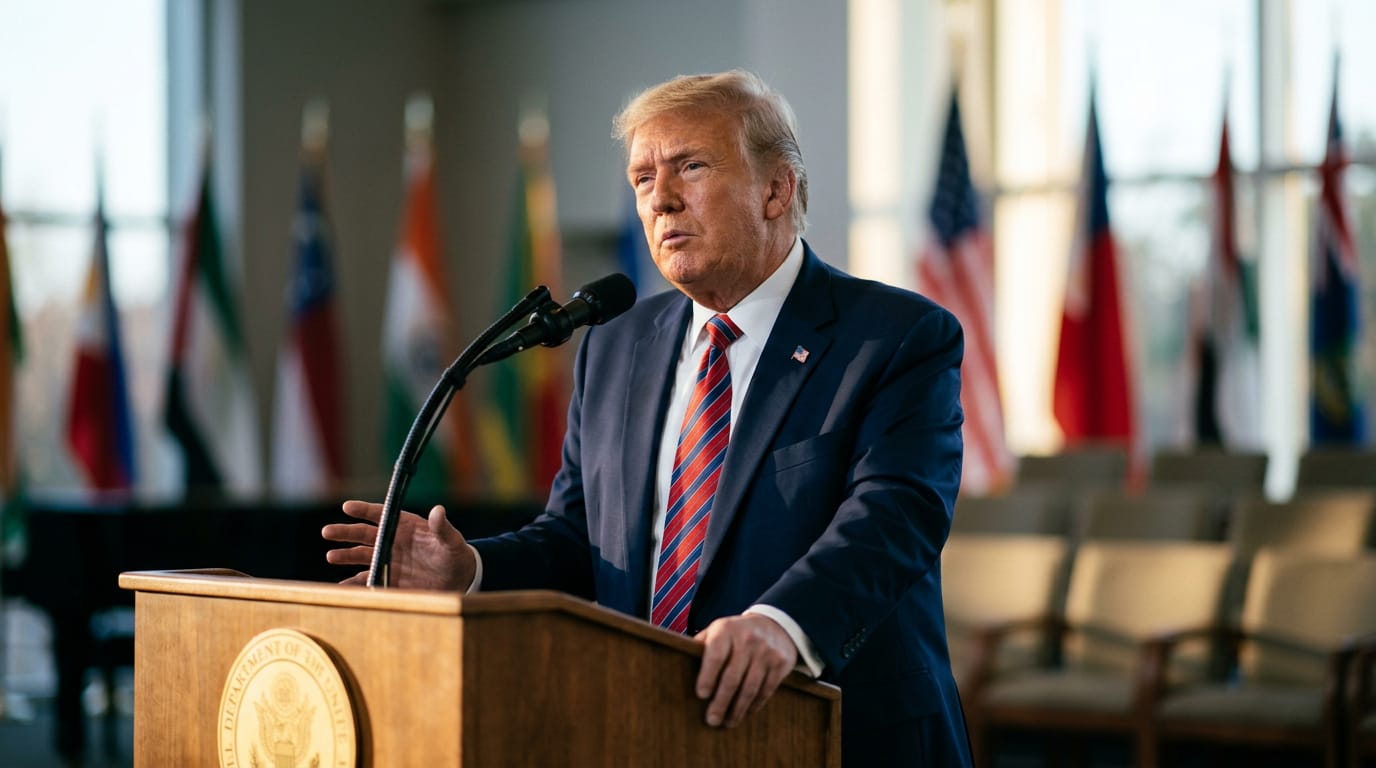
In a dramatic escalation of rhetoric, former U.S. President Donald Trump announced Friday his intent to declare the Strait of Hormuz a territory of the United States. The pronouncement, made during a political rally in Garden City, New York, comes amidst an ongoing conflict between the U.S., its allies, and Iran, which has seen the vital global shipping lane become a central flashpoint. Trump stated the declaration would follow a "defeat" of Iran, a nation he characterized as "being very badly defeated."
This extraordinary claim signals a potential profound shift in international maritime policy and has ignited immediate debate over its legality and geopolitical implications. The Strait, a narrow waterway bordering Iran and Oman, is a critical chokepoint for a significant portion of the world's oil and liquefied natural gas shipments. Its status has long been governed by complex international laws, which largely recognize it as an international strait ensuring freedom of navigation.
The President's Assertion Amidst Conflict
Speaking to supporters, Trump articulated his plan, stating, "After we finish defeating Iran… pretty soon I'll be declaring the Hormuz Strait a territory of the United States." His comments underscore heightened tensions in the region, where a declared war between the U.S., Israel, and Iran commenced in February 2026. The conflict has severely impacted maritime traffic through the Strait, with reports indicating a significant plummet in vessel crossings, operating at roughly 20% of pre-war volumes.
The Trump administration has also maintained a naval blockade on Iranian ports, a measure aimed at crippling its economy. Concurrently, Iran has reportedly established de facto control over large sections of the Strait, disrupting commercial shipping and demanding permissions for passage, with some reports suggesting it is charging fees for safe transit for "friendly countries". Trump emphasized the effectiveness of the U.S. blockade, asserting, "No ships get through unless we want them to." This statement, however, stands in stark contrast to Iran's reported control and reduced shipping volumes, indicating a complex and contested operational environment.
The Strategic Chokepoint: International Law and Sovereignty
The Strait of Hormuz is recognized under international law as an international strait, crucial for continuous and expeditious transit between two areas of high seas or exclusive economic zones. International legal frameworks, primarily the 1982 United Nations Convention on the Law of the Sea (UNCLOS) and the 1958 Geneva Convention on the Law of the Sea, dictate the legal regime of "transit passage" and "innocent passage" respectively. These principles ensure that all ships and aircraft, including military vessels, have the right to pass through the Strait without impediment, as long as their passage is peaceful and does not threaten coastal states.
While the Strait's narrowest point, approximately 21-22 nautical miles wide, places it within the territorial waters of Iran and Oman, customary international law prioritizes transit passage for international navigation. Iran, notably, has not ratified UNCLOS, asserting its own interpretation of customary international law that allows it to deny passage to vessels associated with "aggressor parties". Oman, the other coastal state, typically adheres more closely to international norms, but the current conflict dynamics have centered on Iran's assertive posture.
Geopolitical Fallout and Legal Ramifications
A unilateral declaration by the United States claiming the Strait of Hormuz as its territory would be met with overwhelming international condemnation and legal challenges. Such a move would be a dramatic departure from established international maritime law and norms, which uphold the freedom of navigation through international straits. The sovereignty over the Strait is shared between Iran and Oman, and any attempt by a third party to claim it would be viewed as an act of aggression and a violation of territorial integrity.
Analysts suggest that such a declaration would not only intensify the existing conflict with Iran but also create severe diplomatic rifts with numerous countries dependent on the Strait for energy supplies, as well as those who are staunch advocates of international law. The implications for global trade, energy markets, and international relations would be profound, potentially leading to further instability in the already volatile Middle East and beyond. The legal community would largely view such a declaration as unenforceable and contrary to decades of international consensus on the law of the sea.
Iran's Assertive Stance and Regional Dynamics
Iranian officials have swiftly rebuked Trump's declarations, asserting that the Strait of Hormuz remains under Iran's control and will only be opened or closed under Tehran's authority. Iran's Deputy Foreign Minister Kazem Gharibabadi stated that Tehran "neither fears threats nor cowers before displays of power," underscoring the nation's defiant posture.
Iran has consistently linked the reopening of the Strait to broader demands, including an end to the U.S. blockade of its ports, the lifting of sanctions, and the release of frozen Iranian assets. This strategic leverage, however, comes at a cost, as prolonged disruption also carries economic and diplomatic consequences for Iran. Negotiations towards a ceasefire and a final agreement, brokered by Pakistan in April and June 2026, have reportedly stalled over these very issues, particularly regarding security guarantees and freedom of navigation. The ongoing stalemate highlights the deeply entrenched positions of both sides and the significant hurdles to de-escalation in the critical waterway.
Conclusion
Donald Trump's declared intention to claim the Strait of Hormuz as U.S. territory injects a new and highly contentious element into an already volatile geopolitical landscape. While presented as a definitive move following a perceived "defeat" of Iran, the pronouncement clashes fundamentally with existing international legal frameworks and is set against a backdrop of complex sovereignty claims and an active military conflict. The potential for such a declaration to further destabilize global energy markets and international relations remains immense, placing the future of this indispensable maritime artery in a state of precarious uncertainty.


