U.S. Escalates Venezuelan Pressure with Pursuit of Third Oil Tanker
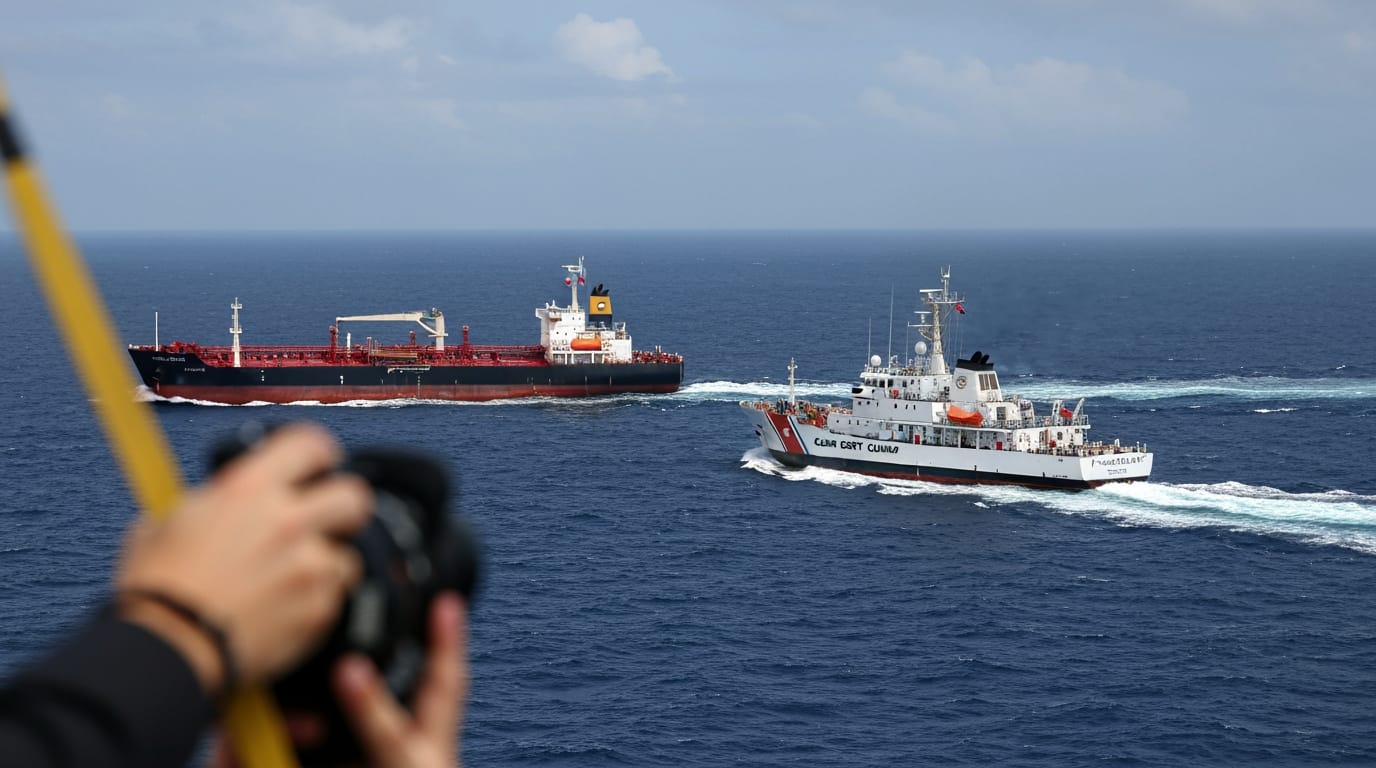
Caribbean Sea, December 21, 2025 – The United States Coast Guard is actively pursuing a third oil tanker in international waters near Venezuela, marking a significant escalation in Washington's ongoing pressure campaign against the government of President Nicolás Maduro. This latest interdiction effort, involving the Panamanian-flagged vessel Bella 1, follows the seizure of two other tankers in less than two weeks, underscoring a newly declared "total and complete blockade" aimed at disrupting what the U.S. identifies as illicit oil trade funding the Venezuelan regime. The intensified maritime operations reflect a deepening commitment by the Trump administration to choke off Venezuela's primary source of revenue, drawing sharp condemnation from Caracas and raising concerns about regional stability and global energy markets.
The Third Target: A Sanctioned Vessel En Route
The latest vessel under pursuit, identified as the Bella 1, is a Panamanian-flagged tanker reportedly under U.S. sanctions and was en route to Venezuela to load crude oil, according to media reports. Officials familiar with the operation described the Bella 1 as a "sanctioned dark fleet vessel" engaged in illegal sanctions evasion, flying a false flag and operating under a judicial seizure order. While the vessel was empty when it approached Venezuelan waters on Sunday, its past activities include transporting Venezuelan oil to China in 2021 and previously carrying Iranian crude, highlighting its role within a broader network of sanctioned shipping. As of Sunday, the tanker had not yet been boarded, with U.S. officials indicating that interception tactics can range from shadowing to aerial monitoring.
This pursuit follows closely on the heels of two successful interdictions earlier in the month. On December 10, U.S. forces seized the tanker Skipper near Venezuela, a vessel alleged to be part of an oil shipping network supporting the Lebanese militant group Hezbollah and Iran's Islamic Revolutionary Guard Corps-Qods Force. Then, on Saturday, December 20, the U.S. Coast Guard boarded the Panamanian-flagged supertanker Centuries, which the White House asserted was a "falsely flagged vessel operating as part of the Venezuelan shadow fleet to traffic stolen oil." The crude oil found aboard the Centuries originated from Petróleos de Venezuela SA (PDVSA), Venezuela's state-owned oil company, which remains under U.S. sanctions. These actions underscore a tactical shift towards more aggressive physical interdictions at sea.
"Total and Complete Blockade": A Broadening Strategy
The heightened maritime enforcement aligns with President Donald Trump's directive on December 16, ordering a "total and complete blockade" on all sanctioned oil tankers entering or exiting Venezuelan waters. This declaration was accompanied by the designation of the Venezuelan government as a "foreign terrorist organization," with the administration accusing the Maduro regime of utilizing oil revenues to finance "drug terrorism" and other criminal activities. The US strategy aims to dismantle what officials describe as the core financial lifeline of the Maduro regime: illegal oil exports, drug trafficking networks, and complex sanction-evasion schemes.
This intensified pressure campaign against President Nicolás Maduro seeks to compel his removal from power, a long-standing objective of the Trump administration. To facilitate this, the U.S. has significantly ramped up its military presence in the Caribbean region, including a substantial naval buildup that features assets such as the USS Gerald R. Ford aircraft carrier, Reaper drones, and F-35 fighter jets. Beyond tanker interdictions, these military operations have involved over two dozen strikes on vessels in the Pacific Ocean and Caribbean Sea, which the U.S. alleges were involved in drug smuggling, resulting in over 100 fatalities. These measures represent a blend of traditional naval power with sophisticated financial and legal mechanisms to exert maximum economic and political pressure.
Crippling the "Shadow Fleet": Economic Fallout
A central target of the U.S. blockade is Venezuela's "shadow fleet" – a network of tankers and associated entities designed to evade international sanctions and mask the origin and destination of Venezuelan crude. These illicit operations typically deliver oil to countries like China and Cuba, employing various tactics to obscure shipping routes and vessel identities. The U.S. maintains that these sanctioned vessels constitute a vital financial lifeline for the Maduro regime, enabling it to sustain its patronage system and maintain power.
The impact of these interdiction efforts is already evident. According to maritime intelligence firms, even before the latest pursuits, several sanctioned tankers operating near Venezuelan waters had begun to divert or alter their courses following the seizure of the Skipper. Critically, U.S. enforcement operations have drastically reduced Venezuelan crude flows, plummeting to approximately 258,000 barrels per day in December 2025. This represents a staggering 76% reduction compared to the 1.08 million barrels per day exported during the same period in 2024, significantly weakening Venezuela's oil-dependent economy. Analysts suggest that this disruption of Venezuela's economic lifeline is intended to destabilize the Maduro regime and pressure him to concede power.
Geopolitical Repercussions and Escalating Tensions
The U.S. actions have drawn vehement reactions from Venezuela and its allies, escalating geopolitical tensions in the region. Caracas has unequivocally condemned the interceptions, denouncing them as "piracy," "theft," and "hijacking" of its sovereign resources. President Maduro has repeatedly asserted that the U.S. seeks to "colonize Venezuela to seize our oil wealth" and uses false accusations of drug trafficking as a pretext for intervention. Cuba, a close ally and recipient of Venezuelan oil, has also sharply criticized the U.S. seizures, characterizing them as an intensification of "maximum pressure and economic suffocation" that negatively affects the island nation.
In response to the blockade, the Venezuelan Navy has reportedly been ordered to escort oil tankers, a move that carries the potential for direct confrontation and further heightens the risk of maritime incidents. The disruption of Venezuelan oil supply also carries wider economic implications, with concerns that a reduction in global supply could contribute to an increase in international oil prices. This unfolding situation underscores a complex interplay of economic warfare, maritime control, and geopolitical maneuvering with far-reaching consequences for international relations and global energy markets.
The pursuit of the Bella 1 signals a new, more aggressive phase in the U.S. strategy towards Venezuela, moving beyond traditional sanctions to direct physical interdiction of vessels. This approach aims to directly sever the financial lifelines that sustain the Maduro regime, targeting the "shadow fleet" that has enabled sanctions evasion. While designed to force political change in Venezuela, these actions carry significant risks, including potential military escalation, humanitarian concerns within an already struggling Venezuelan economy, and broader instability in global energy markets. The coming weeks will likely reveal the full extent of this blockade's effectiveness and its ultimate impact on the geopolitical landscape of the Caribbean and beyond.


