US and Iran Announce Conflicting Accounts of Nuclear Talks
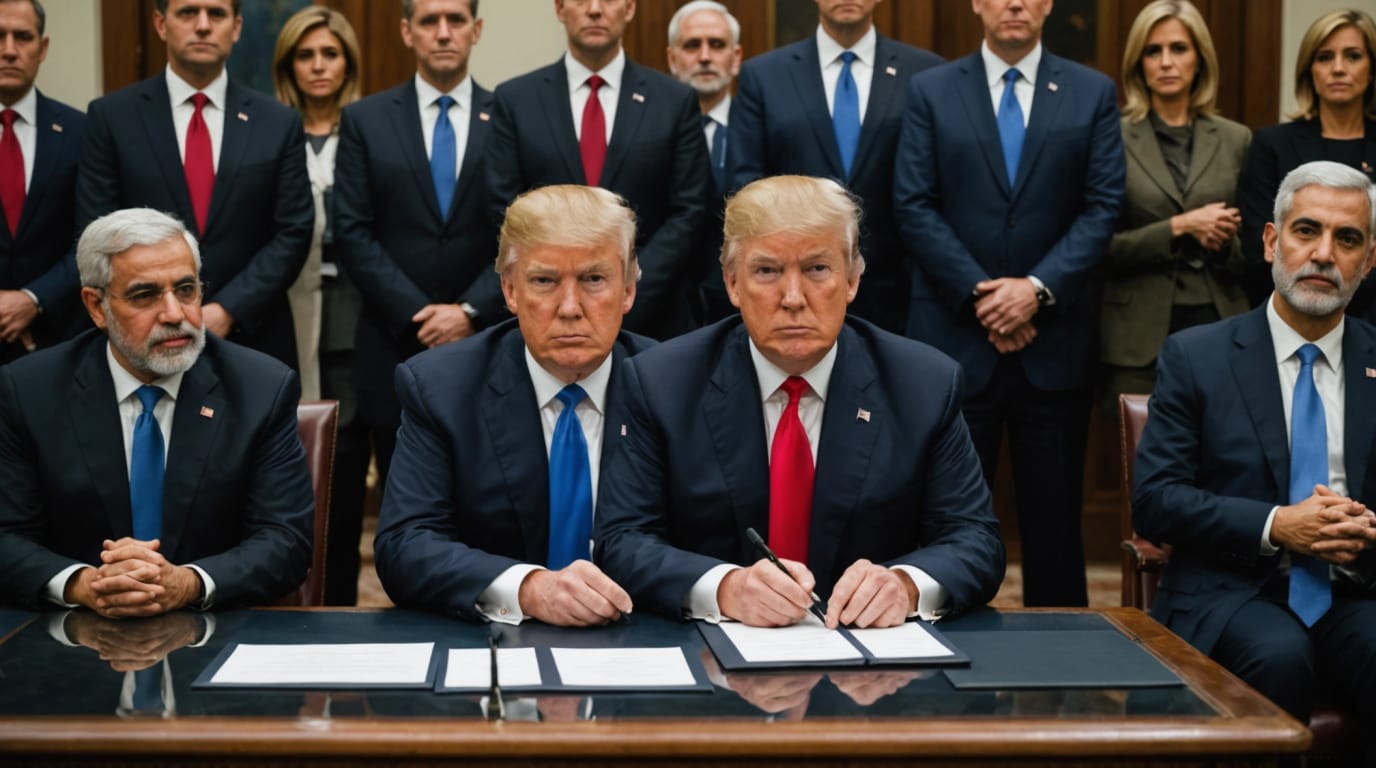
WASHINGTON - In a sudden turn of events, President Donald Trump announced Monday that the United States would engage in direct talks with Iran regarding its nuclear program. However, Tehran quickly countered, stating that any discussions would be indirect and mediated by Oman. The conflicting announcements have injected uncertainty into the already tense relationship between the two nations.
Trump's Announcement and Tehran's Response
Speaking to reporters at the White House alongside Israeli Prime Minister Benjamin Netanyahu, Trump declared that direct talks with Iran had already commenced and would continue on Saturday. He emphasized the importance of preventing Iran from obtaining nuclear weapons, warning of "great danger" if diplomatic efforts failed.
"We're having direct talks with Iran, and they've started," Trump said. "It'll go on Saturday. We have a very big meeting, and we'll see what can happen. And I think everybody agrees that doing a deal would be preferable."
However, shortly after Trump's statement, Iranian Foreign Minister Abbas Araghchi took to social media to assert that the talks would be indirect, with Oman acting as an intermediary. "Iran and the United States will meet in Oman on Saturday for indirect high-level talks," Araghchi wrote. "It is as much an opportunity as it is a test. The ball is in America's court."
Netanyahu's Cautious Support
Prime Minister Netanyahu, who has long been a vocal critic of Iran's nuclear ambitions, offered a cautiously supportive response to the announcement. While standing alongside Trump, Netanyahu stated that if diplomacy could fully eliminate Iran's nuclear program, it would be "a good thing," but stressed that the program had to be stopped by any means necessary.
Netanyahu's presence at the announcement underscores the close alignment between the U.S. and Israel on the issue of Iran's nuclear program. Israel is widely believed to possess an undeclared nuclear arsenal and views a nuclear-armed Iran as an existential threat.
The Stakes of the Negotiations
The upcoming talks, regardless of whether they are direct or indirect, carry significant implications for regional and global security. The primary objective of the negotiations is to address concerns about Iran's nuclear program and prevent the country from developing nuclear weapons.
Under the current regime, Iran has ramped up its enrichment of uranium up to 60 percent purity, which has no application beyond nuclear weapons, and has obstructed international inspectors from checking its nuclear facilities.
Trump has warned that if the talks are unsuccessful, Iran would face severe consequences. "If the talks aren't successful, I think it's going to be a very bad day for Iran," Trump said. He did not rule out military action as a potential option.
The Shadow of the 2015 Nuclear Deal
These developments occur against the backdrop of the 2015 nuclear agreement, formally known as the Joint Comprehensive Plan of Action (JCPOA). During his first term, Trump withdrew the U.S. from the JCPOA, which had placed strict limits on Iran's nuclear activities in exchange for sanctions relief. He also reimposed sweeping U.S. sanctions on Iran as part of a "maximum pressure" campaign.
Since then, Iran has gradually rolled back its commitments under the JCPOA, raising concerns about its nuclear ambitions. The upcoming talks represent an attempt to find a new path forward and address the shortcomings of the previous agreement.
Trump has indicated that any new deal with Iran would need to be "stronger" than the 2015 agreement. However, it remains unclear what specific terms the U.S. would seek and whether Iran would be willing to accept them.
Potential Obstacles and Challenges
Several obstacles could potentially derail the negotiations between the U.S. and Iran. One major challenge is the deep mistrust between the two countries, stemming from decades of animosity and conflicting interests.
Another obstacle is the differing perspectives on the scope and terms of any potential agreement. The U.S. is likely to demand significant concessions from Iran regarding its nuclear program, while Iran may seek sanctions relief and guarantees that its nuclear program will not be disrupted.
Furthermore, regional dynamics could also complicate the negotiations. The involvement of other actors, such as Israel and Saudi Arabia, could influence the outcome of the talks.
Conclusion: A Delicate Path Forward
The announcement of upcoming talks between the U.S. and Iran, despite the conflicting accounts of their format, represents a significant development in the ongoing efforts to address Iran's nuclear program. The negotiations offer an opportunity to de-escalate tensions and prevent a potential crisis in the Middle East.
However, the path forward is fraught with challenges and uncertainties. Overcoming the deep mistrust between the two countries, bridging the gap in their respective positions, and navigating the complex regional dynamics will require skillful diplomacy and a willingness to compromise. The world watches with bated breath as these two nations embark on this delicate path, hoping for a peaceful resolution to a long-standing conflict.


