Venezuela Charts New Course: Acting President Rodriguez Meets US Envoy Amidst Post-Maduro Era
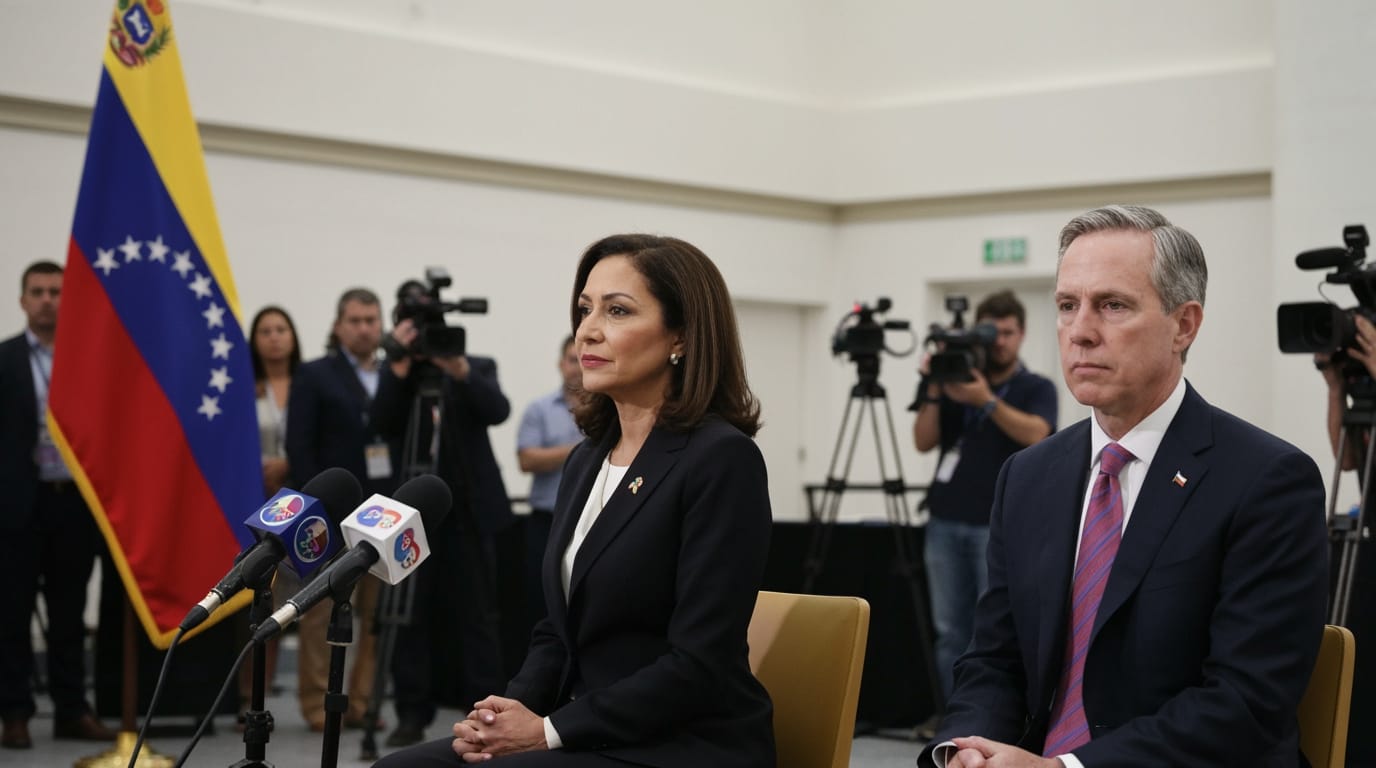
Caracas, Venezuela – In a dramatic shift for long-strained bilateral relations, Venezuela’s acting president, Delcy Rodriguez, held a high-level meeting with U.S. Charge d'Affaires Laura Dogu on Monday in Caracas, marking a significant diplomatic engagement in the wake of former President Nicolás Maduro's recent capture by United States forces. The encounter at the Miraflores Presidential Palace signals a potentially pivotal moment for Venezuela, as its new leadership navigates an uncertain future following years of deep political and economic turmoil.
The unexpected meeting, which unfolded just weeks after the U.S. operation that led to Maduro’s removal, underscores the intricate and rapidly evolving geopolitical landscape of the South American nation. While details of the discussions remain limited, the very act of such direct, high-level contact suggests a cautious re-evaluation of strategies by both Caracas and Washington, pointing toward an intricate path of dialogue and potential rapprochement after years of open hostility.
A Sudden Change at the Helm: Rodriguez Assumes Presidency
Delcy Rodriguez, a prominent figure in Venezuelan politics, assumed the role of acting president on January 3, 2026, following the stunning U.S. military operation that saw Nicolás Maduro and his wife, Cilia Flores, captured in Caracas and flown to New York to face drug-trafficking charges. Rodriguez, who had served as Vice President since 2018 under Maduro, was formally sworn into her new position on January 5, 2026, marking an abrupt end to Maduro’s controversial presidency.
The U.S. action, described by Venezuelan authorities as a "large-scale strike," effectively decapitated the leadership that Washington had long deemed illegitimate. Rodriguez's immediate reaction was to denounce the U.S. operation as a violation of the United Nations founding charter and an attempt at regime change. However, her tone appeared to shift quickly, adopting a more conciliatory stance and expressing a desire for "balanced and respectful international relations" with the United States. Prior to her ascension, Rodriguez held numerous key positions within the Venezuelan government, including Minister of Foreign Affairs, Minister of Economy and Finance, and Minister of Petroleum, cementing her as a powerful and experienced figure within the Bolivarian establishment.
Diplomatic Channels Reopen: US Envoy’s Mission
The arrival of Laura Dogu, the U.S. Charge d'Affaires to the Venezuela Affairs Unit, in Caracas on February 1, 2026, set the stage for Monday's significant encounter. Dogu's presence in the Venezuelan capital itself represented a thawing of diplomatic ice, as bilateral relations had been severed by the Maduro government in 2019. The meeting with Acting President Rodriguez, as described by Venezuela’s Minister of Communication and Information, took place "within the framework of the working agenda between the two countries."
Following the discussions, Dogu indicated on social media platform X that she engaged with Rodriguez on U.S. plans concerning "stabilization, economic recovery, reconciliation and transition" for Venezuela. These topics align with long-standing U.S. policy objectives for the nation, which has endured years of economic crisis, hyperinflation, and a mass exodus of its citizens. The meeting comes shortly after a reported agreement between the two countries to export up to $2 billion worth of Venezuelan crude to the United States, suggesting a pragmatic shift in economic engagement. Furthermore, Rodriguez has announced a proposed "amnesty law" for hundreds of prisoners and plans to convert the Helicoide detention center into a facility for sports and social services, moves that could signal an attempt to address human rights concerns and foster national dialogue.
A History of Hostility: The Complex US-Venezuela Relationship
The backdrop to this recent diplomatic exchange is a turbulent history marked by escalating tensions, particularly over the past decade. U.S.-Venezuela relations have been characterized by sanctions, mutual accusations, and a lack of direct high-level contact for several years. The United States consistently refused to recognize Nicolás Maduro's presidency as legitimate, instead recognizing the 2015 democratically elected Venezuelan National Assembly as the country's sole legitimate branch of government.
In the period leading up to Maduro's capture, U.S. pressure on Venezuela intensified dramatically. Throughout 2025, there was a significant escalation of U.S. military actions in the region, including maritime "anti-narcotics" campaigns in the Caribbean and Pacific, which involved numerous strikes against alleged drug smuggling boats, resulting in dozens of fatalities. The U.S. had also imposed extensive sanctions on key individuals within the Venezuelan government and its vital oil sector, aiming to isolate the Maduro regime and exert economic pressure. President Donald Trump had publicly stated his authorization of covert CIA operations within Venezuela and weighed the possibility of land operations, further ratcheting up the pressure. This culminated in the dramatic January 3, 2026, "large-scale strike" on Caracas that led to Maduro's apprehension, an event that fundamentally reshaped the political landscape in Venezuela.
Implications for Venezuela's Future: A Path Forward?
The new reality of Delcy Rodriguez as acting president and the cautious re-opening of diplomatic channels with the United States present both opportunities and formidable challenges for Venezuela. The immediate implications are profound for the nation's political stability and economic future. The U.S. focus on "stabilization, economic recovery, reconciliation and transition" suggests a desire to facilitate a return to democratic norms and address the deep-seated humanitarian crisis that has gripped the country. The potential for increased oil exports to the U.S. could offer a vital lifeline to Venezuela's devastated economy, which relies heavily on its vast petroleum reserves.
However, the path forward is fraught with complexities. Delcy Rodriguez's administration faces the immense task of rebuilding a nation scarred by years of political polarization, economic collapse, and social unrest. Her ability to unite diverse political factions, ensure transparent governance, and address the humanitarian needs of the Venezuelan people will be critical. The international community, long divided over the Venezuelan crisis, will be closely watching for signs of genuine reform and a commitment to democratic principles. The re-engagement with the U.S., while offering hope for stability, also means navigating the powerful influence of a nation that directly intervened to change Venezuela's leadership. The coming months will undoubtedly test the resilience of Venezuela's new leadership and the willingness of both Caracas and Washington to forge a more constructive and lasting relationship.
The meeting between Acting President Rodriguez and Envoy Dogu signals a potential pivot point in the tumultuous history of U.S.-Venezuela relations. It underscores the profound impact of the recent change in Venezuelan leadership and hints at a future where diplomatic engagement, rather than isolation, may take precedence. While the road ahead remains uncertain, this initial high-level contact represents a tentative step towards addressing Venezuela's multifaceted challenges and potentially reshaping its place in the global community.


