Venezuelan Leader Nicolás Maduro Captured by U.S. Forces, Faces Narco-Terrorism Charges in New York Amid International Outcry
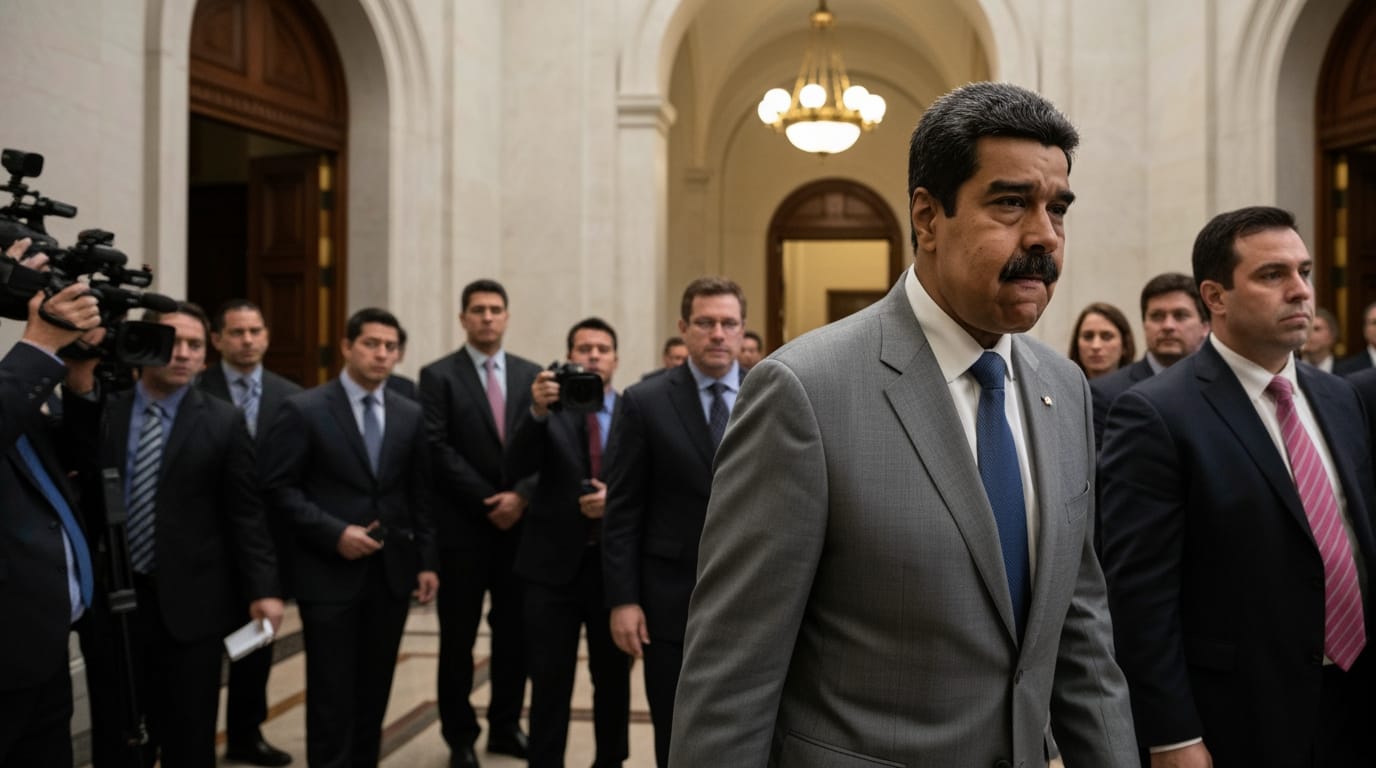
In a dramatic escalation of long-standing tensions, Venezuelan President Nicolás Maduro was captured by U.S. Special Forces in Caracas on January 3, 2026, and subsequently flown to New York to face federal charges related to narco-terrorism and drug trafficking. The unprecedented military operation has sent shockwaves across the globe, prompting an emergency meeting of the United Nations Security Council (UNSC) and igniting a fierce debate over international law and national sovereignty.
The U.S. Department of Justice unsealed a new indictment against Maduro and his wife, Cilia Flores, accusing them of overseeing a "corrupt, illegitimate government" that facilitated the shipment of thousands of tons of cocaine into the United States. This audacious capture marks a pivotal moment in the complex relationship between Washington and Caracas, with profound implications for Venezuela's future and the international legal order.
The Audacious Capture and Federal Charges
The early morning hours of Saturday, January 3, 2026, witnessed a large-scale U.S. military operation in Caracas, Venezuela. Multiple explosions were reported across the city, including at military installations, as U.S. forces executed a raid that resulted in the capture of President Nicolás Maduro and his wife, Cilia Flores. The operation, which reportedly lasted less than 30 minutes, led to casualties, including civilians and Venezuelan military personnel. Following their apprehension, Maduro and Flores were transported out of Venezuela and are now expected to appear in a Manhattan federal court to face charges.
The indictment against Maduro, first brought in 2020 during the Trump administration and recently superseded to include charges against his wife, details four primary counts: narco-terrorism conspiracy, cocaine importation conspiracy, possession of machine guns, and conspiracy to possess machine guns and destructive devices. Prosecutors allege that Maduro leveraged his positions within the Venezuelan government to partner with violent drug traffickers and narco-terrorists, including the Revolutionary Armed Forces of Colombia (FARC) and cartels like Sinaloa, to traffic cocaine. U.S. authorities claim that this network allowed up to 250 tons of cocaine to be trafficked through Venezuela annually by 2020, enriching Maduro, his family, and members of his regime. A $50 million reward for information leading to Maduro's arrest had been in place, doubling an earlier reward. The U.S. Department of Justice describes Maduro as being at the forefront of this corruption, asserting he "tarnished every public office he has held."
International Outcry and Emergency UN Security Council Session
The U.S. military action and the subsequent capture of a sitting head of state have triggered a wave of condemnation and alarm on the international stage. The United Nations Security Council (UNSC) convened an emergency session on Monday, January 5, 2026, at the request of Colombia, supported by China and the Russian Federation, with Venezuela formally appealing to the Council.
Venezuela's Ambassador to the UN, Samuel Moncada, vehemently denounced the U.S. operation as a "colonial war" aimed at destroying Venezuela's republican government and plundering its vast natural resources, particularly its oil reserves. He argued that the U.S. actions flagrantly violate Article 2(4) of the UN Charter, which prohibits the threat or use of force against the territorial integrity or political independence of any state.
UN Secretary-General Antonio Guterres expressed deep alarm over the escalation, warning that the crisis could undermine the foundations of international law and set a "dangerous precedent." While the U.S. has justified the operation as a criminal justice function and an act of self-defense against narco-terrorist organizations, this stance is expected to face strong opposition within the Council. Any resolution critical of the United States is likely to be vetoed, underscoring the deep divisions among member states. The European Union, while acknowledging the priority of combating transnational organized crime, has emphasized the need to uphold international law, territorial integrity, and sovereignty.
Regional and Economic Repercussions
The immediate aftermath of the military operation saw significant disruptions across the Caribbean. The Federal Aviation Administration imposed airspace restrictions around Venezuela and parts of the Caribbean, leading to the cancellation of hundreds of flights to and from popular destinations like Puerto Rico, Aruba, and the Virgin Islands. These restrictions, imposed due to "military activity," caused widespread travel chaos, though they were lifted by Sunday evening.
The U.S. State Department concurrently reissued a Level 4 "Do Not Travel" advisory for Venezuela, the highest level of warning, citing risks including wrongful detention, torture, terrorism, and arbitrary enforcement of local laws. This advisory strongly urges all U.S. citizens and lawful permanent residents to depart Venezuela immediately, noting the U.S. government's inability to provide emergency consular services in the country.
Economically, the capture of Maduro further destabilizes an already fragile Venezuela. President Donald Trump indicated that the U.S. would "run" Venezuela until a "safe, proper and judicious transition" could be established, explicitly linking this to the country's oil resources and the alleged narco-terrorist activities. This follows a history of U.S. sanctions targeting Venezuelan government entities and individuals, including those in the oil, gas, and gold industries. The power vacuum created by Maduro's removal raises concerns about the country's governance, legitimacy, and potential for increased insecurity and worsening humanitarian conditions.
Legal Precedents and the Future of International Law
The seizure of President Maduro on Venezuelan soil by U.S. forces has ignited a complex legal debate concerning the boundaries of national sovereignty and the reach of international law. Critics argue that such an operation, without a UN Security Council resolution or clear self-defense justification, constitutes a violation of the UN Charter's prohibition on the use of force. Legal experts have drawn parallels to past controversial interventions, such as the U.S. invasion of Panama in 1989 to depose Manuel Noriega and the 2003 Iraq war, raising questions about whether international law is being reshaped by practice rather than consensus.
The U.S. maintains that its actions are justified on criminal justice grounds and as a response to narco-terrorism posing a threat to its security. However, the UN Secretary-General's warning about a "dangerous precedent" underscores the potential for this event to impact how similar situations are handled globally in the future. The case now proceeds in a U.S. federal court, where the legal battle is expected to be protracted and highly scrutinized, further highlighting the tensions between sovereign immunity and international criminal jurisdiction.
An Uncertain Path Forward
The capture of Nicolás Maduro marks a profound turning point for Venezuela and the international community. As Maduro faces trial in a New York courtroom, the political landscape in Venezuela remains volatile, with a power vacuum and pressing questions about the country's immediate governance and long-term stability. The emergency UNSC meeting reflects the global concern over the implications of the U.S. action, particularly regarding the respect for international law and national sovereignty. The coming weeks and months will undoubtedly reveal the full ramifications of this extraordinary event, shaping not only Venezuela's destiny but also potentially redefining the parameters of international relations and the enforcement of justice on a global scale.


