Wave of Terror: Over 160 Civilians Massacred in Western Nigeria Village Attacks
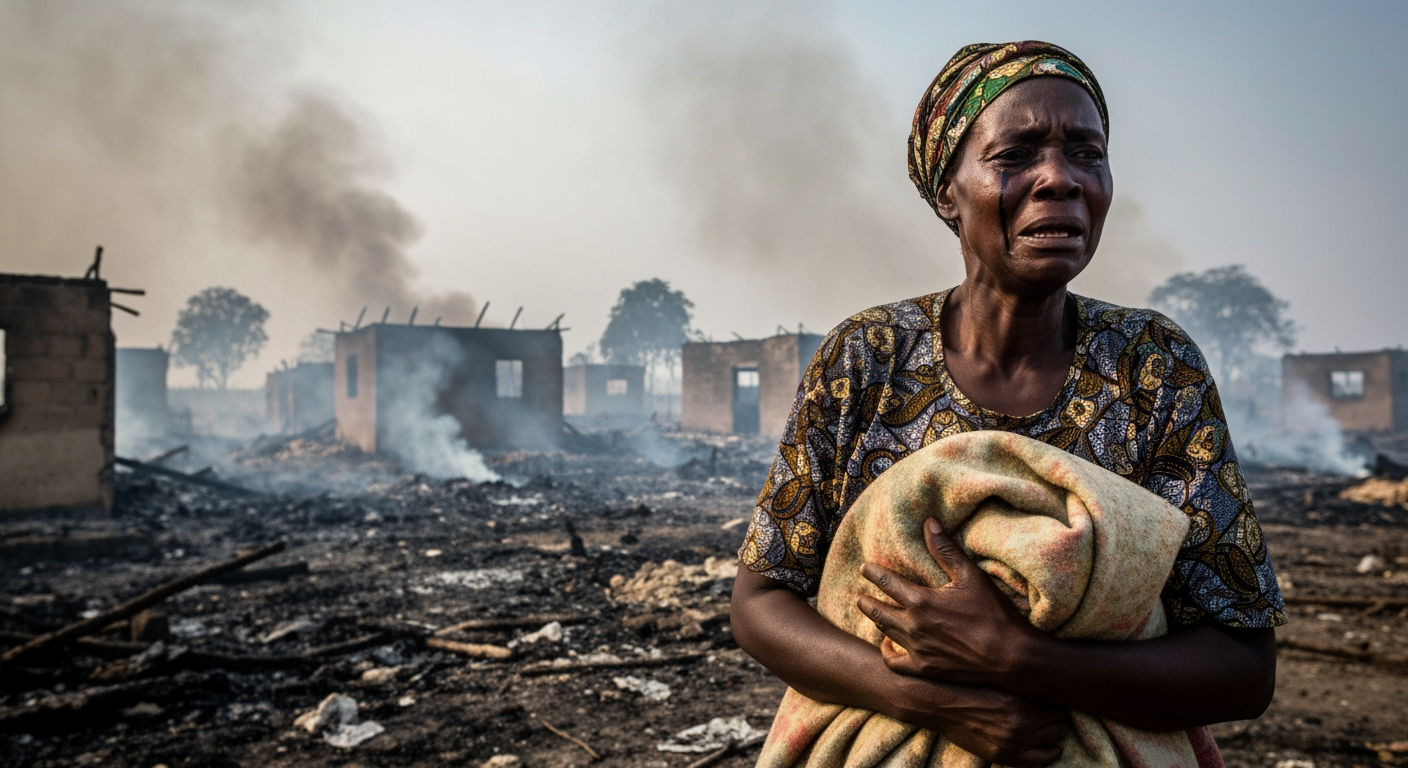
SOKOTO, Nigeria – In a harrowing escalation of Nigeria's multifaceted security crisis, armed extremists killed at least 162 people in coordinated assaults on the villages of Woro and Nuku in Kwara State, western Nigeria, on Tuesday evening. The attacks, attributed to the Lakurawa group, an affiliate of the Islamic State, mark one of the deadliest incidents in the country in recent months and underscore the deepening reach of militant violence beyond Nigeria's traditional conflict zones in the northeast. The brutal efficiency of the assailants, who reportedly rounded up residents, bound their hands, and executed them before setting homes and businesses ablaze, has sent shockwaves through a nation already grappling with persistent insecurity.
A Night of Unspeakable Horrors in Kwara State
The tranquility of Tuesday evening shattered for the inhabitants of Woro and Nuku, remote communities nestled in Kwara State, as armed extremists descended upon them. Reports from a local lawmaker, Mohammed Omar Bio, and the Kwara State Red Cross secretary, Ayodeji Emmanuel Babaomo, paint a grim picture of systematic brutality. Gunmen, later identified as members of the Lakurawa group, stormed the villages, indiscriminately attacking residents in their homes, in markets, and on the streets. Eyewitness accounts, corroborated by grim footage broadcast on local television, revealed scenes of horror: bodies lying in pools of blood, some with their hands tied behind their backs, amidst the smoldering ruins of torched houses and shops.
The initial death toll quickly climbed as search teams ventured into the devastated communities. By Wednesday afternoon, the Red Cross placed the number of fatalities at 162, a figure echoed by Sa'idu Baba Ahmed, a politician representing the Kaiama region, who also mentioned estimates of up to 170 lives lost. Many villagers, desperate to escape the onslaught, fled into the surrounding bushland, some sustaining gunshot wounds in their frantic dash for safety. The remote nature of the affected areas, located approximately eight hours from the state capital and close to Nigeria's border with Benin, has significantly hampered relief efforts and the ability of aid organizations to reach the traumatized communities. The whereabouts of several individuals, including the traditional king of one of the villages, remained unknown in the immediate aftermath, fueling fears of further casualties or abductions.
The Shadow of Lakurawa and the Islamic State
The perpetrators of this horrific act have been identified as the Lakurawa, an armed group now explicitly linked to the Islamic State. This affiliation signifies a worrying trend, indicating a potential expansion of the Islamic State's influence into new territories within Nigeria, particularly its western and north-central regions. Residents reported that the gunmen, prior to unleashing their violence, preached in the villages, demanding that locals abandon their allegiance to the Nigerian state and instead adhere to Sharia, or Islamic law. When these demands were resisted, the militants opened fire, underscoring their extremist ideology and ruthless enforcement.
The Lakurawa group's increasing operational footprint in Nigeria's western border communities is a relatively recent development. Intelligence suggests the group has roots in neighboring Niger and became more active in Nigeria following a 2023 military coup in that country. This regional instability appears to have provided fertile ground for the group to establish and expand its presence, exploiting porous borders and local grievances. The attacks in Kwara State are seen by Governor AbdulRahman AbdulRazaq as a "cowardly expression of frustration by terrorist cells" in response to ongoing military operations targeting armed extremists within the state. This suggests that the recent military pressure may be provoking retaliatory violence, putting civilian populations in precarious positions.
Nigeria's Entrenched Security Crisis
The massacre in Kwara State is a stark reminder of the complex and multi-layered security challenges plaguing Nigeria. While the northeast has long been the epicenter of the Boko Haram and Islamic State West Africa Province (ISWAP) insurgencies, the nation now faces a broader spectrum of threats. The Lakurawa's emergence in the west adds another dimension to this crisis, highlighting the adaptability and spread of extremist ideologies across the country. The northeastern region continues to grapple with deadly clashes between rival jihadist factions, with Boko Haram and ISWAP vying for territorial control and resources, resulting in tens of thousands of deaths and millions displaced since 2009.
Beyond the jihadist groups, Nigeria's northwest and north-central regions are plagued by a surge in kidnappings for ransom, perpetrated by various armed gangs. Intercommunal violence, often rooted in land and resource disputes, also remains prevalent in the central states. Just last week, armed extremists in northeastern Nigeria killed at least 36 people in separate attacks on a construction site and an army base. Simultaneously, on the same Tuesday as the Kwara massacre, another 13 people were killed in the village of Doma in the northwestern state of Katsina by unknown gunmen. This confluence of threats paints a grim picture of a nation besieged by violence on multiple fronts, challenging the government's capacity to protect its citizens and maintain order.
A Government Under Pressure: Response and Challenges Ahead
The Nigerian government has repeatedly affirmed its commitment to combating terrorism and restoring security across the nation. Military operations are ongoing in various states, including Kwara, targeting extremist elements and armed gangs. However, the ability of groups like Lakurawa to carry out such devastating attacks, particularly in remote areas, underscores the immense challenges faced by security forces. The Red Cross's difficulty in accessing the affected villages due to their remoteness highlights logistical hurdles that empower these groups to operate with relative impunity in certain regions.
International pressure has also been a factor in Nigeria's counter-terrorism efforts. Concerns, particularly from the United States, regarding the protection of Christian communities and the overall security situation, have led to increased cooperation with Washington. While the Nigerian authorities deny systematic persecution of Christians, they acknowledge the need to improve security for all citizens. Despite recent claims by the military of "neutralizing" a significant number of bandits and clearing their hideouts in ongoing operations, the recent mass casualty events suggest that extremist groups retain considerable operational capabilities and a willingness to inflict severe violence on civilian populations.
The tragic events in Woro and Nuku serve as a stark reminder of the enduring human cost of extremist violence in Nigeria. The immediate priority remains to provide aid and support to the survivors and displaced, while a long-term strategy for comprehensive security and stability across all regions of the country is more critical than ever. The continued expansion and adaptation of extremist groups, coupled with Nigeria's complex internal conflicts, demand a robust and multi-faceted response to prevent further loss of life and to safeguard the future of its communities. The path to lasting peace in Nigeria remains fraught with peril, with recent events casting a long shadow over the nation's struggle against an evolving and relentless enemy.
Related Articles

Ratko Mladić, "Butcher of Bosnia" and Convicted War Criminal, Dies at 84
THE HAGUE, Netherlands – Ratko Mladić, the former Bosnian Serb military commander known as the "Butcher of Bosnia" and convicted of genocide, war crimes, and crimes against humanity, has died at the age of 84. Serbian...

Long-Awaited 9/11 Mastermind Trial Set for 2028, Decades After Attacks
GUANTANAMO BAY, Cuba – Nearly a quarter-century after the devastating terror attacks of September 11, 2001, a military judge has finally set a trial date for Khalid Sheikh Mohammed, the alleged mastermind behind the...