Afghan Forces Claim to Engage Pakistani Jets Over Kabul Amid Escalating "Open War"
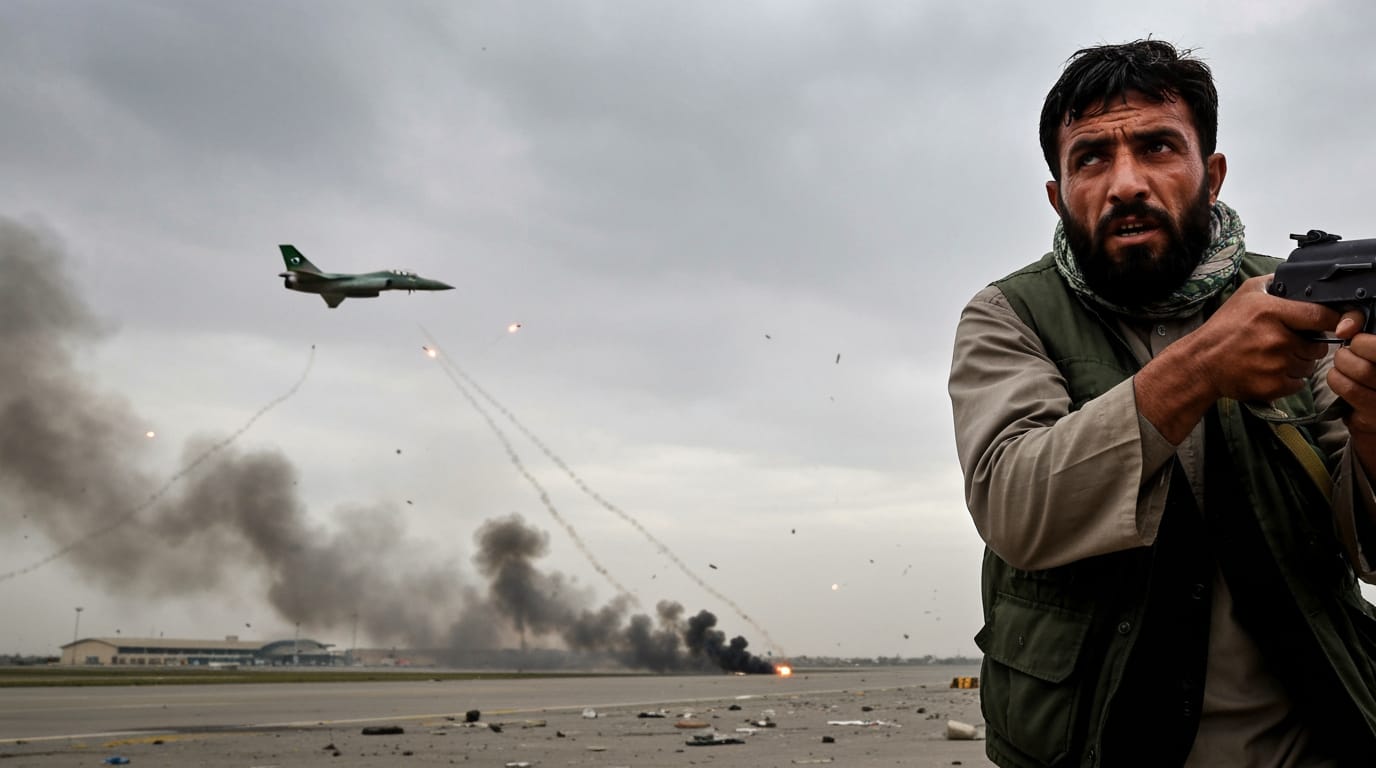
KABUL – In a dramatic escalation of hostilities, Afghan authorities on Sunday, March 1, 2026, claimed their air defense systems engaged Pakistani military jets attempting to bomb Bagram Air Base, north of Kabul. The incident marks a perilous new phase in the increasingly volatile relationship between Afghanistan's Taliban administration and Pakistan, with Islamabad having recently declared an "open war" following a series of deadly cross-border clashes and retaliatory airstrikes. The alleged targeting of Pakistani aircraft over the Afghan capital deepens concerns over a widening conflict that threatens regional stability.
The reported aerial confrontation over Kabul follows days of intense military exchanges along the disputed Durand Line, fundamentally altering the nature of the long-standing friction between the two nuclear-armed neighbors. While Afghan officials swiftly asserted the successful repulsion of the Pakistani air assault, Islamabad has yet to officially comment on the Taliban's specific claims regarding the attempted Bagram strike or the engagement of its aircraft. The lack of independent verification from either side underscores the fog of war that has descended upon the border region, leaving the international community to grapple with conflicting narratives and heightened uncertainty.
Air Defense Engagements Reported Over Capital
On the morning of Sunday, March 1, 2026, residents of Kabul reported hearing explosions and gunfire, particularly in the vicinity of Bagram Air Base, once the largest U.S. military installation in Afghanistan. The Taliban administration's spokesperson, Zabihullah Mujahid, later stated that Afghan forces initiated "air defense attacks" against Pakistani aircraft over the capital, reassuring Kabul residents that they should not be concerned. This assertion was corroborated by the police headquarters of Parwan province, where Bagram Air Base is located, which issued a statement claiming that several Pakistani military jets had breached Afghan airspace around 5 a.m., attempting to bomb the base. The statement detailed that Afghan forces responded with "anti-aircraft and missile defense systems," successfully neutralizing the threat and thwarting the attack.
The incident at Bagram, if confirmed, represents a significant development, as it would be a direct engagement between Afghan air defenses and Pakistani warplanes over a crucial strategic location within Afghanistan. Prior to this, Pakistani airstrikes, while widespread, were primarily met with condemnation and ground-based retaliatory fire from the Afghan side. Pakistani officials, including the Prime Minister's office, information ministry, and military, did not immediately issue a response to the Taliban's specific claims of their jets being targeted over Kabul or the attempted attack on Bagram.
Escalating Cycle of Retaliation and "Open War" Declaration
The alleged engagement over Kabul on Sunday was the culmination of a rapidly escalating cycle of aggression that began earlier in the week. Pakistan had launched a series of airstrikes inside Afghanistan on the night of Thursday, February 26, targeting multiple locations including Kabul, Kandahar, and Paktia. These Pakistani operations, which Islamabad claimed were part of "Operation Gazab lil-Haq" ("Righteous Fury"), were reportedly a response to what it described as "unprovoked cross-border firing" from Afghanistan and the Taliban's alleged failure to curb the activities of the Tehrik-i-Taliban Pakistan (TTP) militant group on Afghan soil. Pakistan has long accused the Taliban of harboring TTP militants who launch attacks within Pakistan, a charge the Afghan administration consistently denies, often counter-accusing Pakistan of externalizing its own internal security issues.
The Pakistani airstrikes were met with swift condemnation from the Taliban, which described them as a violation of Afghanistan's sovereignty and announced retaliatory operations along the shared border. The intensity of these exchanges led Pakistan's Defense Minister to declare an "open war" with the Taliban government, signaling a profound deterioration in bilateral relations. This declaration underscored the gravity of the situation, moving beyond traditional border skirmishes into a more direct and confrontational military stance. Witnesses in Kabul and Kandahar reported hearing jets overhead and explosions following the Pakistani strikes, with heavy fighting also reported along various border regions.
The Taliban's Limited Air Defense Capabilities
The Afghan Taliban's claim of successfully engaging Pakistani jets raises questions about the actual extent of their air defense capabilities. While the Taliban inherited a substantial amount of military hardware following the U.S. withdrawal in 2021, their capacity to operate and maintain sophisticated air defense systems remains largely unconfirmed by external assessments. Historically, the Taliban has been known to possess rudimentary anti-aircraft platforms such as ZPU-1 and ZU-23-2 heavy machine guns, which can be effective against low-flying aircraft or helicopters. There have also been reports of the Taliban acquiring some Man-Portable Air-Defense Systems (MANPADS), including Stinger and SA-24 Igla-S systems, though their functional status and operational effectiveness against modern fighter jets are debated.
More recently, the Taliban has openly expressed its intention to bolster Afghanistan's air defenses, even seeking advanced Russian equipment. In 2023, the Taliban allocated a significant portion of its national budget to defense, with a commander stating that "anti-aircraft missiles are a necessity for all countries." While they have shown an interest in acquiring systems like Pantsir-S1, Tor-M2, or Buk missile systems, it remains unclear whether they have successfully obtained or deployed such advanced capabilities that could effectively counter Pakistani fighter jets. The use of "Zico One and Two Mile defense systems" as mentioned by the Parwan police headquarters, further adds to the ambiguity, as these are not widely recognized as standard military air defense designations, potentially referring to locally adapted or colloquial terms for existing weaponry.
Regional Implications and Mounting Casualties
The escalating conflict between Afghanistan and Pakistan carries significant regional implications, particularly for a volatile region already grappling with multifaceted security challenges. The "open war" declaration and the direct military engagements mark a critical juncture, moving beyond localized border skirmishes to a broader confrontation between two sovereign entities. The international community, including the United Nations, has expressed deep concern over the escalation, urging both sides to de-escalate and resolve their disputes through dialogue.
Both sides have claimed to inflict heavy casualties on the other, though independent verification of these figures is exceedingly difficult. Pakistan's information minister claimed hundreds of Afghan fighters killed and numerous military locations targeted, while the Taliban reported significant Pakistani military losses and even the capture of several Pakistani soldiers. These conflicting reports highlight the propaganda aspect inherent in such conflicts, making it challenging to ascertain the true human cost and military impact. The presence of other militant groups, including al-Qaida and the Islamic State group, in the region further complicates the security landscape, raising fears that a prolonged conflict could provide fertile ground for their resurgence.
The recent events underscore the deeply entrenched mistrust and unresolved border issues between Afghanistan and Pakistan, particularly concerning the Durand Line and cross-border militancy. The Taliban's claims of engaging Pakistani jets over Kabul represent a bold assertion of their airspace sovereignty and a direct challenge to Pakistan's aerial dominance. As both nations dig in their heels, the specter of a wider, more destructive conflict looms, threatening to destabilize an already fragile region and demanding urgent international diplomatic intervention to prevent further bloodshed and de-escalate tensions.


