Ariane 6 Propels Europe's Navigational Future with Landmark Galileo Launch
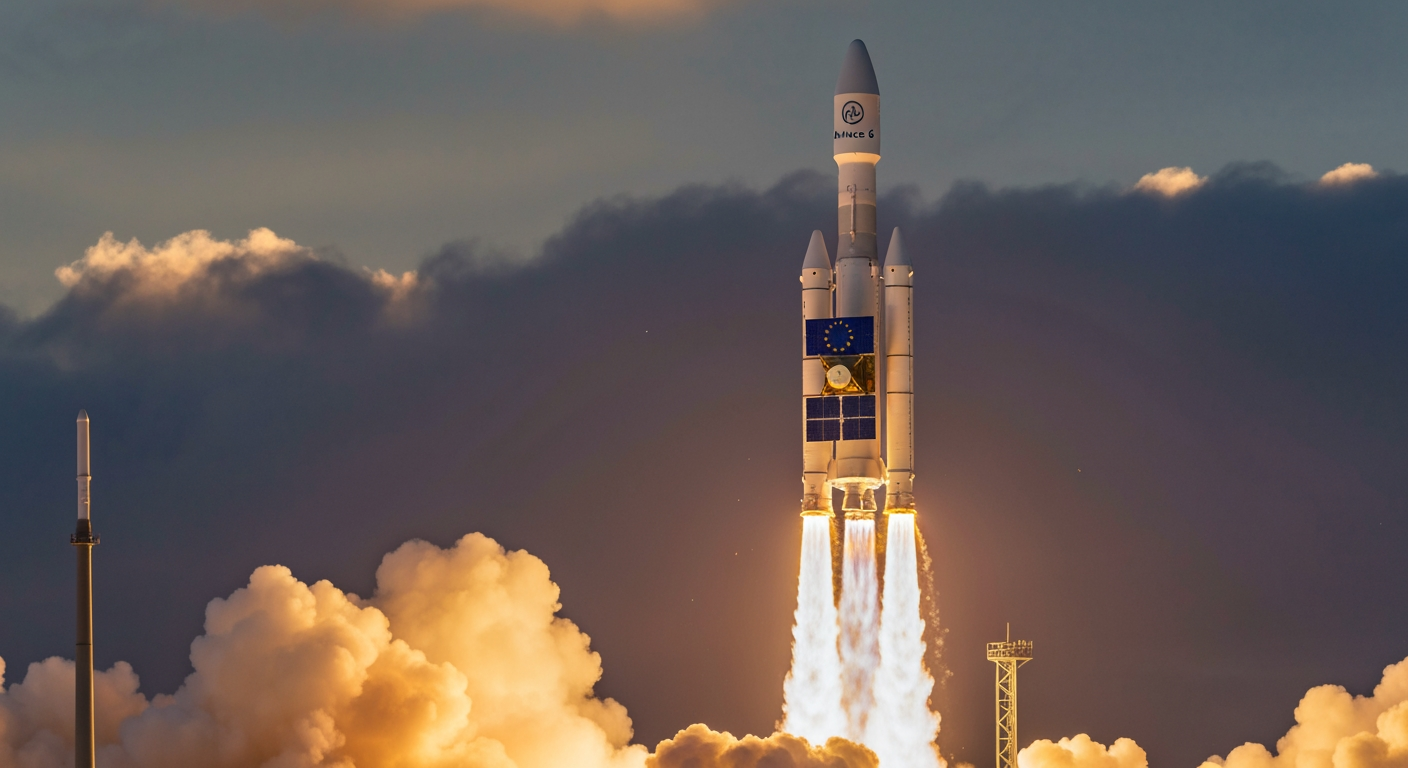
KOUROU, French Guiana – Europe has taken a decisive stride in solidifying its autonomous access to space and bolstering its critical navigation infrastructure. On December 17, 2025, the Ariane 6 rocket successfully launched a pair of Galileo navigation satellites, marking a pivotal moment for the European space program. This mission, the fifth for the next-generation Ariane 6 and the inaugural deployment of Galileo satellites by the new launcher, underscores Europe's commitment to independent capabilities in an increasingly competitive global space arena. The successful liftoff from Europe's Spaceport in French Guiana not only expands the continent's own satellite navigation constellation but also heralds a new era of reliable, homegrown launch services.
A New Chapter for European Launch Capabilities
The pre-dawn launch on December 17 saw the Ariane 62 configuration, equipped with two solid rocket boosters, ascend into the tropical skies of French Guiana. This mission, designated VA266, was the fifth flight for the Ariane 6 and represented the first time the European Union's flagship navigation system, Galileo, entrusted its satellites to the new launcher. The two satellites, designated SAT 33 and SAT 34, embarked on a journey to Medium Earth Orbit (MEO), where they were successfully deployed approximately 3 hours and 55 minutes after liftoff, initially at an altitude of around 22,922 kilometers before gradually reaching their operational orbit at 23,222 kilometers.
The successful launch of these Galileo spacecraft on Ariane 6 marks a significant operational milestone following the Ariane 6's maiden flight on July 9, 2024. That initial demonstration flight, utilizing the same Ariane 62 variant, successfully delivered several experimental payloads into orbit, thereby restoring Europe's independent access to space after the retirement of its predecessor, the Ariane 5, a year prior. While the maiden flight experienced a minor anomaly with its Vinci upper stage, which prevented a final deorbit burn, the overall mission demonstrated the rocket's ability to reach orbit and deploy satellites. The December 17 launch confirmed Ariane 6's growing reliability and its readiness to support critical European missions.
The Ariane 6: Securing Europe's Independent Access
The development of Ariane 6, a project costing approximately €4 billion, was initiated to ensure Europe's independent access to space and to provide a cost-effective, versatile launch solution in a rapidly evolving market. Conceived in the early 2010s and facing delays that pushed its debut from an initial target of 2020 to 2024, the rocket was designed to be approximately 40% cheaper to build and operate than the Ariane 5. This cost efficiency is crucial for maintaining competitiveness against commercial rivals and reducing the financial burden on European taxpayers.
Ariane 6, manufactured by ArianeGroup under the supervision of the European Space Agency (ESA) and the French Space Agency (CNES), comes in two main configurations: the Ariane 62 with two solid boosters for medium-lift missions, and the Ariane 64 with four boosters for heavier payloads. The rocket’s modular design, combined with a re-ignitable upper stage powered by the Vinci engine, allows for flexible mission profiles, including the precise injection of satellites into various orbits. This versatility makes Ariane 6 suitable for a wide array of applications, from Earth observation and telecommunications to scientific research and, notably, navigation satellites like Galileo.
The strategic importance of Ariane 6 became even more pronounced following geopolitical events, particularly the war in Ukraine, which severed Europe's reliance on Russian Soyuz rockets. This situation, combined with the retirement of Ariane 5, left Europe temporarily dependent on external launch providers, including SpaceX, to put its satellites into orbit. The operationalization of Ariane 6, with more than 30 flights already booked, including a significant number for commercial constellations such as Amazon Kuiper, is thus paramount for Europe's strategic autonomy and its ability to launch institutional and governmental missions without external reliance. Arianespace projects a significant ramp-up in launch tempo, aiming for six flights in 2025, eight in 2026, and a steady state of ten launches per year by 2027.
Galileo: Precision Navigation for a Connected Continent
The two new satellites launched by Ariane 6 are critical additions to the Galileo constellation, Europe's own Global Navigation Satellite System (GNSS). Unlike other major GNSS systems like the American GPS or Russian GLONASS, Galileo operates under civilian control, a key distinction that ensures its reliability and security for European users. The system is designed to provide highly accurate, guaranteed global positioning, navigation, and timing information, with real-time accuracy down to the meter range. For specialized applications, Galileo's High Accuracy Service, operational since 2023, offers even greater precision, providing horizontal accuracy down to 20 centimeters and vertical accuracy of 40 centimeters.
The applications of Galileo extend far beyond simple car navigation or smartphone location services, impacting numerous facets of daily life and critical infrastructure. Its signals are vital for emergency services, including Search and Rescue (SAR) operations, where the precise positioning of distress signals can dramatically reduce response times. In the transport sector, Galileo enhances the efficiency and safety of road, aviation, maritime, and rail traffic, enabling advanced fleet management and tracking of critical shipments. Furthermore, Galileo plays a crucial role in scientific research, environmental monitoring, and meteorological forecasting, by providing highly accurate timing signals essential for atomic clocks and improving measurements of atmospheric conditions. Even critical infrastructure like power grids, telecommunication networks, and the global financial system rely on Galileo's precise timing signals for synchronization and secure operations.
With the addition of SAT 33 and SAT 34, the Galileo constellation now comprises 29 active satellites, strengthening its robustness, availability, and overall performance. The European Union Agency for the Space Programme (EUSPA), responsible for Galileo's exploitation management, will oversee the integration and operation of these new satellites, ensuring they meet evolving market needs and foster innovation across various sectors.
Reinforcing European Space Autonomy
The successful Ariane 6 launch of Galileo satellites is more than a technical achievement; it represents a significant geopolitical and strategic victory for Europe. In a world where access to space and reliable satellite services are increasingly vital for economic prosperity, security, and defense, independent capabilities are paramount. The retirement of Ariane 5 and the geopolitical shifts highlighted Europe’s vulnerability and the urgent need for a sovereign launch capacity. Ariane 6 directly addresses this, ensuring Europe can deploy its strategic assets, such as Galileo, without relying on non-European partners.
This mission reinforces Europe’s long-term vision for space, underscoring its determination to be a major player in space exploration and utilization. The investment in programs like Ariane 6 and Galileo not only safeguards critical services for its citizens but also fosters innovation, creates high-tech jobs, and strengthens Europe's competitive position in the global space market. By integrating launch capabilities with essential services like navigation, Europe is building a resilient and self-sufficient space ecosystem.
The successful journey of the Galileo satellites aboard the Ariane 6 marks a powerful statement of European unity and technological prowess. It is a testament to years of dedicated effort across multiple European nations, culminating in a system that provides both practical benefits to billions worldwide and strategic independence for the continent. As Ariane 6 continues to ramp up its operations and the Galileo constellation expands its reach, Europe’s presence in space is set to become even more robust and influential, securing its place at the forefront of global space endeavors for decades to come.
Related Articles

Ratko Mladić, "Butcher of Bosnia" and Convicted War Criminal, Dies at 84
THE HAGUE, Netherlands – Ratko Mladić, the former Bosnian Serb military commander known as the "Butcher of Bosnia" and convicted of genocide, war crimes, and crimes against humanity, has died at the age of 84. Serbian...


Long-Awaited 9/11 Mastermind Trial Set for 2028, Decades After Attacks
GUANTANAMO BAY, Cuba – Nearly a quarter-century after the devastating terror attacks of September 11, 2001, a military judge has finally set a trial date for Khalid Sheikh Mohammed, the alleged mastermind behind the...