Art Unveils Power Dynamics at German Presidential Residence
Berlin, Germany – Schloss Bellevue, the official residence of German President Frank-Walter Steinmeier, has become an unexpected canvas for a bold art exhibition challenging traditional notions of power, representation, and artistic freedom. This unusual display, featuring provocative installations and large-scale artworks, has transformed the presidential palace into a dynamic public forum, igniting discussion across the nation about the role of art in political discourse.
The exhibition, a collaboration between the Federal President's Office and the Berlin Academy of Arts, aims to democratize access to art and encourage critical engagement with political themes. Its most striking pieces deliberately subvert expectations, inviting contemplation on who holds power, how it is perceived, and the importance of an unencumbered artistic voice. With over 35,000 free tickets offered to the public, the initiative underscores a commitment to making high-level cultural commentary accessible to a broad audience, leveraging the symbolic weight of the presidential residence itself.
The Art of Deconstruction: Challenging Presidential Imagery
At the heart of the exhibition are several works designed to deconstruct and reimagine political authority. Prominently featured is a large-format portrait by Berlin street artist El Bocho, titled "Die Bundespräsidentin" (The Female President). The painting depicts a young woman, bearing a resemblance to writer Ronja von Rönne, a poignant statement on representation and the future of Germany's highest office. This piece provocatively asks citizens to envision a different kind of leadership, one that has yet to materialize in the nation's history, highlighting a progressive aspiration within the hallowed halls of presidential power. The artwork, through its mere presence in Schloss Bellevue, serves as a powerful symbol of potential change and the evolving landscape of German society.
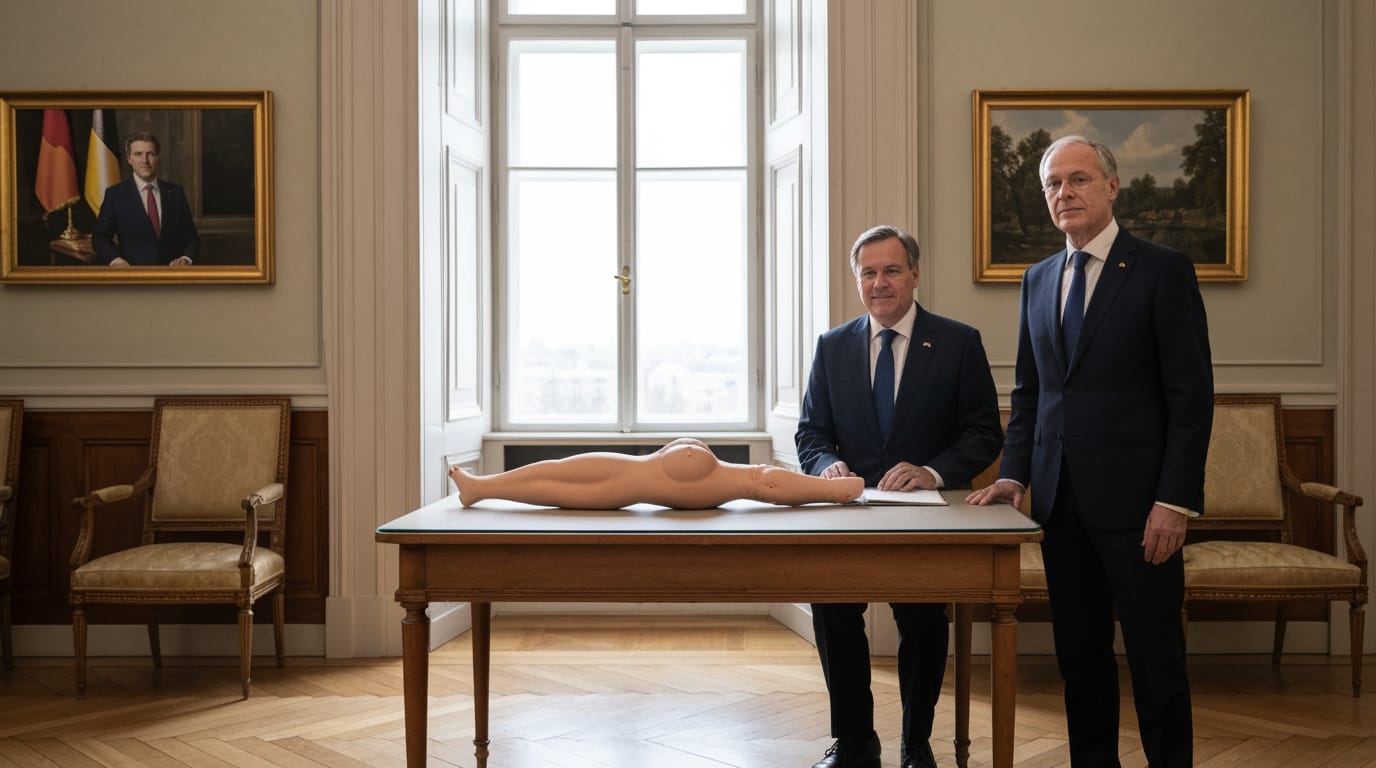
Another intriguing element of the display involves a depiction of President Steinmeier himself, scaled down to a "fraction of his being." This artistic choice challenges the grandeur often associated with high office, prompting viewers to consider the human element behind political figures and perhaps the perceived humility of power. Such a portrayal within his own residence signifies a remarkable openness from the President to engage with art that reflects on his position and the institution it represents. It speaks to a willingness to allow art to serve as a mirror, reflecting societal perspectives back onto the political sphere.
"Freiraum Kunst" and the Call for Artistic Liberty
Dominating the exterior of Schloss Bellevue is another significant installation: a colossal painting affixed to the palace roof, emblazoned with the words "Freiraum Kunst" (Freedom of Art). This dramatic visual, visible from the street, acts as an unequivocal declaration of the exhibition's overarching message. Installed by climbers in a striking display of commitment, the banner champions the fundamental right to artistic expression, signaling its paramount importance from one of Germany's most venerable political institutions. This public affirmation of artistic freedom carries particular weight in a contemporary landscape where cultural policy and artistic autonomy are frequently subjects of debate.
Adding another layer of urgency to the exhibition's message is a nightly Morse code signal, emanating from Schloss Bellevue into the Berlin night. The signal repeatedly transmits "SOS," a universally recognized distress call. This enigmatic message, broadcast from the President's residence, serves as a poignant reminder of potential threats to artistic liberty and the broader cultural landscape. It suggests a subtle warning, an appeal for vigilance, and a call to action to protect the spaces where creativity and critical thought can flourish. The "SOS" signal transforms the presidential palace into a beacon, not just for art, but for the principles that underpin a free society.
Presidential Endorsement and Broader Implications
President Steinmeier’s endorsement of such an exhibition at his official residence is a notable gesture, particularly given the provocative nature of some of the works. His declared belief that "A freedom without art loses its social relevance" underscores a conviction that art is not merely decorative but essential for societal health and progress. This stance stands in stark contrast to recent controversies surrounding cultural policy, including actions by figures like Culture Minister Wolfram Weimer, who reportedly eliminated certain independent bookstores from a prize process, and the "patriotic cultural policy" advocated by the AfD, which seeks to impose specific ideological frameworks on art.
By hosting an exhibition that directly champions freedom of expression, the President’s office implicitly pushes back against tendencies to curtail artistic independence or to instrumentalize culture for political ends. The event thus becomes more than just an art show; it evolves into a significant political statement about the values Germany upholds. It provides a platform for dialogue at a time when cultural institutions globally face increasing pressure and scrutiny regarding their content and messaging.
Conclusion: Art as a Catalyst for Public Discourse
The art exhibition at Schloss Bellevue represents a powerful moment for cultural and political discourse in Germany. By opening its doors to unconventional art that directly questions power structures and champions artistic freedom, the President's residence has transformed from a symbol of governmental authority into a dynamic space for reflection and critical engagement. The initiative highlights the enduring capacity of art to provoke thought, challenge norms, and foster dialogue in a democratic society. It reinforces the idea that true political strength lies not in suppressing dissent or artistic expression, but in embracing it as a vital component of a vibrant public sphere. The visual and symbolic power of these installations at such a prominent location ensures that their message resonates far beyond the walls of Schloss Bellevue, cementing art's role as a vital catalyst for national conversation.