Between Renunciation and Global Acclaim: What Modern Fame Means for Francis of Assisi
Eight centuries after a young medieval merchant stripped off his fine garments in a public square to embrace total poverty, his name resonates across international diplomacy, ecological activism, and global tourism. Francis of Assisi sought total obscurity and radical simplicity when he died on bare ground outside his hometown in October 1226. Today, his legacy anchors a multimillion-dollar heritage industry, provides inspiration for environmental treaties, and defines the public identity of the Catholic Church’s modern leadership.
The contrast between the medieval friar’s original ascetic intentions and his modern status as a global icon highlights a complex historical evolution. While millions revere him as a gentle patron of animals and nature, historians and religious scholars note that the reality of his life was demanding, severe, and sharply at odds with contemporary consumer culture.
From Absolute Poverty to a Thriving Economy
Francis founded the Order of Friars Minor on an uncompromising principle: absolute disavowal of property. Early Franciscan friars were forbidden from touching money or owning permanent buildings. They survived by manual labor and daily begging.
Today, the Italian hill town of Assisi, with a permanent population of fewer than 30,000 residents, welcomes an estimated four to five million visitors each year. Tourism forms the backbone of the local economy. A newly coordinated network of walking routes known as the Way of St. Francis stretches across more than 960 miles and six Italian regions, supported by tens of millions of euros in public infrastructure funding.
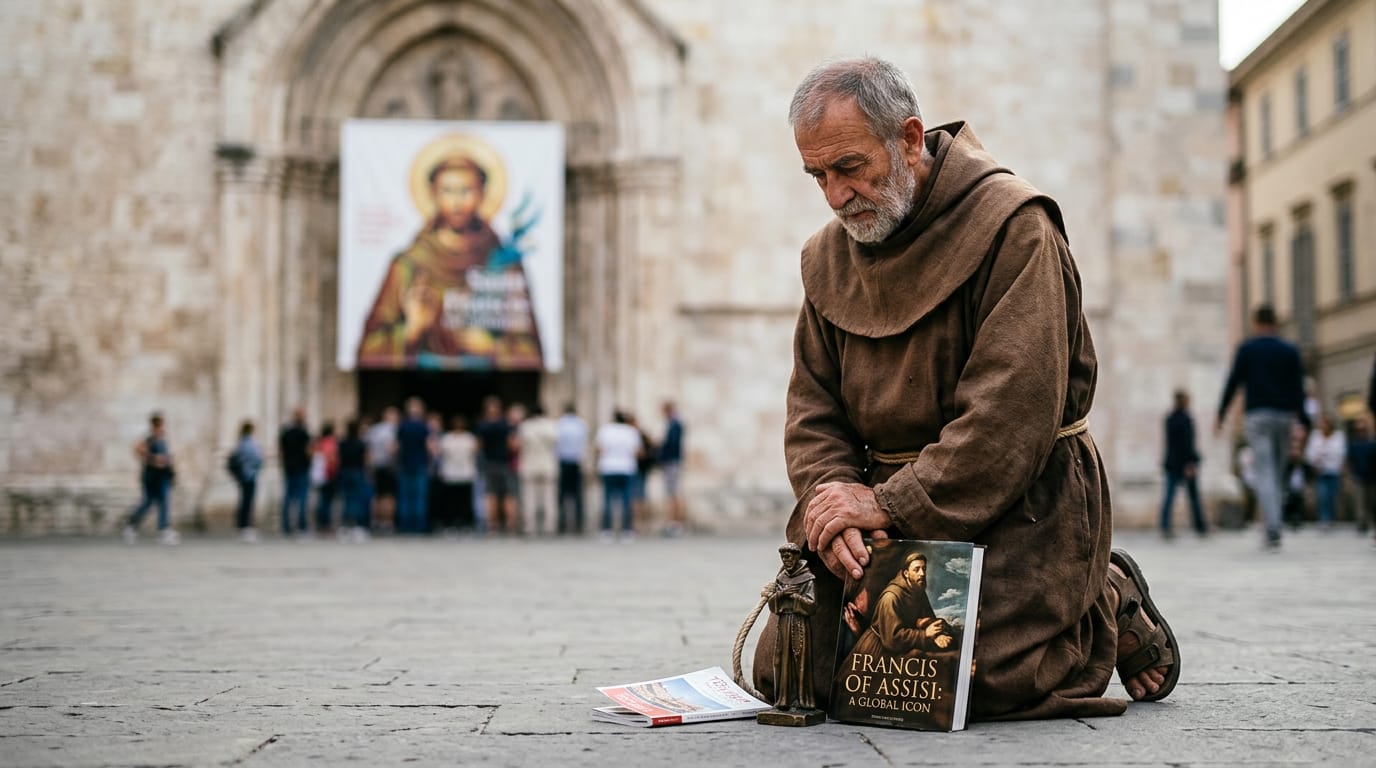
Souvenir shops lining the steep stone streets of Assisi sell mass-produced rosaries, ceramic likenesses, and garden statues. Above his burial site rises the monumental Basilica of Saint Francis, a towering two-level Gothic and Romanesque complex filled with priceless 13th-century frescoes by artists like Giotto and Cimabue. The monumental architecture stands as a masterpiece of European art, yet it represents the very material wealth that Francis spent his adult life rejecting.
The Evolution of an Ecological Standard-Bearer
Beyond tourism, Francis has become a universal figurehead for the modern environmental movement. In 1979, the Vatican declared him the patron saint of ecologists, recognizing his view of nature as expressed in his famous 13th-century poem, the Canticle of the Creatures. In that work, Francis addressed the elements, celestial bodies, and animals as brothers and sisters in a shared community of creation.
That message reached a global diplomatic audience when the papacy adopted his name and framed its landmark environmental teaching around his words. The encyclical Laudato Si’, published in 2015, directly referenced the canticle and framed climate change, biodiversity loss, and poverty as interconnected moral responsibilities.
Modern environmental advocates and policy bodies have repeatedly invoked Franciscan principles to argue against unchecked industrial growth and resource depletion. In international climate forums, his historical rejection of personal accumulation is frequently cited as an early philosophical model for sustainability and responsible stewardship.
Sentimentality Versus Historical Rigor
Despite his broad appeal, modern portrayals of Francis often depart from the historical record. Contemporary popular culture frequently reduces the friar to a cheerful, soft-spoken figure surrounded by docile forest creatures.
Historical accounts paint a much harsher portrait. Early biographies document rigorous fasting, self-inflicted penance, and chronic physical suffering. Francis suffered from severe eye infections and painful ailments for much of his later life. His rejection of wealth was not a casual preference for the outdoors, but an intentional social protest against the emerging merchant economy of northern Italy.
He also acted on international political and religious stages. During the Fifth Crusade in 1219, Francis crossed enemy lines in Egypt to meet directly with Sultan al-Kamil, attempting to broker peace through dialogue rather than armed conquest. Scholars emphasize that his life was defined by active civic disruption and radical religious discipline, traits that are often softened in modern commemorative art.
A Message Enduring Through Contradiction
The enduring global fascination with Francis of Assisi illustrates the complex ways historical figures are reimagined across eras. The commercial machinery of modern Assisi and the proliferation of garden statuary contrast sharply with a man who insisted on being buried without a coffin in a public cemetery for criminals.
Yet observers suggest that the global durability of his name also reflects a continuing hunger for the core ideals he represented. In an interconnected world grappling with economic inequality, consumer excess, and ecological decline, Francis's insistence on simplicity, mutual care, and reconciliation remains an urgent reference point. While the pageantry of modern renown might sit uncomfortably with his personal humility, the sustained survival of his principles demonstrates that his central questions about human purpose and ethical living continue to command international attention.