Assassination of Youth Leader Ignites Widespread Violence Across Bangladesh Amidst Fraught Election Preparations
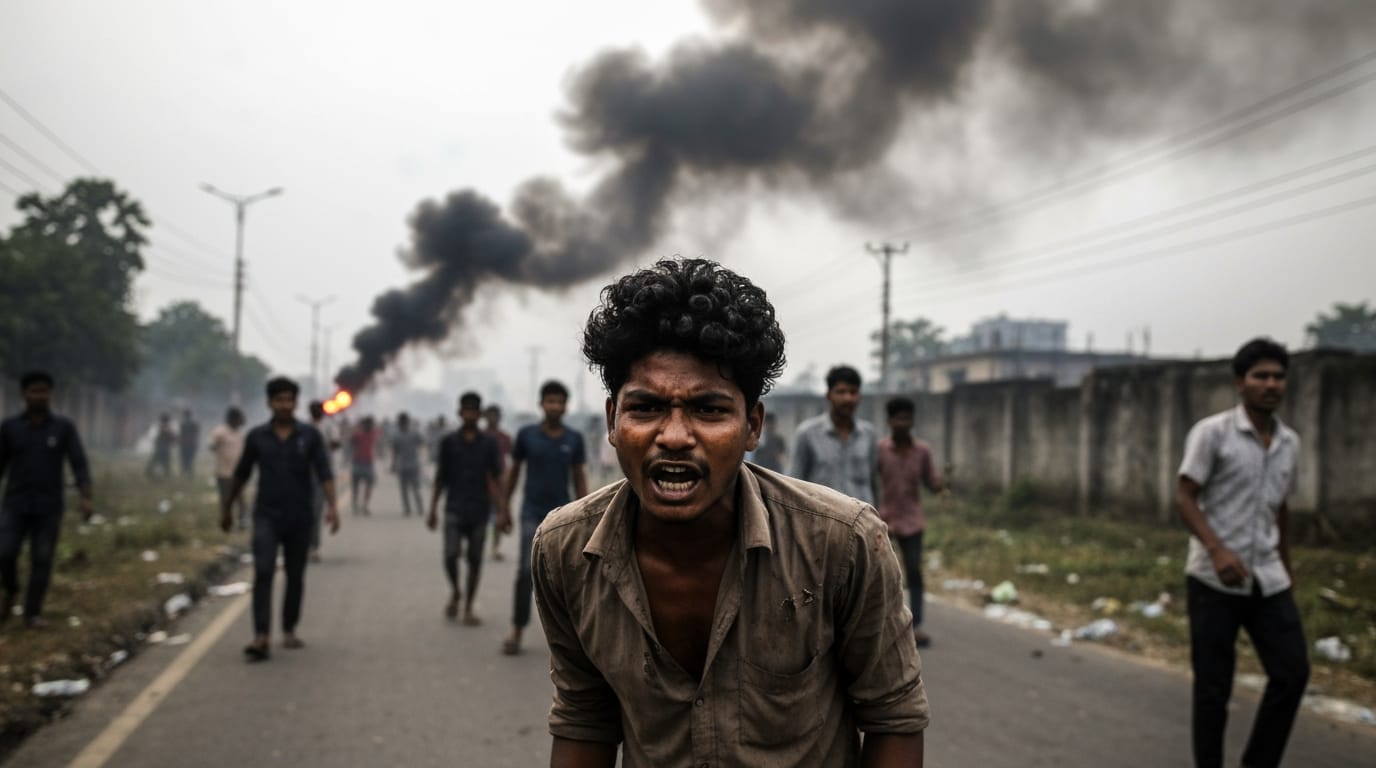
DHAKA, Bangladesh – The fragile political landscape of Bangladesh has plunged into fresh turmoil following the death of prominent youth leader Sharif Osman Hadi, 32, who succumbed to gunshot wounds sustained in an assassination attempt last week. His demise on Thursday, December 18, while undergoing treatment in Singapore, triggered immediate and widespread protests across the capital, Dhaka, and other parts of the nation, escalating fears of deepening instability ahead of crucial national elections. Demonstrators, mourning Hadi and demanding swift justice, engaged in acts of vandalism, including setting fire to the offices of two leading national newspapers, marking a severe setback for the country's delicate transition towards renewed democratic practice.
The Attack and Its Violent Repercussions
Sharif Osman Hadi, a pivotal figure in the 2024 student-led uprising that led to the ouster of former Prime Minister Sheikh Hasina, was shot by masked assailants on December 12. The attack occurred as he was leaving a mosque in Dhaka, just a day after Bangladeshi authorities announced the schedule for the first parliamentary elections since the historic uprising. Hadi, who was planning to contest as an independent candidate in the February 2026 elections, had been airlifted to Singapore for advanced medical care, where he battled his injuries for six days before his passing. News of his death on Thursday sent shockwaves through the nation, immediately sparking spontaneous demonstrations. Hundreds of his supporters converged in Dhaka's central Shahbagh Square and other locations, chanting slogans such as "Who are you, who am I – Hadi, Hadi," expressing both grief and outrage. The protests quickly turned violent, with demonstrators vandalizing and torching the offices of the country's largest newspapers, Prothom Alo and Daily Star. Reports indicated that staff members were trapped inside the burning buildings amidst the chaos. Police and military forces were deployed to manage the escalating unrest, while firefighters worked to rescue those endangered by the blazes.
A Symbol of Youth Activism and a Contested Election
Hadi was not merely a political aspirant; he was a symbol of the youth movement, a senior leader of the student protest group Inqilab Mancha (Revolutionary Platform), which emerged as a key force in the 2024 anti-government demonstrations. The uprising ultimately ended Sheikh Hasina's 15-year rule, ushering in an interim government led by Nobel laureate Muhammad Yunus. Hadi's platform, Inqilab Mancha, focused on opposing injustice, discrimination, and political repression, drawing significant support from politically active young people. His decision to run as an independent candidate in the upcoming national parliamentary elections was seen as an effort to bring about change outside traditional party structures. Hadi, who was also a lecturer at the University of Scholars in Dhaka, had reportedly received death threats in the weeks leading up to the attack, a detail that has resurfaced on social media, fueling public anger and demands for accountability. The interim government, through Chief Adviser Muhammad Yunus, swiftly condemned the assassination, describing it as a "premeditated attack" designed to "derail the election." Yunus declared a day of national mourning for Hadi, stating that "the country's march toward democracy cannot be halted through fear, terror, or bloodshed." Investigations into the shooting are ongoing, with several individuals reportedly detained for questioning.
Bangladesh's Volatile Political Climate
Hadi's assassination and the subsequent unrest underscore the deep-seated political tensions and fragility pervading Bangladesh, particularly as the nation gears up for general elections scheduled for February 12, 2026. The period since Sheikh Hasina's departure in August 2024 has been marked by significant instability. Hasina, now in self-imposed exile in India, was later sentenced to death in absentia for crimes against humanity related to the 2024 protests, during which an estimated 1,400 people died. Her Awami League party has been banned from participating in the electoral process, creating a vacuum that has intensified competition among other political entities. The Bangladesh Nationalist Party (BNP) and the Islamist party Jamaat-e-Islami, traditionally rivals who found common ground in their opposition to Hasina, are now vying for dominance. This dynamic, coupled with internal divisions within these parties, contributes to a highly volatile environment. The interim government, under Muhammad Yunus, faces the daunting task of navigating these turbulent waters, ensuring a peaceful and credible election, and establishing a stable democratic framework. Concerns about political violence and election-related insecurity have been widely voiced by rights groups and opposition parties, particularly for independent candidates and activists operating outside established political structures.
Regional Dynamics and Calls for Justice
The unrest following Hadi's death has also taken on a significant anti-India dimension. Hadi himself was an outspoken critic of neighboring India, where Sheikh Hasina remains in exile. During the protests, demonstrators attempted to march towards Indian diplomatic premises in Dhaka and Rajshahi, with some engaging in stone-pelting near the Indian Assistant High Commission office. Protest leaders, including Sarjis Alm of the National Citizen Party (NCP), have explicitly called for the interim government to shut down the Indian High Commission until the alleged assassins, who they claim have fled to India, are returned. This has complicated diplomatic relations, with Bangladesh having previously summoned India's High Commissioner to seek cooperation in the investigation and to prevent suspects from escaping across the border. The intertwining of domestic political grievances with regional relations further exacerbates the situation, adding another layer of complexity to Bangladesh's already fraught political landscape. The international community, including India, is closely monitoring the situation, recognizing that stability in Bangladesh has broader implications for regional security.
The assassination of Sharif Osman Hadi has undeniably dealt a severe blow to Bangladesh's aspirations for a smooth democratic transition. His death has not only sparked immediate violent outbursts but has also reignited deeply rooted political grievances and anxieties about the upcoming elections. The interim government faces immense pressure to swiftly bring Hadi's killers to justice while simultaneously managing widespread public outrage, preventing further escalation of violence, and ensuring the integrity of the electoral process. The tragic event underscores the profound challenges inherent in establishing lasting peace and democracy in a nation still grappling with its recent authoritarian past and persistent political divisions. The path forward remains uncertain, with the country on edge as it navigates this critical juncture.


