Bayeux Tapestry Arrives at British Museum in Historic, Covert Transfer
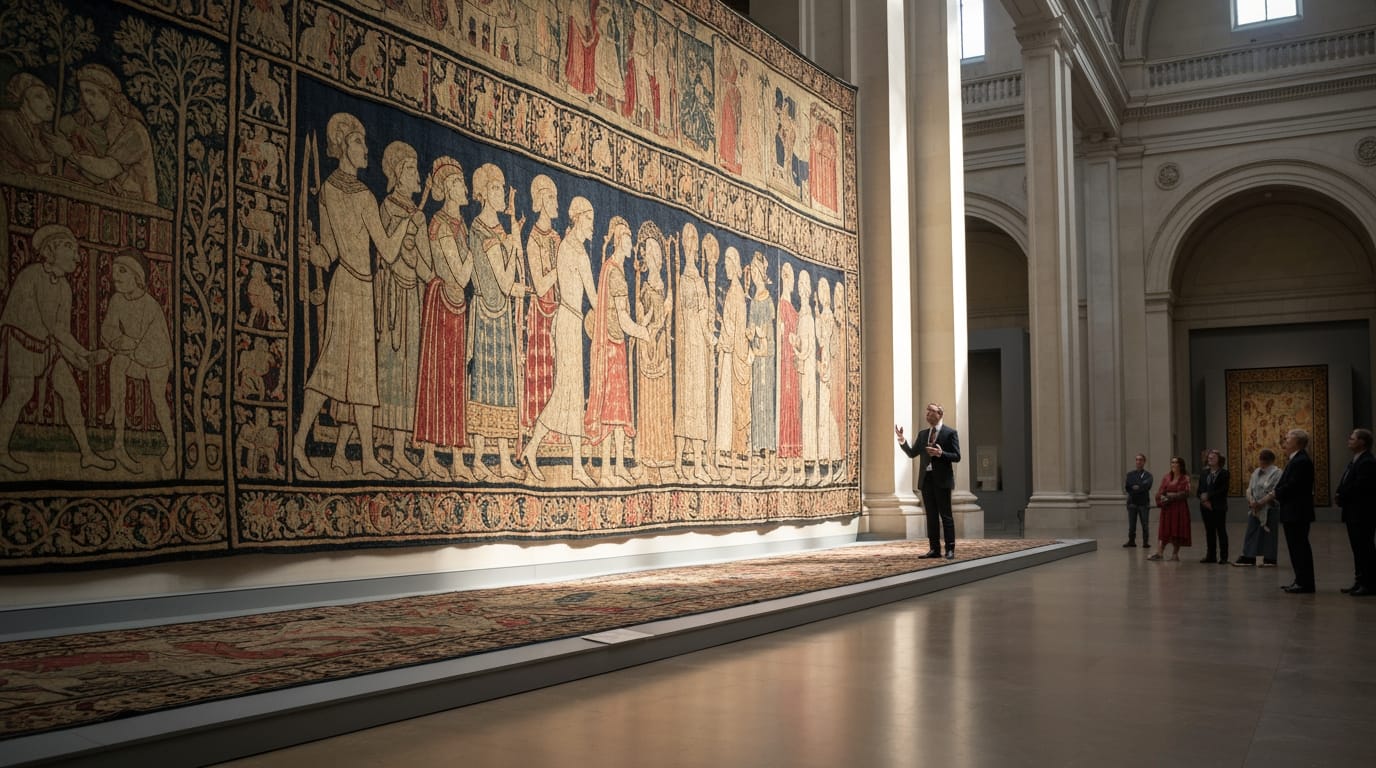
LONDON, UK – After nearly a millennium, the iconic Bayeux Tapestry has returned to English soil, arriving at the British Museum in London early Friday morning, July 10, 2026, under an operation described by officials as cinematic in its precision and secrecy. This monumental 11th-century embroidery, depicting the pivotal events leading to the 1066 Norman Conquest of England, will go on public display from September 10, 2026, until July 2027, marking a historic cultural exchange between Britain and France. Its arrival culminates years of delicate negotiations and meticulous planning, offering a once-in-a-generation opportunity for British audiences to witness a profound piece of shared Anglo-French history.
A Covert Journey Across the Channel
The transfer of the nearly 70-meter (230-foot) long artwork from its permanent home in Bayeux, Normandy, to the British Museum was executed with the utmost discretion and security, reminiscent of a "heist movie in reverse," according to eyewitness accounts. The priceless artifact was carefully folded in an accordion style and placed within a climate-controlled case, which was then secured in a specially designed, shock-absorbing cradle. This delicate cargo embarked on an 11-hour, 560-kilometer journey, traveling by truck through the Channel Tunnel with a police escort, before arriving at the British Museum in the dead of night.
British Museum Director Nicholas Cullinan, who awaited the tapestry's arrival, expressed immense excitement, stating, "It feels extraordinary that after so much work and planning and care and thought that it's actually happening." He emphasized the significance of the event, remarking that "it's the first time in 1,000 years that such an important piece of British — French too — history is going to be on these shores." The meticulous operation, kept under wraps due to security concerns, concluded with hushed applause from museum staff and British and French diplomats as the container, roughly the size of a small car, was gingerly brought to the ground inside the museum. The tapestry will now undergo several days of acclimatization before being carefully unpacked and prepared for its grand exhibition.
Diplomacy Woven in Wool
The loan of the Bayeux Tapestry is more than just a logistical marvel; it represents a profound act of cultural diplomacy, strengthening ties between France and the United Kingdom. The agreement was first announced by French President Emmanuel Macron during a state visit to the UK in July 2025. This exchange is reciprocal, with the British Museum slated to loan significant treasures from its collection, including artifacts from the Sutton Hoo ship burial and the renowned Lewis Chessmen, to museums in Rouen and Caen. This collaboration coincides with a two-year renovation project at the Musée de la Tapisserie de Bayeux, offering a timely window for the tapestry's unprecedented journey.
Previous attempts by Britain to secure the tapestry for exhibition were met with denials. Requests for its display in 1931, for Queen Elizabeth II's coronation in 1953, and for the 900th anniversary of the Battle of Hastings in 1966, were all rejected, largely due to concerns over the artwork's fragility and its impact on tourism in Bayeux. A 2018 proposal from President Macron also fell through after a three-year study deemed the relic too delicate for transport, requiring extensive restoration and repair to address numerous points of weakness, including 30 unstabilized tears. The success of this current loan underscores the completion of these crucial conservation efforts.
The diplomatic significance of such a loan, especially in times of evolving international relations, has not gone unnoticed. Retired British diplomat Peter Ricketts, who played a key role in securing the deal, hailed it as "an extraordinary mark of friendship and confidence in the U.K. to entrust this object to us for a year." Indeed, art has long served as a "mute diplomat," capable of conveying messages and fostering connections beyond formal political discourse. While the loan has been overwhelmingly celebrated, some voices in France initially expressed apprehension, citing historical concerns about the tapestry's potential damage during transit and the symbolic implications of France lending a visual testament to England's last successful invasion. Nonetheless, the UK government has pledged substantial financial commitment, agreeing to cover up to £800 million in potential damages to the tapestry during its stay.
An Embroidered Chronicle of Conquest
Despite its common name, the Bayeux Tapestry is not a woven tapestry but a meticulously embroidered cloth, a unique form of medieval artistry. Crafted from wool yarn stitched onto a bleached linen background, it measures approximately 70 meters (230 feet) in length and 50 centimeters (20 inches) in height. Consisting of 58 distinct scenes, the embroidery vividly recounts the events leading up to the Norman Conquest of England in 1066, culminating in the decisive Battle of Hastings.
The artwork serves as an invaluable visual primary source for this transformative period in English history. While most historical accounts from the era are written, the tapestry offers a rare pictorial narrative, bringing to life the figures and events that shaped the destiny of a nation. It predominantly presents a Norman viewpoint, believed to have been commissioned by Bishop Odo of Bayeux, William the Conqueror's half-brother, and likely created in England, possibly in Canterbury, by Anglo-Saxon embroiderers.
The tapestry's intricate details provide a window into 11th-century life, showcasing contemporary military equipment, battle tactics, architecture, and even clothing. It depicts key figures such as William, Duke of Normandy, and Harold Godwinson, King of England, engaged in a struggle for the throne. Beyond the human drama, it features over 627 people, 737 animals, and even a depiction of Halley's Comet, which appeared in 1066 and was seen as an omen. The Bayeux Tapestry is widely recognized as a masterpiece of Romanesque art, its survival over nine centuries considered miraculous by scholars.
An Exhibition of the Century
The British Museum is preparing what it describes as an "exhibition of the century," promising a "once-in-a-generation show" for the Bayeux Tapestry. For the first time in its public display history, the tapestry will be presented flat and in one continuous length within a specially constructed showcase, a departure from its usual vertical orientation or coiled display. This innovative presentation aims to allow visitors to fully appreciate the sheer scale and intricate detail of the monumental embroidery.
To enhance the visitor experience, the exhibition will incorporate digital elements, offering deeper context and understanding of the tapestry's narrative. Complementing the main attraction, the display will feature objects from the British Museum's own extensive collection, alongside significant loans from other UK and European institutions. These supporting artifacts, such as a charter of Edward the Confessor and the Junius II manuscript, will help place the tapestry within the broader historical and cultural context of medieval England and the events surrounding the Norman Conquest.
Early indications suggest immense public interest, with tickets for the initial September to December 2026 period already sold out. Further ticket releases are planned, reflecting the anticipation surrounding this unprecedented event, which curators believe could rival the blockbuster Tutankhamun exhibition at the British Museum in 1972. The exhibition is made possible in part by a significant sponsorship from hedge fund billionaire Igor Tulchinsky. Throughout its stay, the British Museum's highly qualified conservation team will collaborate closely with their French counterparts, ensuring the ongoing safety and preservation of this ancient and delicate artifact.
The arrival of the Bayeux Tapestry in London transcends a mere museum exhibition; it is a powerful reaffirmation of shared European heritage and a unique opportunity to connect with a defining moment in history. As the tapestry unfolds in its new, temporary home, it promises to illuminate the past, foster cultural dialogue, and engage a new generation with the enduring narrative of 1066, a year that forever altered the course of England. This historic loan also sets the stage for France's "Year of the Normans" in 2027, ensuring the tapestry's legacy and awareness continue to grow on both sides of the Channel.


