Beijing Emerges as Geopolitical Nexus Amidst High-Stakes Diplomatic Shuffle
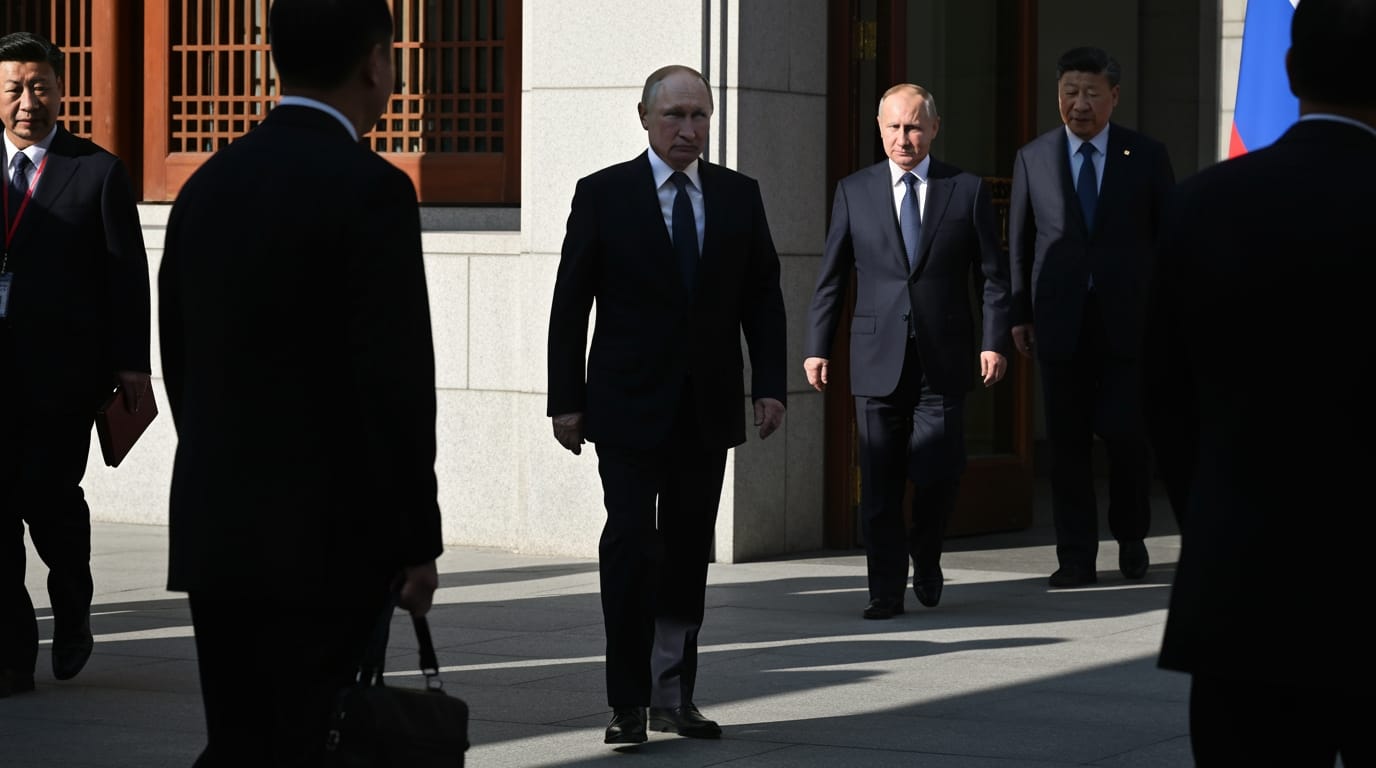
BEIJING, China – In a swift and carefully choreographed sequence of events, Beijing has cemented its role as a central stage for global diplomacy, hosting Russian President Vladimir Putin just days after the departure of U.S. President Donald Trump. This rare back-to-back reception of leaders from two of the world's most powerful, and often adversarial, nations underscores China's strategic positioning in a rapidly evolving international landscape. The dual visits highlight Beijing's intricate balancing act, as it navigates deepening ties with Moscow while simultaneously seeking a "constructive strategic stability" with Washington.
The concurrent presence of American and Russian leaders in the Chinese capital, separated by less than a week, has drawn significant international attention. Chinese state media has been quick to frame these events as a testament to Beijing's growing influence and its aspiration to act as a "key mediator" in a fractured global order. This diplomatic marathon serves not only to advance China's bilateral relationships but also to project an image of stability and centrality in an era marked by geopolitical turbulence.
Putin Solidifies "Privileged Partnership" with Xi
Russian President Vladimir Putin arrived in Beijing on May 19 for a two-day state visit, marking his 25th trip to China. The Kremlin has expressed "very serious expectations" for the visit, aiming to further develop what both nations term a "particularly privileged and strategic partnership." This high-level engagement coincides with the 25th anniversary of the Treaty of Good-Neighbourliness and Friendly Cooperation and the 30th anniversary of the strategic partnership between China and Russia, providing a symbolic backdrop for strengthened collaboration.
Discussions between President Putin and President Xi Jinping are expected to encompass a broad range of bilateral issues, including economic cooperation, with a particular focus on energy projects such as the proposed Power of Siberia 2 gas pipeline. Beyond economic ties, the leaders are set to exchange views on critical international and regional matters, reinforcing their coordinated stance on global affairs. This robust partnership has gained increasing significance for Moscow since Western sanctions were imposed following Russia's actions in Ukraine, driving Russia to rely more heavily on Beijing for economic and diplomatic support. Chinese state media emphasizes that the relationship is "at its best period in history" and provides "stability and certainty" to the world.
Trump's Bid for "Strategic Stability" Yields Mixed Results
Just prior to Putin's arrival, U.S. President Donald Trump concluded a two-day state visit to Beijing on May 15. This marked the first visit by a U.S. president to China in nine years, following a prior meeting between Trump and Xi in Busan in October 2025. Chinese officials portrayed the interactions as having "enhanced mutual understanding, deepened mutual trust, and advanced practical cooperation," while also injecting "much-needed stability and certainty into the world." Both leaders reportedly agreed on a new vision for a "constructive China-U.S. relationship of strategic stability," aiming to guide bilateral ties for years to come.
However, reports from Washington and other Western sources suggest that substantive breakthroughs during Trump's visit were limited. While there was considerable pomp and ceremony, concrete agreements on pressing issues such as trade imbalances, the future of Taiwan, and the ongoing conflict in Iran remained elusive or vague. Trump indicated a willingness to reconsider U.S. arms sales to Taiwan, a long-standing demand from Beijing, raising concerns among some U.S. allies. Despite the warm rhetoric, analysts noted that the summit was "heavier on symbolism than it was on substance," reflecting the deep-seated structural issues that continue to challenge U.S.-China relations.
Beijing's Balancing Act on the Global Stage
The sequential visits underscore Beijing's deliberate strategy to manage its complex relationships with the world's two largest powers. By hosting both leaders within such a short timeframe, China projects an image of diplomatic indispensability, positioning itself as a pivotal actor capable of engaging with, and influencing, both sides of an increasingly polarized international order. This approach allows China to advance its "no-limits" partnership with Russia, which has served as a crucial bulwark against Western pressure, while simultaneously attempting to stabilize its crucial economic and strategic ties with the United States.
The context of these visits is further complicated by ongoing global tensions, including the war in Ukraine and the conflict in the Middle East, both of which impact China's broader geopolitical calculations. China's continued economic and diplomatic support for Russia, even in the face of Western criticism, remains a significant point of concern for many Western nations. At the same time, Beijing seeks to mitigate the risks of direct confrontation with the U.S., advocating for a framework of "cooperation as the mainstay, a sound stability with moderate competition, a constant stability with manageable differences, and an enduring stability with promises of peace."
Implications for a Reshaping World Order
The concentrated diplomatic activity in Beijing signals a critical moment in the ongoing reshaping of the global order. China's strategic engagements with both Russia and the United States reflect its ambition to forge a multipolar world, where its own influence is paramount. The visits highlight the growing divergence between the U.S. and its allies regarding engagement with China, and the increasing alignment between China and Russia on a range of international issues.
While Beijing outwardly champions "stability" and "cooperation," the underlying dynamics reveal a calculated effort to enhance its leverage and position itself at the center of future global power configurations. The outcomes of these high-stakes meetings, both stated and unstated, will undoubtedly have profound implications for international relations, trade, security, and the ongoing trajectory of geopolitical competition and cooperation for years to come.


